
Grade 8 Independent & Dependent Clauses (Advanced) [With Examples]
![Grade 8 Independent & Dependent Clauses (Advanced) [With Examples]](https://cdn5.planetspark.in/media/small_16_65b5f107ca.png)

Grade 8 English Grammar Worksheet on Independent and Dependent Clauses (Advanced)
Have you ever read a sentence and felt that something was missing? Maybe half the sentence made perfect sense on its own, but the other half left you hanging. That is because sentences are built from building blocks called clauses, and understanding the difference between independent and dependent clauses is one of the most important skills a Grade 8 student can develop. Whether you are writing an essay, preparing for a grammar exam, or simply trying to communicate more clearly, knowing how clauses work gives your writing strength and precision.
This blog will walk you through the concept of independent and dependent clauses and share a complete worksheet designed by Archita Srivastava that covers multiple choice questions, fill in the blanks, true and false, clause identification, and creative sentence writing.
You can download all our worksheets for free and book a free trial to get expert guidance on English grammar topics like this one.
What Is Independent and Dependent Clauses?
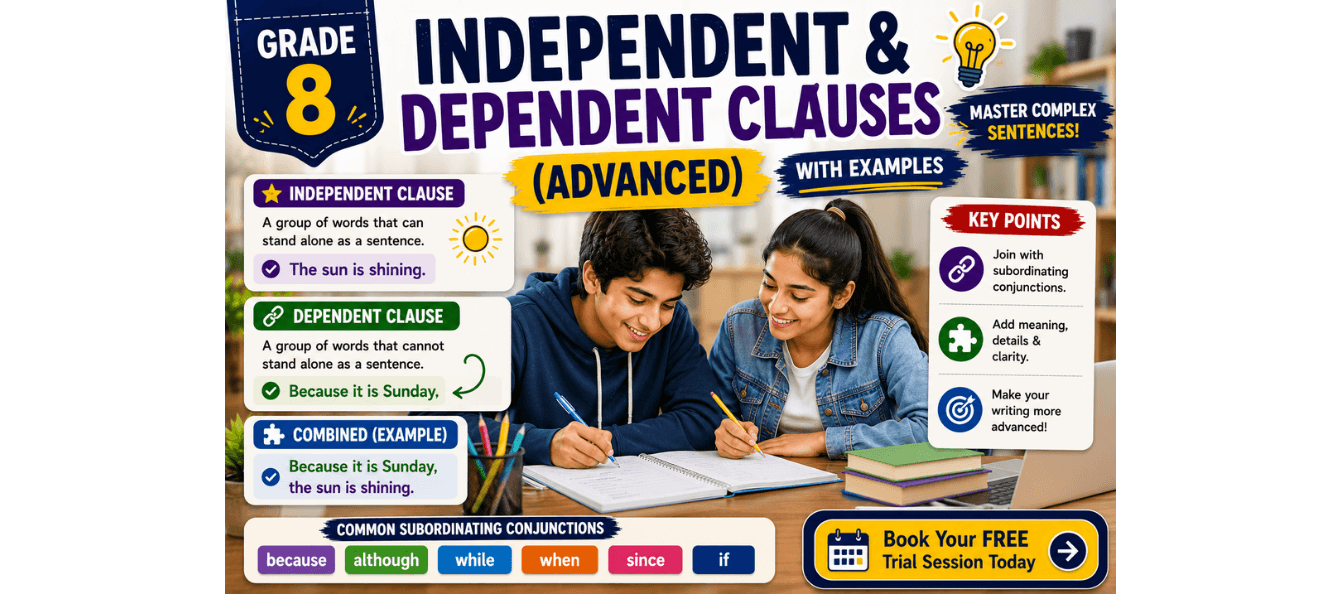
An independent clause is a group of words that contains both a subject and a verb and expresses a complete thought. It can stand alone as a full sentence. For example, "The sun rises in the east" is an independent clause because it has a subject ("the sun"), a verb ("rises"), and it conveys a complete meaning.
A dependent clause, also known as a subordinate clause, also has a subject and a verb, but it does not express a complete thought. It cannot stand alone as a sentence. It depends on an independent clause to make sense. For example, "Because the sky was clear" is a dependent clause because, even though it has a subject ("the sky") and a verb ("was"), it leaves the reader wondering what happened as a result.
When you combine an independent clause with a dependent clause using a subordinating conjunction like "although," "because," "if," "when," or "unless," you create a complex sentence. "Because the sky was clear, we went for a walk" is a complex sentence where the dependent clause provides additional context and the independent clause delivers the main message.
What's in This Worksheet?
This Grade 8 English grammar worksheet by Archita Srivastava includes five carefully designed exercises that test every aspect of your understanding of independent and dependent clauses:
1. Multiple choice questions that test your knowledge of clause definitions, sentence types, conjunctions, and the structural properties of independent and dependent clauses.
2. Fill in the blanks exercise with a word bank of subordinating conjunctions and transitional words, challenging you to select the correct connector for each sentence.
3. True and false statements that check your conceptual clarity about what independent and dependent clauses can and cannot do, the role of conjunctions, and sentence classification.
4. Underline the independent clause and circle the dependent clause exercise that builds your analytical reading skills by asking you to identify clause types within complex sentences.
5. Sentence writing tasks where you compose your own sentences using independent clauses, dependent clauses, compound sentences, complex sentences, and compound-complex sentences on a variety of topics.
Definitions, Examples, Techniques, and Tips
An independent clause always has a subject and a verb and expresses a complete idea. In the sentence "She sings beautifully," "she" is the subject and "sings" is the verb, and the thought is complete. You do not need any additional information to understand what the sentence means.
A dependent clause also has a subject and a verb but cannot stand alone. "When she sings" is a dependent clause because it has a subject ("she") and a verb ("sings"), but it does not express a complete thought. The reader is left wondering what happens when she sings.
Subordinating conjunctions are the words that introduce dependent clauses. Common subordinating conjunctions include "although," "because," "since," "unless," "until," "while," "if," "when," "whenever," "wherever," "whatever," "whichever," "moreover," "furthermore," "meanwhile," "therefore," and "otherwise." These words signal that the clause they introduce is dependent and cannot stand alone.
A compound sentence is formed by joining two independent clauses with a coordinating conjunction such as "and," "but," or "or." For example, "The team played well, and they won the match" has two independent clauses connected by "and."
A complex sentence has one independent clause and one or more dependent clauses. For example, "Although it rained heavily, the match continued" has the dependent clause "Although it rained heavily" and the independent clause "the match continued."
A compound-complex sentence has at least two independent clauses and one or more dependent clauses. For example, "The match continued although it rained, and the crowd cheered loudly" has two independent clauses and one dependent clause.
A useful technique for identifying clauses is to cover part of the sentence with your hand. If the remaining words form a complete thought, that part is an independent clause. If the remaining words leave you hanging, that part is a dependent clause.
Why Is It Important to Learn This?
Learning the difference between independent and dependent clauses is essential for several reasons. First, it is a fundamental building block of English grammar. Every sentence you write is made up of clauses, and if you do not understand how they work, your sentences will be unclear, choppy, or grammatically incorrect.
Second, clause identification is a common topic in school exams and competitive tests. Questions about sentence types, error detection, and sentence correction all rely on your ability to distinguish between independent and dependent clauses. Scoring well in these sections requires a solid understanding of clause structure.
Third, knowing how clauses work allows you to write more varied and interesting sentences. Instead of writing only simple sentences, you can create compound, complex, and compound-complex sentences that flow better and hold the reader's attention.
Fourth, understanding clauses improves your reading comprehension. When you can identify the main clause and the supporting clauses in a passage, you can extract the key information faster and understand the author's message more clearly.
Where Will This Knowledge Help You?
This knowledge will help you across many areas of your academic life and beyond. In school, every English exam includes questions about sentence structure, clause identification, and sentence correction. Mastering clauses will help you score well in all of them.
In reading comprehension, long and complex passages become much easier to navigate when you can break them down into independent and dependent clauses. You will be able to find the main idea quickly by locating the independent clause in each sentence.
In writing assignments, whether for English class or any other subject, you will be able to construct sentences that are varied, clear, and grammatically correct. Teachers value writing that demonstrates a strong command of sentence structure, and understanding clauses is the key to achieving that.
In competitive exams such as Olympiads, scholarship tests, and entrance exams, grammar sections are a major component. Questions on error detection, sentence improvement, and fill in the blanks frequently test your understanding of clauses and conjunctions.
In daily communication, whether you are writing an email, a letter, or a social media post, using correct sentence structure makes your message more professional and easier to understand. Knowing how to combine clauses effectively is a skill that will serve you for life.
How to Use This Worksheet?
Follow these simple steps to get the most out of this worksheet:
1. Read through the definitions and explanations above so that you understand the basic rules before you begin.
2. Start with the multiple choice questions. Read each question carefully, think about the difference between independent and dependent clauses, and choose the best option.
3. Move on to the fill in the blanks. Use the word bank provided and think about which subordinating conjunction or transitional word fits logically in each sentence.
4. Attempt the true and false exercise next. Read each statement and decide whether it is correct or incorrect based on your understanding of clause rules and sentence types.
5. For the clause identification exercise, read each sentence carefully, underline the independent clause, and circle the dependent clause. Take your time to analyse the structure.
6. Complete the sentence writing tasks last. Use your creativity and understanding of clause types to write meaningful sentences for each prompt.
7. After finishing all exercises, check your answers using the complete answer key provided at the end of this blog.
8. Review any mistakes you made and try to understand why the correct answer is right. This is the most important step for long-term learning.
Important Tips and Tricks
Here are some tips and tricks to remember when working with independent and dependent clauses:
1. Always check whether a group of words has a subject and a verb. If it has both and expresses a complete thought, it is an independent clause. If it has both but does not express a complete thought, it is a dependent clause.
2. Memorise common subordinating conjunctions: "although," "because," "since," "unless," "until," "while," "if," "when," "whenever," "wherever," "whatever," and "whichever." These words are your signals that a dependent clause is coming.
3. Remember that coordinating conjunctions such as "and," "but," and "or" join independent clauses, not dependent clauses. This is a common source of confusion in true and false questions.
4. A compound sentence always has two independent clauses. If a sentence has two dependent clauses but no independent clause, it is not a proper sentence at all.
5. Use the cover-up test to identify independent clauses. Cover part of the sentence with your hand. If the uncovered part makes sense on its own, it is independent.
6. In true or false questions, pay close attention to absolute words like "always" or "cannot." These absolutes often signal a false statement.
7. When writing complex sentences, start with the independent clause first and then add the dependent clause. This helps you ensure that your sentence has a clear main idea.
8. Every dependent clause has a subject and a verb. If a group of words does not have both, it is a phrase, not a clause.
Complete Answer Key
Exercise 1 – Multiple Choice Questions
1. b) complete idea
2. a) dependably
3. c) subordinate
4. a) subordinate
5. b) complete
6. c) independent clause
7. a) subordinate
8. b) compound
9. c) essential
10. a) conjunctions
Exercise 2 – Fill in the Blanks
1. Although
2. Wherever
3. Whenever
4. Whatever
5. Whichever
6. moreover
7. furthermore
8. therefore
9. meanwhile
10. otherwise
Exercise 3 – True or False
1. True
2. False
3. True
4. False
5. True
6. True
7. False
8. True
9. True
10. False
Exercise 4 – Underline the Independent Clause and Circle the Dependent Clause
1. Underline: I will go | Circle: if it is fine
2. Underline: Pooja left | Circle: Since she was ill
3. Underline: Aryan lost | Circle: Though he tried
4. Underline: rivers rise | Circle: When rain falls
5. Underline: She reads | Circle: before she sleeps
6. Underline: the phone rang | Circle: While Diya cooked
7. Underline: you cannot | Circle: Unless you try
8. Underline: Rahul worked hard | Circle: to play
9. Underline: we cleaned | Circle: After guests left
10. Underline: they went | Circle: Even though late
Exercise 5 – Sentence Writing
Answers may vary.
1. The sun sets in the west every evening.
2. When the bell rang, students rushed out because they were eager to go home.
3. Because she was unwell, she could not attend the class today.
4. Rahul worked very hard, but he could not pass the final examination.
5. When the monsoon arrived, the dried-up river started flowing once again.
6. She likes reading books, and he enjoys playing cricket in the park.
7. Although the team was tired, they played the cricket match with full energy.
8. Because the village fair was organised after many years, thousands of people attended it.
9. When the teacher entered the classroom, the students stood up, and the monitor greeted her politely.
10. While the Diwali preparations were going on at home, the children were busy making rangoli, and the elders were decorating the house with lights.
Independent and dependent clauses are the foundation of every sentence you will ever write. Understanding how they work, how to identify them, and how to combine them correctly is a skill that will improve your grammar, your writing, and your reading comprehension all at once. This worksheet by Archita Srivastava gives Grade 8 students a thorough and engaging practice session covering every angle of independent and dependent clauses, from basic definitions to advanced sentence writing. Work through each exercise carefully, check your answers, and keep practising until clause identification feels natural and effortless. Strong grammar skills open doors to better grades, clearer communication, and greater confidence in every subject.