
Grade 8 Reducing Clauses to Phrases [With Examples]
![Grade 8 Reducing Clauses to Phrases [With Examples]](https://cdn5.planetspark.in/media/small_20_75e97cc675.png)

English Grammar Worksheet for Grade 8: Reducing Clauses to Phrases (With Answer Key)
Are you ready to write cleaner and more impressive sentences? If you are in Grade 8 and want to master reducing clauses to phrases, this worksheet is exactly what you need. Many students struggle with long, wordy sentences that make their writing feel heavy. By learning how to reduce clauses to phrases, you can make your writing concise and clear without losing any meaning.
Reducing clauses to phrases is one of the most useful skills you will learn in English grammar this year. It helps you express the same idea using fewer words, which makes your writing more effective and professional. This worksheet has been carefully prepared by Archita Srivastava and includes multiple choice questions, fill in the blank exercises, true or false statements, identification tasks, and sentence writing practice.
Download these English grammar worksheets and practice regularly to strengthen your language skills and build a strong foundation. You can also book a free trial to get expert guidance and improve your reading, writing, and comprehension abilities. The worksheets are designed in a simple and structured way to help K-8 students learn grammar concepts easily and use them confidently in everyday communication.
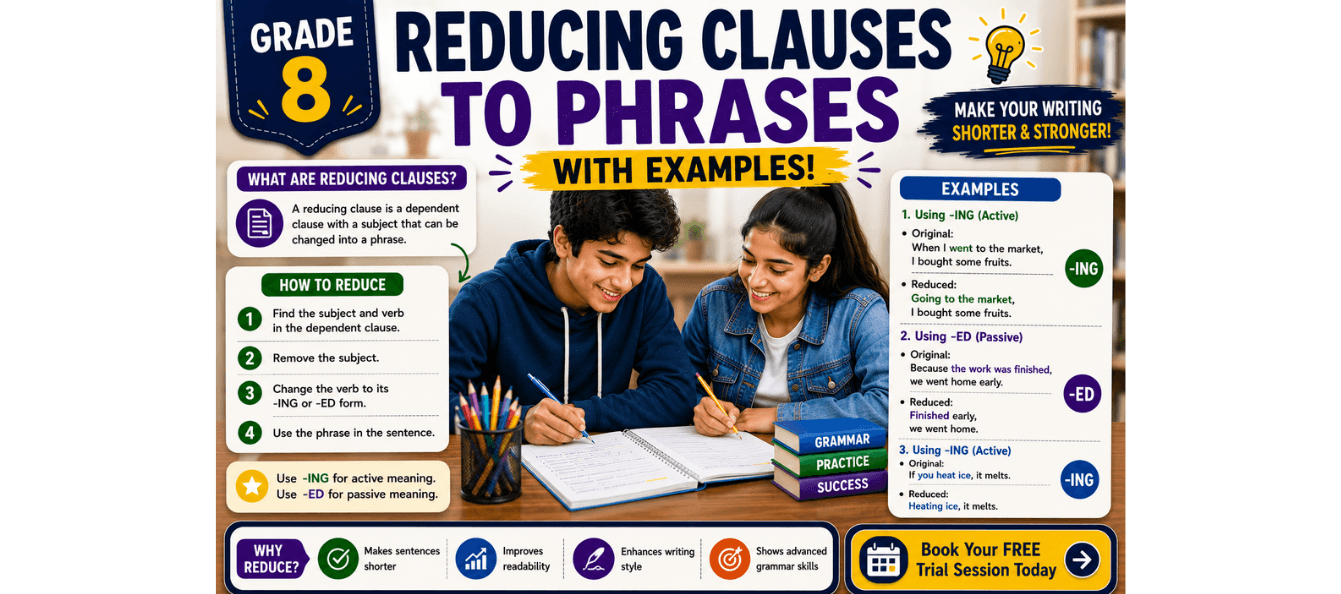
What is reducing clauses to phrases?
Reducing clauses to phrases is a grammar technique where you take a full clause and shorten it into a phrase. A clause is a group of words that has a subject and a verb. A phrase is a group of words that does not have both a subject and a verb working together. When you reduce a clause to a phrase, you remove unnecessary words and keep only the key idea.
For example, the clause "Because he was tired" can be reduced to the phrase "Being tired." The meaning is fully maintained, but the sentence becomes more concise. This technique is common in academic writing where clarity and conciseness are valued.
Not all clauses can be converted into phrases, but many subordinate clauses can be. A reduced relative clause acts as a participle. Passive clauses reduce to the word "being" plus a participle form. The word "being" is common in reduced phrases. Reducing a clause does not add new words; instead, it makes the sentence shorter while keeping the original meaning intact.
What is in this worksheet?
This worksheet on reducing clauses to phrases is divided into five well-structured exercises that help you build your understanding step by step.
1. Multiple choice questions: Ten questions that test your understanding of conciseness, passive clauses, participle forms, subordinate clauses, and academic writing.
2. Fill in the blanks: Ten sentences where you choose the correct past participle from a word bank including encouraged, confused, delighted, interested, surprised, frightened, fascinated, exhausted, embarrassed, and terrified.
3. True and false: Ten statements about clause reduction covering rules such as whether all clauses can be reduced, whether tense changes during reduction, and whether reduction works for passive clauses.
4. Underline the reduced phrase and circle the word it modifies: Ten sentences where you identify the reduced phrase and find the word it modifies.
5. Sentence writing: Ten tasks that ask you to create your own reduced phrases from clauses and write original sentences using reduced forms.
Definitions, examples, techniques, and tips
Here are the key definitions, examples, techniques, and tips covered in this worksheet.
A clause is a group of words containing a subject and a verb. Examples from the worksheet include "Because he was tired," "After he finished," and "boy who is running."
A phrase is a shortened version of a clause that does not have a full subject-verb structure. "Because he was tired" becomes "Being tired," and "After he finished" becomes "After finishing."
A reduced relative clause acts as a participle. For example, "the boy who is running" can be reduced to "the boy running." The meaning is maintained, but the phrase has fewer words than the full subordinate clause.
Passive clauses reduce to "being" plus a participle form. For example, "Because he was tired" reduces to "Being tired." The word "being" is common in these reduced phrases and works as a modifier in the sentence.
Participle phrases are one of the most common results of clause reduction. Words like delighted, exhausted, surprised, frightened, interested, confused, embarrassed, terrified, encouraged, and fascinated are all past participles that appear in reduced phrases throughout the worksheet.
Specific reduction examples from the worksheet include: "Walking in the park" modifies Rahul, "Inspired by the speech" modifies he, "Hearing the noise" modifies they, "Covered in mud" modifies the team, "Having eaten" modifies Pooja, "Tired from the trip" modifies she, "Known for truth" modifies Diya, "Driven by hope" modifies Rohan, "Standing at the gate" modifies Nisha, and "Born in Mumbai" modifies he.
An important technique is to remove the conjunction or relative pronoun along with the subject, then change the verb to a participle form. For example, "While he walked" becomes "While walking." Not every clause can be reduced, so always read the sentence carefully.
Why is it important to learn this?
Learning how to reduce clauses to phrases is important for several reasons connected to this worksheet.
First, reducing clauses helps achieve sentence conciseness. Your sentences become shorter and more to the point without losing their original meaning. Second, a reduced phrase has fewer words than a full subordinate clause, making your writing less repetitive and more engaging.
Third, clause reduction is common in academic writing. As you move into higher grades, you will be expected to write essays and reports that are well-structured and concise. Fourth, understanding clause reduction helps you become a better reader by helping you recognize reduced phrases in texts and understand their meaning more quickly. Finally, learning this concept builds your overall grammar foundation and teaches you how to make smart choices about sentence construction.
Where will this knowledge help you?
The skills you develop from this worksheet will help you in many areas.
Academic writing is one of the most important areas. Clause reduction is common in academic writing, and being able to reduce clauses makes your writing sharper and more professional.
Reading comprehension improves when you understand how clauses are reduced. Many school texts contain reduced phrases, and recognizing them helps you understand their connection to the rest of the sentence.
Narrative writing benefits from clause reduction. Using reduced phrases like "Walking in the park, Rahul sat" makes your stories more vivid and engaging without making sentences overly long.
Grammar tests and exams frequently include questions on clause reduction. This worksheet prepares you for multiple choice questions, fill in the blank exercises, true and false items, identification tasks, and sentence writing prompts.
How to use this worksheet?
Follow these steps to get the most out of this worksheet.
1. Read each question carefully before answering. Make sure you understand what is being asked.
2. For the multiple choice section, think about concepts like conciseness, meaning, participle forms, subordinate clauses, and academic writing.
3. For the fill in the blanks section, read the entire sentence first, then choose the past participle that best matches the context.
4. For the true and false section, pay attention to words like "all," "never," and "only," as these often signal a false statement.
5. For the underline and circle section, identify the reduced phrase and find the noun or pronoun it modifies.
6. For the sentence writing section, practice creating your own reduced phrases and write complete sentences.
7. After completing all exercises, check your answers using the answer key provided at the end.
8. Review any mistakes and try to understand why the correct answer is right.
9. Practice regularly to improve your grammar skills.
10. Ask for help if you are unsure about any concept.
Important tips and tricks
Here are important tips and tricks based on the content of this worksheet.
1. Reducing clauses makes sentences shorter and more concise. Always look for opportunities to simplify without changing the meaning.
2. A reduced clause keeps the original meaning. Check that your reduced phrase conveys the same idea as the original clause.
3. A relative clause can be reduced to a phrase. "A boy who is running" becomes "a boy running."
4. Not all clauses can be converted into phrases. If reducing makes the sentence confusing, leave it as a full clause.
5. Passive clauses reduce to "being" plus a participle form. Remember this pattern when you encounter passive voice.
6. A reduced relative clause acts as a participle and functions as a modifier describing a noun or pronoun.
7. The word "being" is common in reduced phrases that come from passive clauses.
8. Clause reduction works for both active and passive clauses, so do not limit yourself to one type.
9. Reducing a clause does not add new words. It removes unnecessary words and streamlines the sentence.
10. Reduced phrases are common in academic writing. Practice using them in your school essays and assignments.
Complete answer key
Multiple choice questions:
1. b (conciseness)
2. a (maintained)
3. c (participle)
4. b (subordinate)
5. b (infinitive)
6. c (finishing)
7. c (participle)
8. b (converted)
9. a (modifier)
10. a (academic)
Fill in the blanks:
1. delighted (Rahul, delighted by the film, clapped.)
2. exhausted (Pooja, exhausted from the walk, rested.)
3. surprised (Nisha, surprised by the news, froze.)
4. frightened (Arjun, frightened by the dog, ran.)
5. interested (Diya, interested in art, joined today.)
6. confused (Aryan, confused by the sum, paused.)
7. embarrassed (Rohan, embarrassed by his error, spoke.)
8. terrified (Neha, terrified of spiders, yelled.)
9. encouraged (Kartik, encouraged by praise, tried hard.)
10. fascinated (Anvi, fascinated by the tale, asked.)
True and false:
1. True (Reducing clauses makes sentences shorter.)
2. True (A reduced clause keeps original meaning.)
3. True (A relative clause can be reduced to phrase.)
4. True (After having finished is reduced clause.)
5. True (Reduced phrases never change the tense; the original meaning is maintained.)
6. False (All clauses can be reduced to phrases. Not all clauses can be converted into phrases.)
7. False (Reduction is only for active clauses. Passive clauses can also be reduced.)
8. True (Reduced phrases are common in writing, especially academic writing.)
9. True (Because he was ill reduces to Being ill.)
10. False (Reducing a clause adds new words. Reducing removes words and makes sentences shorter.)
Underline the reduced phrase and circle the word it modifies:
1. Reduced phrase: Walking in the park - Modifies: Rahul
2. Reduced phrase: Inspired by the speech - Modifies: he
3. Reduced phrase: Hearing the noise - Modifies: they
4. Reduced phrase: Covered in mud - Modifies: the team
5. Reduced phrase: Having eaten - Modifies: Pooja
6. Reduced phrase: Tired from the trip - Modifies: she
7. Reduced phrase: Known for truth - Modifies: Diya
8. Reduced phrase: Driven by hope - Modifies: Rohan
9. Reduced phrase: Standing at the gate - Modifies: Nisha
10. Reduced phrase: Born in Mumbai - Modifies: he
Sentence writing:
Answers may vary.
1. Being tired, she rested on the sofa.
2. Walking down the road, he noticed a stray dog.
3. After finishing her homework, Pooja went out to play.
4. The boy running across the field is my classmate Aryan.
5. Arriving during the monsoon, we enjoyed the cool breeze and rain.
6. Batting with focus, the player scored a brilliant century for his team.
7. The teacher, known for her patience, explained the chapter with great care.
8. Celebrating Diwali with family, children lit diyas and burst crackers happily.
9. Living in the village, he wakes up early every morning to help his parents.
10. Exhausted after the long journey, she fell asleep as soon as she reached home..
Reducing clauses to phrases is a valuable grammar skill that every Grade 8 student should practice and master. It helps you write with clarity and confidence, and it prepares you for the more complex writing tasks you will face in higher grades. This worksheet, created by Archita Srivastava, gives you plenty of practice with multiple choice questions, fill in the blanks, true and false items, identification exercises, and sentence writing tasks. By working through each exercise carefully and checking your answers with the key provided, you will build a strong understanding of how clauses can be reduced to phrases and how these reduced forms improve your writing. Keep practicing, stay curious, and watch your grammar skills grow with every worksheet you complete.