
Combining Sentences Precisely: Grade 7 Grammar Worksheet with Answers
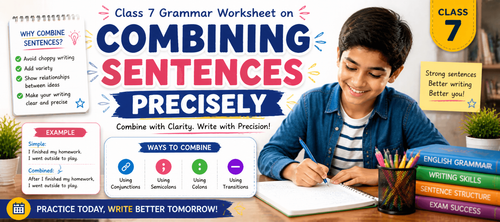

English Grammar Worksheet Grade 7: Combining Sentences with Precision
Combining sentences with precision is an essential skill for improving writing clarity and variety. In this Grade 7 worksheet on "Combining Sentences with Precision," students will learn how to effectively combine multiple sentences into one, using appropriate conjunctions and structures. Mastering this skill will help students write more fluid and engaging sentences, making their writing clearer and more concise.
Download these English grammar worksheets and practice regularly to strengthen your language skills and build a strong foundation. You can also book a free trial to get expert guidance and improve your reading, writing, and comprehension abilities. The worksheets are designed in a simple and structured way to help K–8 students learn grammar concepts easily and use them confidently in everyday communication. Book a free trial!
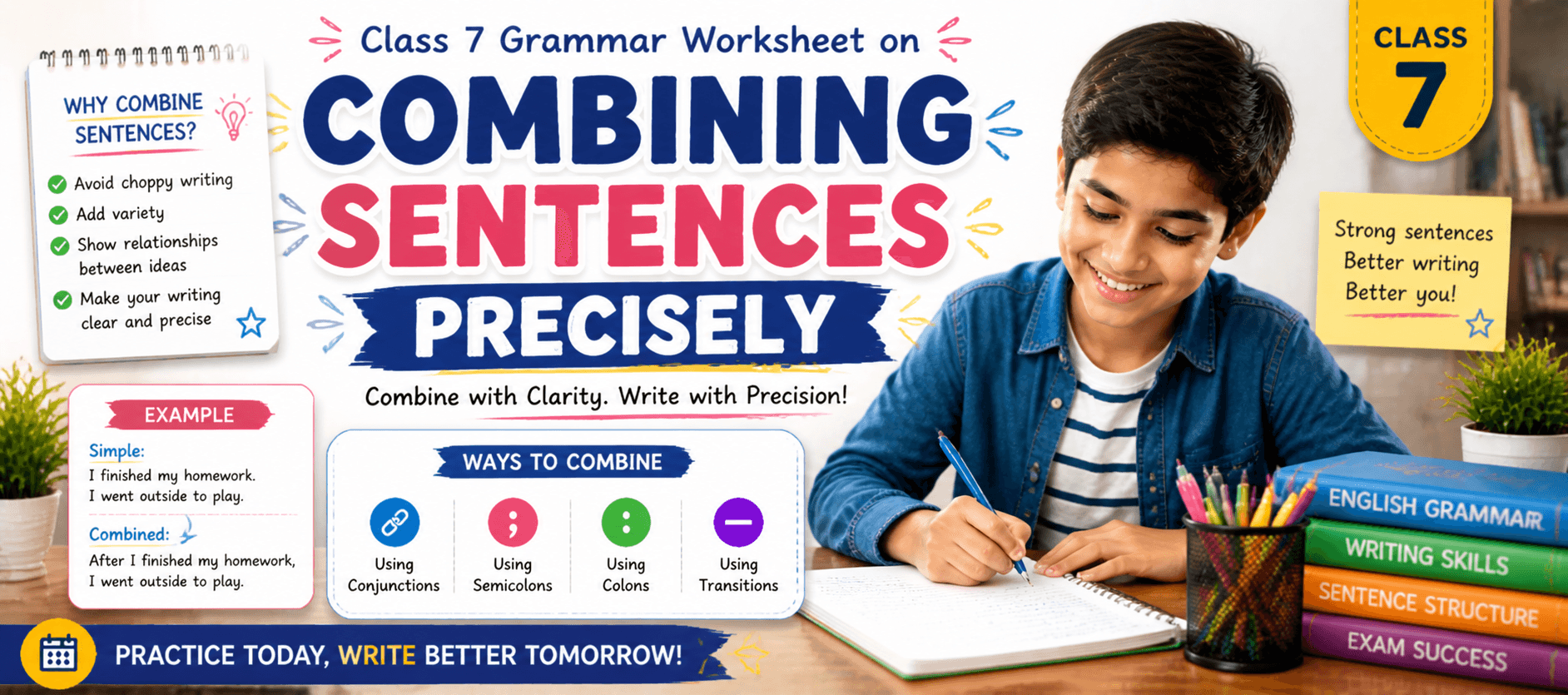
## What is the topic?
The focus of this worksheet is on combining sentences in a way that maintains clarity and coherence. Instead of using short, choppy sentences, students will learn how to merge related ideas into more complex yet concise sentences. This helps in making writing more cohesive and fluid.
Students will learn:
- How to use conjunctions and other linking words to combine sentences.
- How to make sentences more precise and avoid unnecessary repetition.
- How to effectively balance sentence length and structure to improve readability.
## What’s in this worksheet?
This worksheet provides a series of exercises to help students practice combining sentences with precision. The exercises include:
1. **Underline the words** – Identifying sentence components to understand how ideas can be connected.
2. **Multiple choice questions** – Choosing the correct sentence combination using conjunctions.
3. **Sentence rewriting** – Rewriting sentences to combine them while maintaining clarity and meaning.
4. **Fill in the blanks** – Completing sentences by adding appropriate conjunctions or connectors.
5. **Paragraph writing** – Writing a short paragraph using combined sentences, applying the concept of sentence precision.
By practicing these exercises, students will develop stronger sentence construction skills, improving both their writing and communication abilities.
## Definitions, examples, techniques, and tips
- **Combining Sentences Definition**: Combining sentences is the process of merging two or more sentences into one, using conjunctions like "and," "but," "so," or "because." This technique helps to create varied and well-structured sentences that maintain clarity.
- **Example of Combining Sentences**:
- **Separate**: "He was tired. He went to bed early."
- **Combined**: "He was tired, so he went to bed early."
- **Techniques for combining sentences**:
1. Use coordinating conjunctions (and, but, or, so) to connect ideas of equal importance.
2. Use subordinating conjunctions (because, although, while, since) to show a relationship between ideas.
3. Avoid run-on sentences by making sure the conjunction properly connects the ideas.
- **Quick learning tips**:
- When combining sentences, make sure the ideas flow logically.
- Ensure that the combined sentence remains grammatically correct.
- Avoid making sentences too long; clarity is more important than complexity.
## Why is it important to learn this?
Mastering the skill of combining sentences with precision is crucial for writing well-organized and fluid pieces. By learning how to combine sentences effectively:
- Students can write more concisely, avoiding unnecessary repetition.
- They can convey complex ideas in a clear, logical way.
- This skill helps improve both written and spoken communication, making it easier to express thoughts effectively.
Grade 7 students will find this skill especially helpful in improving their essays, reports, and any other academic writing.
## Where will this knowledge help you?
This knowledge is applicable in:
- **Exams**: Many grammar tests require students to combine sentences effectively.
- **Writing tasks**: This skill is important for structuring clear and concise essays, reports, and creative writing.
- **Class participation**: Combining sentences correctly is essential for clear oral communication during class discussions and presentations.
## How to use this worksheet?
1. **Attempt independently first**: Read each pair of sentences and try to combine them using the appropriate conjunctions.
2. **Review answers carefully**: Check if the meaning of the original sentences has been preserved and if the sentence flows logically.
3. **Correct mistakes**: If the sentence sounds awkward or unclear, rewrite it to improve clarity.
4. **Practice regularly**: Continue practicing to improve your sentence structure skills.
The solutions follow the exact worksheet order. Compare your answers carefully to ensure accuracy.
## Important tips and tricks
- **Common mistakes**:
- Using incorrect conjunctions or placing them incorrectly.
- Combining sentences in a way that makes the new sentence confusing or awkward.
- **What examiners expect**:
- Well-structured sentences that clearly express ideas without unnecessary complexity.
- Correct use of conjunctions and sentence structures that connect ideas logically.
- **How to score full marks**:
- Focus on clarity when combining sentences, ensuring that the meaning is preserved.
- Use conjunctions correctly and avoid overcomplicating the sentence.
- **How to approach activity-based or writing-based tasks**:
- For rewriting tasks, focus on maintaining the meaning of the original sentences.
- When writing paragraphs, try to combine short sentences to improve sentence flow and coherence.
## Complete Answer Key
**Exercise No. 1:**
- He was tired and because he worked hard. (Underline: He, Circle: was tired)
- She was hungry and she ate quickly. (Underline: She, Circle: was hungry)
- He is tired because he studied late. (Underline: He, Circle: is tired)
- They are friends, but they argue a lot. (Underline: They, Circle: are friends)
- She didn’t come, and she missed the meeting. (Underline: She, Circle: didn’t come)
**Exercise No. 2:**
1. b) He was tired because he worked hard.
2. b) She was hungry, so she ate quickly.
3. a) He is tired because he studied late.
4. c) They are friends, yet they argue a lot.
5. b) She didn’t come, so she missed the meeting.
**Exercise No. 3:**
1. He was tired because he worked hard. (Ensure the sentences are combined logically.)
2. She was hungry, so she ate quickly. (Ensure the sentences are combined logically.)
3. He is tired because he studied late. (Ensure the sentences are combined logically.)
4. They are friends, but they argue a lot. (Ensure the sentences are combined logically.)
5. She didn’t come, so she missed the meeting. (Ensure the sentences are combined logically.)
**Exercise No. 4:**
1. so
2. Although
3. Though
4. Even though
5. Although
6. so
7. Though
8. so
**Exercise No. 5**: Answers may vary.
This activity is a creative task and does not have a predefined answer. Example: "The importance of teamwork cannot be overstated. When individuals work together toward a common goal, they can achieve things that would be impossible alone. Effective communication and shared responsibility allow for better ideas and solutions. Teamwork fosters trust, collaboration, and mutual respect, all of which are essential for success in both academic and professional life."
## Outro
By practicing sentence combination, students will not only improve their writing fluency but also learn how to express their ideas more clearly and effectively. Mastering this skill will enhance both academic writing and everyday communication.
Book a free trial!