
Commas in Introductory Clauses: Grammar Practice for Grade 5
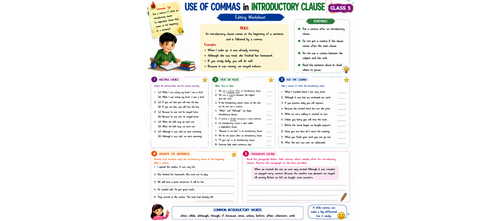

Title: Commas After Introductory Clauses: Grade 5 English Grammar Worksheet
Have you ever written a sentence like “When I arrived she left” and wondered if you needed a comma? You do! A comma is used after an introductory clause. Introductory clauses come at the beginning of a sentence before the main clause. They often start with words like “when,” “if,” “because,” “although,” “while,” “before,” “after,” “as,” “since,” “until,” and “whereas.” The comma helps separate the introductory clause from the main clause, making the sentence easier to read. In Grade 5, learning to use commas correctly after introductory clauses will make your writing clearer and more professional. This Grade 5 English grammar worksheet on editing commas in introductory clauses will teach you the rule and help you practice.
Download these English grammar worksheets and practice regularly to strengthen your language skills and build a strong foundation. You can also book a free trial to get expert guidance and improve your reading, writing, and comprehension abilities. The worksheets are designed in a simple and structured way to help K–8 students learn grammar concepts easily and use them confidently in everyday communication.
Book a free trial!
What Is the Topic?
The topic of this worksheet is Editing: Incorrect Use of Commas in Introductory Clauses. An introductory clause is a group of words that comes at the beginning of a sentence before the main clause. It often tells when, why, or under what condition something happened. A comma is used after an introductory clause to separate it from the main clause. For example: “When I arrived, she left.” (comma after “arrived”) “After the rain stopped, we went outside.” (comma after “stopped”) “If you study hard, you will succeed.” (comma after “hard”) “Although it was late, we continued working.” (comma after “late”) “Because it was raining, we stayed indoors.” (comma after “raining”) “While she was reading, he was cooking.” (comma after “reading”) “When the teacher entered, everyone stood up.” (comma after “entered”) Introductory clauses can begin with words like “when,” “if,” “because,” “although,” “while,” “before,” “after,” “as,” “since,” and “whereas.” Without the comma, sentences can be confusing or hard to read. Understanding this rule helps you write clear, correct sentences.
Book a free trial!
What’s in This Worksheet?
This worksheet contains five different exercises that help students master commas after introductory clauses. Here is what is included:
1. Exercise No. 1 – Multiple Choice Questions – Students read each sentence and choose the option with the correct use of a comma after the introductory clause. This exercise tests basic understanding of the rule.
2. Exercise No. 2 – True and False – Students read ten statements about commas in introductory clauses and decide whether each one is true or false. This helps correct common misunderstandings.
3. Exercise No. 3 – Fill in the Blanks – Students read sentences and add commas where needed after the introductory clauses. This exercise practices applying the rule.
4. Exercise No. 4 – Sentence Rewriting – Students read sentences and rewrite them with the correct comma placement. This exercise focuses on identifying and fixing errors.
5. Exercise No. 5 – Paragraph Writing – Students read a paragraph and correct the comma errors related to introductory clauses. This combines reading comprehension with grammar application.
This worksheet supports exam preparation by covering the rule for using commas after introductory clauses that begin with words like when, if, because, although, while, before, and after.
Book a free trial!
Definitions, Examples, Techniques, and Tips
Based only on the content of this worksheet, here are the exact definitions and examples students will learn:
Rules for Commas in Introductory Clauses:
- Rule 1: A comma is used after an introductory clause. The comma helps separate the introductory clause from the main clause.
- Rule 2: Introductory clauses come at the beginning of a sentence, before the main clause. They add extra information about time, reason, or condition.
- Rule 3: Introductory clauses can begin with words like “when,” “if,” “because,” “although,” “while,” “before,” “after,” “as,” “since,” “until,” and “whereas.”
Examples taken directly from the worksheet (Exercise No. 1 – multiple choice):
1. (a) When I arrived, she left. (b) When I arrived she left.
Correct answer: a) When I arrived, she left.
2. (a) After the rain stopped we went outside. (b) After the rain stopped, we went outside.
Correct answer: b) After the rain stopped, we went outside.
3. (a) If you study hard, you will succeed. (b) If you study hard you will succeed.
Correct answer: a) If you study hard, you will succeed.
4. (a) Before the bell rang the students sat quietly. (b) Before the bell rang, the students sat quietly.
Correct answer: b) Before the bell rang, the students sat quietly.
5. (a) Although it was late, we continued working. (b) Although it was late we continued working.
Correct answer: a) Although it was late, we continued working.
6. (a) While she was reading, he was cooking. (b) While she was reading he was cooking.
Correct answer: a) While she was reading, he was cooking.
7. (a) Because it was raining, we stayed indoors. (b) Because it was raining we stayed indoors.
Correct answer: a) Because it was raining, we stayed indoors.
8. (a) After finishing homework I played cricket. (b) After finishing homework, I played cricket.
Correct answer: b) After finishing homework, I played cricket.
9. (a) When the teacher entered, everyone stood up. (b) When the teacher entered everyone stood up.
Correct answer: a) When the teacher entered, everyone stood up.
10. (a) If they arrive early we will start the game. (b) If they arrive early, we will start the game.
Correct answer: b) If they arrive early, we will start the game.
Key facts from True and False section (Page 5):
- A comma is used after an introductory clause. (True)
- Introductory clauses always come at the end of a sentence. (False – they come at the beginning)
- A comma helps separate the introductory clause from the main clause. (True)
- You should never use a comma after an introductory clause. (False)
- “If it rains, we will stay home” uses the comma correctly. (True)
- Introductory clauses can begin with words like “when,” “if,” or “because.” (True)
- “After school we went home” is correctly punctuated. (False – missing comma: “After school, we went home”)
- A comma is needed after “Although he was tired” in a sentence. (True)
- Introductory clauses add extra information before the main clause. (True)
- “While I was sleeping, the phone rang” uses the comma correctly. (True)
Examples from Exercise No. 3 – Fill in the blanks (Page 6 – add commas where needed):
1. If it rains, we will stay home.
2. After lunch, we went to the park.
3. When the movie ended, we went home.
4. Because she was tired, she went to bed early.
5. While he was running, he fell down.
6. Before the class started, the teacher gave instructions.
7. Although it was hot, they continued playing.
8. After the match ended, everyone cheered loudly.
9. If you listen carefully, you will understand better.
10. When the bell rang, the students rushed out.
Examples from Exercise No. 4 – Sentence Rewriting (Pages 7 and 8 – add commas):
1. After dinner, we watched TV.
2. When the sun set, we went home.
3. If you hurry, you will catch the bus.
4. Because he was late, he missed the train.
5. While I was studying, my friend called me.
6. After the game ended, we celebrated.
7. Although it was difficult, she completed the task.
8. Before the exam started, we revised our notes.
9. When the rain stopped, we went outside.
10. If you practice daily, you will improve.
Example from Exercise No. 5 – Paragraph (Page 9) – correct comma errors:
Original paragraph with missing commas:
When I reached the playground I saw my friends already playing cricket near the boundary. After a few minutes we divided ourselves into teams and started the match. Although it was very hot we continued playing with great excitement and energy. When the teacher called us from a distance we didn’t hear her at first. Because we were busy playing we ignored the bell for a while. After realizing the time we quickly gathered our things and walked toward the bench. While we were drinking water we talked about the best moments of the game. Before leaving the ground we thanked our coach for guiding us. When we reached the classroom we were still discussing the match. After the final bell rang we went home feeling happy and tired after such a fun day.
Corrected paragraph:
When I reached the playground, I saw my friends already playing cricket near the boundary. After a few minutes, we divided ourselves into teams and started the match. Although it was very hot, we continued playing with great excitement and energy. When the teacher called us from a distance, we didn’t hear her at first. Because we were busy playing, we ignored the bell for a while. After realizing the time, we quickly gathered our things and walked toward the bench. While we were drinking water, we talked about the best moments of the game. Before leaving the ground, we thanked our coach for guiding us. When we reached the classroom, we were still discussing the match. After the final bell rang, we went home feeling happy and tired after such a fun day.
Quick learning tip: If a sentence starts with a word like “when,” “if,” “because,” “although,” “while,” “before,” or “after,” and that word begins a clause that comes before the main part of the sentence, put a comma after that clause.
Book a free trial!
Why Is It Important to Learn This?
Learning about commas in introductory clauses is important for several reasons. First, a comma is used after an introductory clause. Without it, sentences can be confusing: “When I arrived she left” is harder to read than “When I arrived, she left.” Second, the comma helps separate the introductory clause from the main clause. This makes the sentence’s meaning clear. Third, introductory clauses often begin with words like “when,” “if,” “because,” “although,” “while,” “before,” and “after.” Recognizing these words helps you know when a comma is needed. Fourth, this topic is tested in grammar exams where you may be asked to add missing commas or correct errors. Finally, using commas correctly after introductory clauses makes your writing look professional and easy to read.
Book a free trial!
Where Will This Knowledge Help You?
Knowledge of commas in introductory clauses will help you in many academic and real-life situations:
1. Grammar exams and language tests – Many questions ask you to add commas after introductory clauses. This worksheet directly prepares you for those questions.
2. Writing essays and stories – Using commas correctly after introductory clauses makes your writing smoother and easier to read. “After the rain stopped, we went outside” is clearer than “After the rain stopped we went outside.”
3. Avoiding run-on sentences – The comma after an introductory clause signals a pause, helping readers follow your meaning.
4. Understanding what you read – When you see a comma after a word like “when” or “if,” you know that the introductory clause is ending.
5. Improving sentence variety – Using introductory clauses (and commas) allows you to start sentences in different ways, making your writing more interesting.
6. Building a strong grammar foundation – Comma rules are essential for good writing. Mastering introductory clause commas is a key step.
Book a free trial!
How to Use This Worksheet?
Follow these steps to get the most out of this Grade 5 English grammar worksheet on editing commas in introductory clauses:
1. Attempt independently first – Without looking at any answers, complete all five exercises in order. Start with Exercise No. 1 (Multiple Choice Questions), then Exercise No. 2 (True and False), then Exercise No. 3 (Fill in the Blanks), then Exercise No. 4 (Sentence Rewriting), and finally Exercise No. 5 (Paragraph Writing – correct comma errors).
2. Review answers carefully – After you finish all exercises, go to the Complete Answer Key section below. Compare your answers one by one. Pay special attention to Exercise No. 5 – make sure you added commas after every introductory clause.
3. Correct mistakes – For any answer that is different from the answer key, write the correct answer next to your attempt. Try to understand why you made the mistake. Did you forget the comma after an “if” clause?
4. Practice regularly – Comma rules take practice. Repeat the worksheet after a few days. For the paragraph correction task (Exercise No. 5), try to add all the missing commas without looking at the answer key first.
The solutions follow the exact worksheet order. Students should compare their answers carefully.
Book a free trial!
Important Tips and Tricks
Here are important tips and tricks based directly on this worksheet to help you master commas in introductory clauses and score full marks:
1. Look for introductory words – If a sentence starts with words like “when,” “if,” “because,” “although,” “while,” “before,” “after,” “as,” “since,” “until,” or “whereas,” there is probably an introductory clause. Put a comma after that clause.
2. The comma comes after the clause, not after the word – “When I arrived, she left.” The comma is after “arrived” (the whole clause), not just after “When.”
3. Short introductory clauses still need a comma – Even if the introductory clause is short, use a comma. “After lunch, we went to the park.” (comma needed) “If it rains, we will stay home.” (comma needed)
4. Introductory clauses come at the beginning – A comma is used after an introductory clause at the beginning of a sentence. If the clause is at the end, no comma is needed. “We stayed home because it was raining.” (no comma before “because” – this is not an introductory clause at the beginning).
5. Common introductory clause starters to memorize – When, If, Because, Although, While, Before, After, As, Since, Until, Wherever, Whenever, Wherever.
6. What examiners expect – Examiners expect you to add a comma after an introductory clause at the beginning of a sentence. They expect you to know that “When I arrived she left” is missing a comma. They expect you to correct errors like “After school we went home” to “After school, we went home.”
7. How to score full marks – When answering multiple-choice questions, look for the comma after the first few words of the sentence. If the sentence starts with an introductory word and has no comma, it is incorrect. If it has a comma in the right place, it is correct.
8. For sentence rewriting (Exercise No. 4) – Read each sentence. Does it start with an introductory word (when, if, because, although, while, before, after)? If yes, the first part of the sentence is the introductory clause. Put a comma right after that clause, before the main clause.
9. For paragraph correction (Exercise No. 5) – Read the paragraph slowly. Look for every sentence that starts with “When,” “After,” “Although,” “Because,” “While,” or “Before.” These are introductory clauses. Add a comma after the clause. For example, “When I reached the playground” → add comma → “When I reached the playground, I saw my friends...”
10. Remember: not every “when” or “if” needs a comma** – If the word is not starting an introductory clause, you might not need a comma. But in this worksheet, all the examples are introductory clauses at the beginning of sentences, so they all need commas.
Book a free trial!
Complete Answer Key
Below is the complete answer key for the Grade 5 English grammar worksheet on **Editing: Incorrect Use of Commas in Introductory Clauses**. The answers follow the exact order of the worksheet. Section names and question numbers are reproduced exactly as they appear in the worksheet.
Exercise No. 1
Choose the option with the correct use of a comma after the introductory clause.
1. (a) When I arrived, she left. (b) When I arrived she left.
Answer: a) When I arrived, she left.
2. (a) After the rain stopped we went outside. (b) After the rain stopped, we went outside.
Answer: b) After the rain stopped, we went outside.
3. (a) If you study hard, you will succeed. (b) If you study hard you will succeed.
Answer: a) If you study hard, you will succeed.
4. (a) Before the bell rang the students sat quietly. (b) Before the bell rang, the students sat quietly.
Answer: b) Before the bell rang, the students sat quietly.
5. (a) Although it was late, we continued working. (b) Although it was late we continued working.
Answer: a) Although it was late, we continued working.
6. (a) While she was reading, he was cooking. (b) While she was reading he was cooking.
Answer: a) While she was reading, he was cooking.
7. (a) Because it was raining, we stayed indoors. (b) Because it was raining we stayed indoors.
Answer: a) Because it was raining, we stayed indoors.
8. (a) After finishing homework I played cricket. (b) After finishing homework, I played cricket.
Answer: b) After finishing homework, I played cricket.
9. (a) When the teacher entered, everyone stood up. (b) When the teacher entered everyone stood up.
Answer: a) When the teacher entered, everyone stood up.
10. (a) If they arrive early we will start the game. (b) If they arrive early, we will start the game.
Answer: b) If they arrive early, we will start the game.
Exercise No. 2
True and False. Write True or False for each statement.
1. A comma is used after an introductory clause.
Answer: True
2. Introductory clauses always come at the end of a sentence.
Answer: False
3. A comma helps separate the introductory clause from the main clause.
Answer: True
4. You should never use a comma after an introductory clause.
Answer: False
5. “If it rains, we will stay home” uses the comma correctly.
Answer: True
6. Introductory clauses can begin with words like “when,” “if,” or “because.”
Answer: True
7. “After school we went home” is correctly punctuated.
Answer: False
8. A comma is needed after “Although he was tired” in a sentence.
Answer: True
9. Introductory clauses add extra information before the main clause.
Answer: True
10. “While I was sleeping, the phone rang” uses the comma correctly.
Answer: True
Exercise No. 3
Add commas where needed after the introductory clause.
1. If it rains, we will stay home.
2. After lunch, we went to the park.
3. When the movie ended, we went home.
4. Because she was tired, she went to bed early.
5. While he was running, he fell down.
6. Before the class started, the teacher gave instructions.
7. Although it was hot, they continued playing.
8. After the match ended, everyone cheered loudly.
9. If you listen carefully, you will understand better.
10. When the bell rang, the students rushed out.
Exercise No. 4
Rewrite each sentence with the correct comma placement.
1. After dinner, we watched TV.
2. When the sun set, we went home.
3. If you hurry, you will catch the bus.
4. Because he was late, he missed the train.
5. While I was studying, my friend called me.
6. After the game ended, we celebrated.
7. Although it was difficult, she completed the task.
8. Before the exam started, we revised our notes.
9. When the rain stopped, we went outside.
10. If you practice daily, you will improve.
Exercise No. 5
Read the paragraph carefully and correct the comma errors related to introductory clauses.
Corrected paragraph:
When I reached the playground, I saw my friends already playing cricket near the boundary. After a few minutes, we divided ourselves into teams and started the match. Although it was very hot, we continued playing with great excitement and energy. When the teacher called us from a distance, we didn’t hear her at first. Because we were busy playing, we ignored the bell for a while. After realizing the time, we quickly gathered our things and walked toward the bench. While we were drinking water, we talked about the best moments of the game. Before leaving the ground, we thanked our coach for guiding us. When we reached the classroom, we were still discussing the match. After the final bell rang, we went home feeling happy and tired after such a fun day.
Book a free trial!
You have now completed the entire worksheet on editing commas in introductory clauses. A comma is used after an introductory clause. Introductory clauses come at the beginning of a sentence and often start with words like “when,” “if,” “because,” “although,” “while,” “before,” or “after.” The comma helps separate the introductory clause from the main clause. Remember: “When I arrived, she left.” “After the rain stopped, we went outside.” “If you study hard, you will succeed.” Keep practicing, and soon you will always know where to put the comma. You are building skills that will make your writing clear, correct, and easy to read in Grade 5 and beyond.
Book a free trial!