
Common Prefixes (Un, Re, Dis) for Grade 6 Grammar Practice [PDF]
![Common Prefixes (Un, Re, Dis) for Grade 6 Grammar Practice [PDF]](https://cdn5.planetspark.in/media/small_10_eb2e879b08.png)

Grade 6 English Grammar Worksheet: Common Prefixes (Un, Re, Dis) [With Examples]
For Grade 6 students, understanding prefixes is key to unlocking new words and meanings. This worksheet focuses on common prefixes such as "un-", "re-", and "dis-" and helps students practice how to apply them to base words. By mastering these prefixes, students can easily understand and form new words.
Download these English grammar worksheets and practice regularly to strengthen your language skills and build a strong foundation. You can also book a free trial to get expert guidance and improve your reading, writing, and comprehension abilities. The worksheets are designed in a simple and structured way to help K–8 students learn grammar concepts easily and use them confidently in everyday communication.
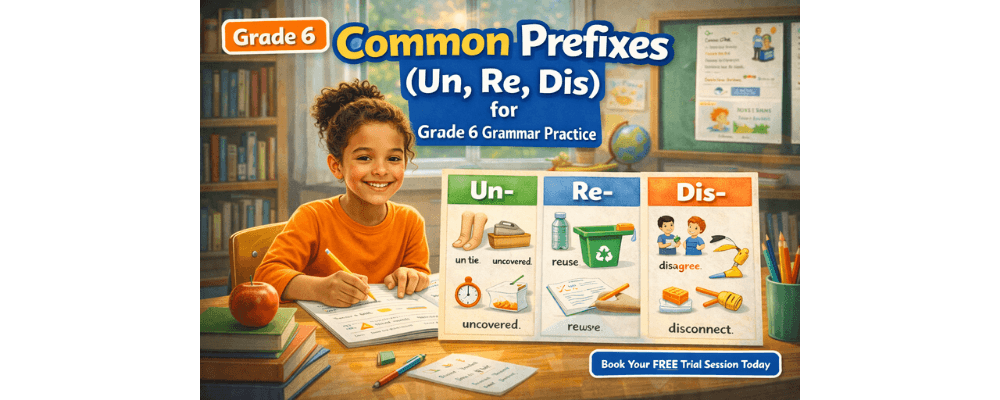
What is the topic?
This worksheet focuses on three common prefixes: "un-", "re-", and "dis-". These prefixes are often added to base words to change their meaning and help students expand their vocabulary.
What's in this worksheet?
1. Exercises for understanding and applying prefixes "un-", "re-", and "dis-".
2. Identifying how these prefixes alter the meaning of base words.
3. Helps students expand their vocabulary and improve their grammar skills.
4. Designed to support grammar exam preparation and real-world usage.
Definitions, Examples, Techniques, and Tips:
• Definitions:
- "Un-" means not or opposite of (e.g., "unhappy" means not happy).
- "Re-" means again or back (e.g., "replay" means to play again).
- "Dis-" means not or opposite of (e.g., "dislike" means not like).
• Examples:
- "Unhappy," "Replay," "Disagree"
• Tips:
- Focus on the meaning of each prefix to understand how it changes the word.
- Practice using these prefixes in sentences to better understand their usage.
Why is it important to learn this?
Understanding these common prefixes helps students create new words and expand their vocabulary. This knowledge is vital for both reading comprehension and writing skills.
Where will this knowledge help you?
• Exams: Prefixes are often tested in grammar and vocabulary sections of exams.
• Writing tasks: Using prefixes improves sentence clarity and variety.
• Class participation: Knowledge of prefixes helps students communicate more clearly in discussions.
How to use this worksheet?
1. Review the prefixes and base words.
2. Practice applying each prefix to the given base word.
3. Check your answers and see if the word makes sense in the sentence.
4. Keep practicing regularly to reinforce your understanding of prefixes.
Important Tips and Tricks:
1. Pay attention to how prefixes change the meaning of base words.
2. Practice forming sentences with different prefixes to strengthen your vocabulary.
3. Double-check your answers to ensure the word is used correctly in context.
Complete Answer Key:
Exercise 1 – Match the Following
un- → happy
re- → write
dis- → honest
un- → fair
re- → play
dis- → agree
un- → kind
re- → cover
dis- → lock
un- → visit
Exercise 2 – Sort the Words
Prefix un-: tie, fair, safe, seen, well, true, kind, lock
Prefix re-: build, made, play, paint, write, open, check
Exercise 3 – Fill in the Blanks
1. re-
2. un-
3. re-
4. dis-
5. un-
6. dis-
7. re-
8. un-
9. re-
10. re-
Exercise 4 – Multiple Choice Questions
1. c) unhappy
2. b) unkind
3. a) unsafe
4. c) unfit
5. a) rewind
6. d) rewind
7. b) disagree
8. a) connect
9. d) rebuild
10. c) untie
Exercise 5 – Sentence Rewriting
1. Anjali said the homework was not clear and very unclear.
2. Rahul chose to unlock the locked box of craft supplies.
3. Diya thought it was unfair that only boys got extra time.
4. Pooja decided to redo her old project from the beginning.
5. Arjun wanted to unpack the cricket match scores carefully.
6. Neha said she would recheck her answer sheet one more time.
7. Kartik felt that the task given to him was too easy.
8. Aarav told Rohan he would disagree with a redo of the plan.
9. Anjali asked if she could rewrap the gift for the contest.
10. Rohan said it was unkind to take his friend's pencil box.
Prefix knowledge is essential for building vocabulary and improving language skills. With regular practice, you’ll find that using prefixes becomes second nature. Keep up the great work, and soon you’ll be using prefixes confidently in both speaking and writing.