
Common Proper and Collective Nouns English Worksheet Grade 5
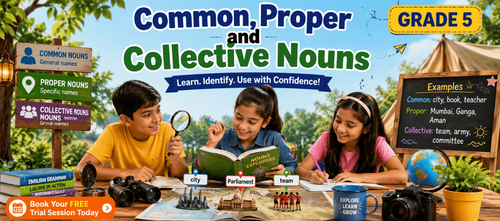

Common, Proper and Collective Nouns with This English Grammar Worksheet for Grade 5
Learning nouns becomes more exciting when students can identify different types of nouns through fun and meaningful activities. This Common Proper and Collective Nouns English grammar worksheet for Grade 5 helps students improve their grammar skills through sorting exercises, fill in the blanks, sentence correction, noun identification, and sentence writing tasks. The worksheet is designed in a simple and engaging way so that children can understand how common nouns, proper nouns, and collective nouns are used in everyday English.
Grade 5 students often use nouns while speaking, reading, and writing, but understanding the difference between common, proper, and collective nouns helps them become more accurate and confident communicators. This worksheet provides many examples and practice exercises that help students recognise nouns correctly and use them properly in sentences.
Download these English grammar worksheets and practice regularly to strengthen your language skills and build a strong foundation. You can also book a free trial to get expert guidance and improve your reading, writing, and comprehension abilities. The worksheets are designed in a simple and structured way to help K–8 students learn grammar concepts easily and use them confidently in everyday communication.
What Is the Topic?
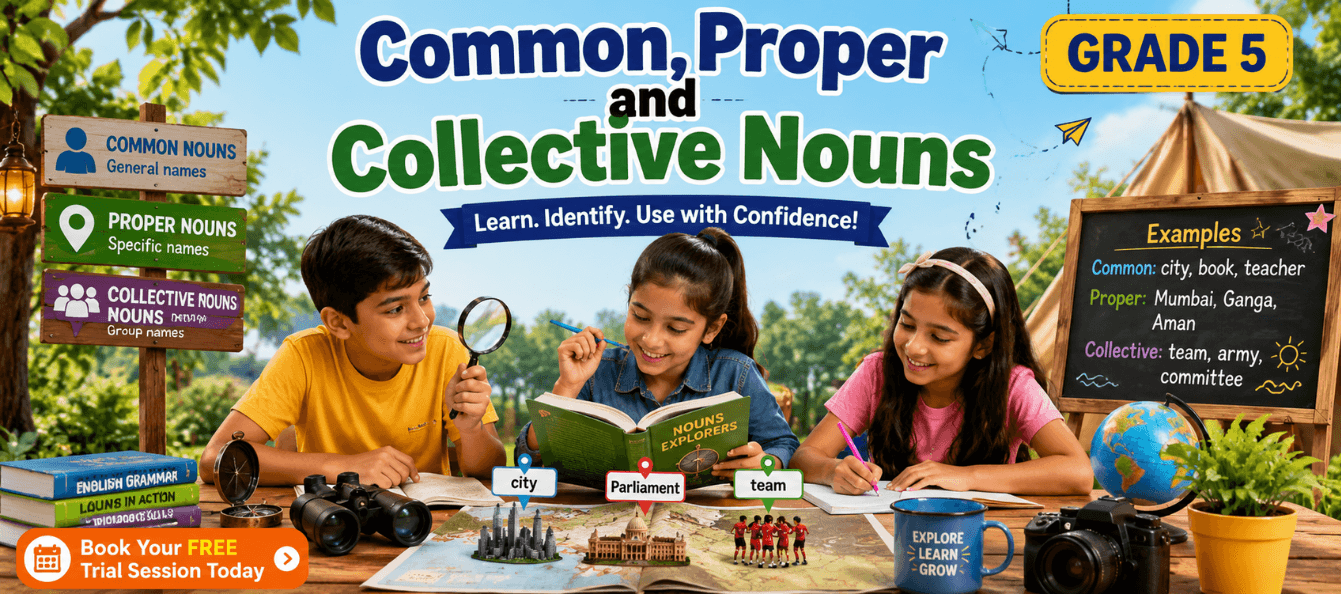
This English grammar worksheet for Grade 5 focuses on common nouns, proper nouns, and collective nouns.
A common noun is a general name for any person, place, animal, or thing. It is not capitalized unless it begins a sentence.
A proper noun is the specific name of a person, place, or thing. It always starts with a capital letter.
A collective noun is a word for a group of people, animals, or things.
Students learn how to:
• Identify different types of nouns
• Sort nouns into correct categories
• Use nouns correctly in sentences
• Rewrite incorrect sentences properly
• Understand capitalization in proper nouns
• Recognise collective nouns used for groups
Examples from the worksheet include:
• We live in Mumbai.
• A team of players won the match.
What’s in This Worksheet?
1. Sorting Exercise
Students sort different nouns into common nouns, proper nouns, and collective nouns.
2. Circle and Underline Activity
Students identify common nouns, proper nouns, and collective nouns in sentences.
3. Fill in the Blanks
Students complete sentences using suitable nouns.
4. Sentence Correction
Students rewrite sentences by correcting errors related to common, proper, and collective nouns.
5. Sentence Formation
Students write sentences using nouns from the given box.
6. Grammar Skill Practice
The worksheet helps students improve noun identification, sentence structure, capitalization, and vocabulary.
7. Exam Preparation Support
These exercises help students prepare for grammar tests, school assignments, and classroom activities.
Definitions, Examples, Techniques, and Tips
Definitions
Common noun:
A common noun is a general name for any person, place, animal, or thing.
Proper noun:
A proper noun is the specific name of a person, place, or thing.
Collective noun:
A collective noun is a word for a group of people, animals, or things.
Examples
• Mumbai
• team
• army
• Parliament
• teacher
• family
• Ganga
• class
• herd
Techniques
• Read the sentence carefully before identifying the noun.
• Check whether the noun is a general name or a specific name.
• Look for capital letters to identify proper nouns.
• Identify words that show groups to recognise collective nouns.
• Practice sentence rewriting carefully to correct capitalization mistakes.
Quick Learning Tips
• Proper nouns always begin with capital letters.
• Collective nouns name groups.
• Common nouns are general names.
• Read every sentence fully before answering.
• Practice rewriting sentences neatly and correctly.
Why Is It Important to Learn This?
Learning common nouns, proper nouns, and collective nouns is important because nouns are used in almost every sentence. Understanding nouns helps students write clearly and speak correctly.
This topic improves grammar accuracy and sentence construction. Students also learn the correct use of capital letters while writing proper nouns. Identifying collective nouns helps students understand group words used in English communication.
For Grade 5 students, this topic builds a strong grammar foundation that supports reading, writing, speaking, and comprehension skills.
Where Will This Knowledge Help You?
• In school grammar exams
• During sentence writing activities
• While reading storybooks and passages
• In classroom discussions
• During comprehension exercises
• While writing essays and paragraphs
• In daily communication and speaking practice
• During homework and worksheet activities
How to Use This Worksheet?
1. Read the definitions carefully first.
Understand the meaning of common nouns, proper nouns, and collective nouns before attempting the exercises.
2. Attempt all questions independently.
Try solving each activity carefully without skipping any question.
3. Follow the worksheet order.
The solutions follow the exact worksheet order. Compare each answer carefully with the question number.
4. Review capitalization rules.
Check whether proper nouns begin with capital letters.
5. Correct mistakes carefully.
Rewrite incorrect sentences neatly and accurately.
6. Practice sentence formation regularly.
Writing your own sentences improves grammar confidence and understanding.
7. Revise the worksheet again.
Repeated practice helps students remember grammar rules better.
Important Tips and Tricks
1. Always capitalise proper nouns.
Words like India, Ravi, Delhi Zoo, and Parliament must begin with capital letters.
2. Identify group words carefully.
Words like team, flock, committee, and audience are collective nouns.
3. Read the entire sentence before answering.
The sentence meaning helps identify the correct noun type.
4. Avoid spelling mistakes while rewriting sentences.
Check names and places carefully.
5. Use neat sentence structure.
Complete sentences properly with punctuation and correct capitalization.
6. Underline nouns correctly.
Follow instructions carefully while identifying nouns.
7. Practice sentence correction.
This improves grammar accuracy in school exams.
Complete Answer Key
Exercise 1
Common Nouns
school
street
teacher
friends
uncle
garden
player
class
library
Proper Nouns
Holi
India
Himalayas
Aman
Taj Mahal
Ganga
Collective Nouns
army
basket
family
committee
Parliament
group
crowd
herd
team
Exercise 2
1. Reena visited Delhi Zoo with her friends.
Common Nouns: Zoo, friends
Proper Nouns: Reena, Delhi Zoo
Collective Nouns: None
2. The team won the trophy after a tough match.
Common Nouns: trophy, match
Proper Nouns: None
Collective Nouns: team
3. Mr. Sharma teaches us English and Science.
Common Nouns: None
Proper Nouns: Mr. Sharma, English, Science
Collective Nouns: None
4. A flock of birds flew across the sky.
Common Nouns: birds, sky
Proper Nouns: None
Collective Nouns: flock
5. The class went to the museum on Monday.
Common Nouns: museum
Proper Nouns: Monday
Collective Nouns: class
6. Ravi and Meena are reading a book together.
Common Nouns: book
Proper Nouns: Ravi, Meena
Collective Nouns: None
7. My uncle works in the Indian Army.
Common Nouns: uncle
Proper Nouns: Indian Army
Collective Nouns: None
8. The audience clapped loudly after the play.
Common Nouns: play
Proper Nouns: None
Collective Nouns: audience
9. The school organised a cricket match.
Common Nouns: school, cricket match
Proper Nouns: None
Collective Nouns: None
10. The committee decided the rules of the game.
Common Nouns: rules, game
Proper Nouns: None
Collective Nouns: committee
Exercise 3
1. My uncle took me to the library to borrow a storybook.
2. We watched the army march past on Republic Day.
3. Aman is my best friend in school.
4. A flock of geese flew over the field.
5. My brother lives in Mumbai with his family.
6. The choir sang songs during the function.
7. Mumbai is the capital of Maharashtra.
8. The class is learning how to bake a cake.
9. A team of players stood near the coach.
10. We went to the garden on a picnic.
Exercise 4
1. India is a big country.
2. My friend studies in St. Joseph School.
3. A bunch of children are playing outside.
4. Mr. Ramesh is a doctor at City Hospital.
5. The cricket team is getting ready.
6. The lion is the king of the jungle.
7. She visited Taj Mahal in Delhi.
8. A group of puppies is called a pack.
9. My uncle is working in the Indian Navy.
10. We saw a herd of girls at the mall.
Exercise 5
1. The park is full of beautiful flowers.
2. The tiger ran quickly into the forest.
3. Ravi plays football every evening.
4. The audience clapped loudly after the show.
5. Our school organised a science exhibition.
This Common Proper and Collective Nouns English grammar worksheet for Grade 5 is a useful way to improve grammar understanding through fun and structured practice. By completing sorting activities, sentence corrections, noun identification, and sentence writing tasks, students can become more confident in using nouns correctly in their daily communication and schoolwork. Regular grammar practice helps students build strong language skills and perform better in exams and classroom activities.