
Compare and Contrast Practice Worksheet for Grade 3 [PDF]
![Compare and Contrast Practice Worksheet for Grade 3 [PDF]](https://cdn5.planetspark.in/media/small_Compare_and_Contrast_Practice_Worksheet_for_Grade_3_PDF_d652c5d67e.png)

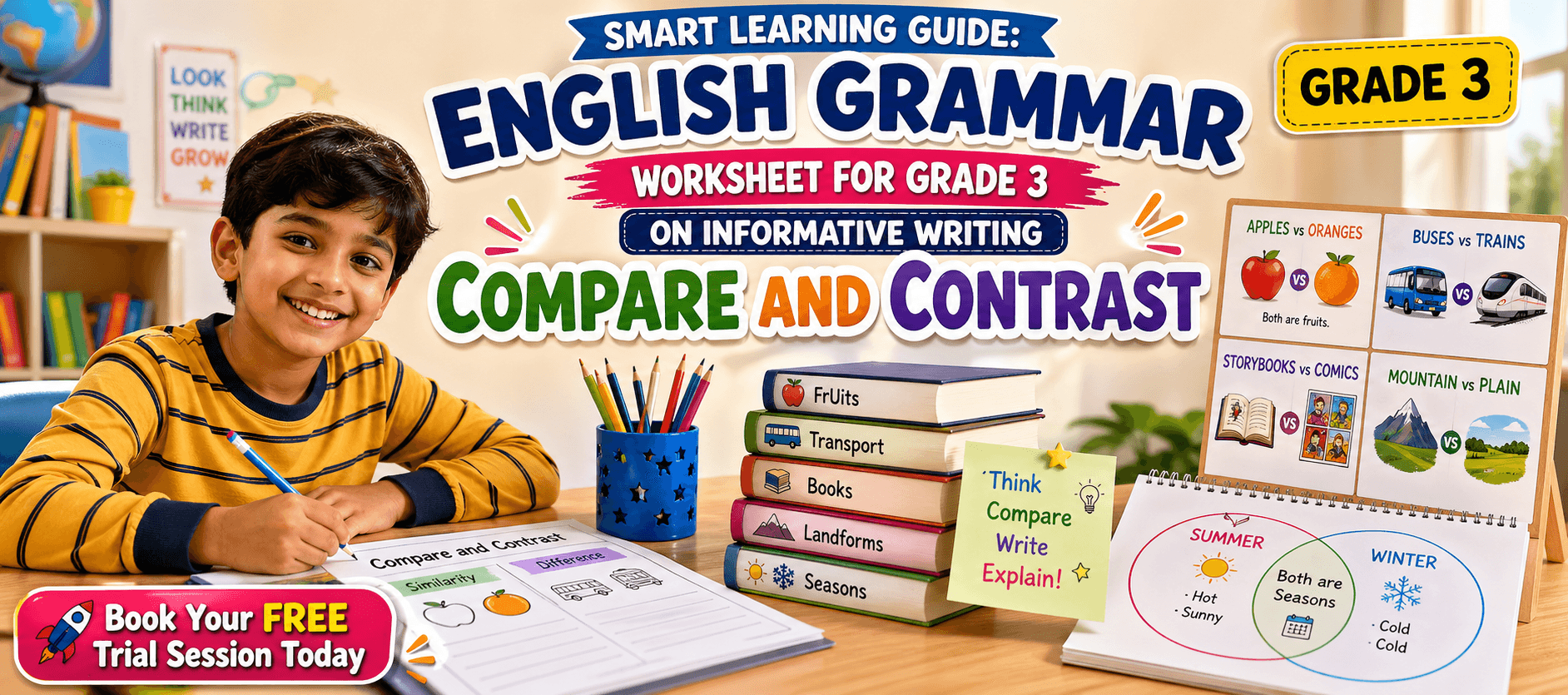
Smart Learning Guide: English Grammar Worksheet for Grade 3 on Informative Writing Compare and Contrast
Learning how to compare and contrast ideas helps young learners think carefully about similarities and differences between objects, places, and concepts. In Grade 3, students begin developing analytical thinking skills by observing details and explaining how two things are alike or different. This skill strengthens both writing and comprehension abilities.
This English grammar worksheet for Grade 3 on Informative Writing Compare and Contrast introduces students to structured comparison writing. Through engaging exercises, learners practice identifying similarities, differences, topic sentences, and conclusion sentences while comparing familiar items such as fruits, transport, books, landforms, and seasons.
Download these English grammar worksheets and practice regularly to strengthen your language skills and build a strong foundation. You can also book a free trial to get expert guidance and improve your reading, writing, and comprehension abilities. The worksheets are designed in a simple and structured way to help K–8 students learn grammar concepts easily and use them confidently in everyday communication.
What Is Compare And Contrast Writing?
Compare and contrast writing helps students examine two subjects and explain how they are similar and how they are different. In Grade 3, students learn to observe details carefully and organize their thoughts using clear sentences.
When comparing, students focus on similarities between two things. When contrasting, students explain differences. Informative compare-and-contrast writing helps learners present balanced information rather than opinions.
This worksheet teaches students to write topic sentences, identify similarities, explain differences, and conclude comparisons clearly.
What’s In This Worksheet?
1. Simple comparison activity identifying one similarity and one difference.
2. Structured paragraph writing using topic sentence, similarity, difference, and conclusion.
3. Practice comparing reading materials such as storybooks and comics.
4. Observation-based comparison of geographical landforms.
5. Compare-and-contrast paragraph writing using a Venn diagram.
6. Activities that develop logical thinking, organization skills, and informative writing confidence.
Definitions, Examples, Techniques, And Tips
Definitions
Compare means to find how two things are alike.
Contrast means to explain how two things are different.
Examples From The Worksheet
Students compare apples and oranges.
Students compare buses and trains using structured sentences.
Students compare storybooks and comics.
Students observe similarities and differences between mountains and plains.
Students compare summer and winter using a Venn diagram.
Techniques Used In The Worksheet
Writing clear topic sentences before comparisons.
Identifying similarities first and then differences.
Using structured formats to organize ideas.
Ending comparisons with a conclusion sentence.
Quick Learning Tips
Read both items carefully before comparing them.
Think about shared features and unique features.
Write short, clear sentences.
Follow the required structure given in each activity.
Why Is It Important To Learn This?
Compare and contrast writing strengthens observation and reasoning skills. Students learn how to analyze information instead of simply describing it.
This skill helps learners understand reading passages better, answer analytical questions in exams, and express ideas logically. It also improves writing organization and clarity.
Where Will This Knowledge Help You?
Students use compare-and-contrast skills in many learning situations:
During English exams requiring comparison questions.
In environmental studies and science lessons.
While participating in classroom discussions.
When explaining similarities and differences in daily learning.
How To Use This Worksheet?
1. Read each instruction carefully before starting.
2. Identify the two items being compared.
3. Think about one similarity and one difference clearly.
4. Follow the structure mentioned in each exercise.
5. Review your answers carefully after writing.
6. Compare your responses step by step because the solutions follow the exact worksheet order.
Important Tips And Tricks
1. Always mention both similarity and difference when required.
2. Begin with a topic sentence if instructed.
3. Keep comparisons clear and simple.
4. Do not mix similarities and differences in one sentence.
5. Use conclusion sentences to summarize comparisons.
6. Read your work again to ensure all instructions are followed.
Complete Answer Key
Exercise No. 1
Compare Apples and Oranges and write one similarity and one difference.
1 Similarity: Both apples and oranges are fruits.
2 Difference: Apples are usually red or green, while oranges are orange in colour.
Exercise No. 2
Compare Buses and Trains, write Topic Sentence, One Similarity, One Difference and then the Conclusion Sentence.
Topic Sentence: Buses and trains are common means of transport.
One Similarity: Both buses and trains carry passengers.
One Difference: Buses travel on roads, while trains travel on railway tracks.
Conclusion Sentence: Buses and trains help people travel from one place to another.
Exercise No. 3
Compare Storybooks and Comics, write Topic Sentence, One Similarity, One Difference and then the Conclusion Sentence.
Topic Sentence: Storybooks and comics are popular reading materials.
One Similarity: Both storybooks and comics tell stories.
One Difference: Storybooks mostly use text, while comics use pictures and speech bubbles.
Conclusion Sentence: Both storybooks and comics make reading enjoyable.
Exercise No. 4
Look at a picture of a Mountain and a Plain and write how they are similar and different.
Similarity: Both mountains and plains are landforms found on Earth.
Difference: Mountains are high and steep, while plains are flat and low.
Exercise No. 5
Use a Venn diagram of Summer and Winter to write a small compare-and-contrast paragraph.
Summer and winter are two different seasons. Both seasons are part of the yearly weather cycle. Summer is hot and sunny, while winter is cold. These seasons bring different weather conditions throughout the year.
Practicing this English grammar worksheet for Grade 3 on Informative Writing Compare and Contrast helps students learn how to analyze ideas clearly and present organized comparisons. With regular practice, learners become confident writers who can explain similarities and differences effectively.