
Complete Guide to Homophones, Homonyms & Homographs Grade 8
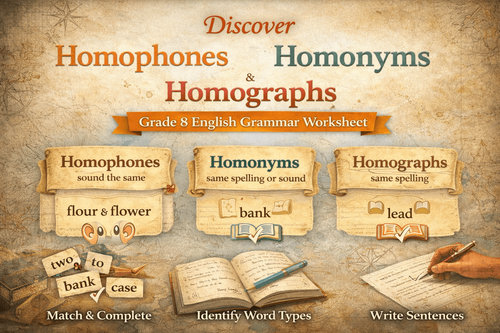

Discover Homophones Homonyms and Homographs Grade 8 English Grammar Worksheet
Learning English vocabulary can sometimes feel confusing, especially when different words sound the same or look the same but have completely different meanings. That is why practicing with a Discover Homophones Homonyms and Homographs Grade 8 worksheet is extremely helpful. In Grade 8 English grammar, students begin exploring how words can share spelling, pronunciation, or both, while carrying different meanings.
This English grammar worksheet focuses on identifying these tricky word types through matching exercises, sentence completion, and sentence writing activities. By working through the exercises, students develop stronger vocabulary skills and learn how context helps determine the correct meaning of a word.
What Is Homophones Homonyms and Homographs?
In English grammar, some words may look alike, sound alike, or even share the same spelling but represent different meanings. These words are classified into three categories: homophones, homonyms, and homographs.
Homophones are words that sound the same but have different spellings and meanings.
Homonyms are words that have the same spelling or pronunciation but carry different meanings.
Homographs are words that share the same spelling but may have different meanings and sometimes different pronunciations.
The Discover Homophones Homonyms and Homographs Grade 8 English grammar worksheet helps students understand these differences through practical exercises and sentence-based questions.
What’s in This Worksheet?
This English grammar worksheet includes a variety of exercises designed to strengthen vocabulary understanding and contextual word usage.
1. A word power matching activity where students connect words to their correct definitions.
2. Sentence completion tasks focusing on homophones.
3. Homonym exercises where students write two sentences showing different meanings of the same word.
4. Context-based word choice questions that require selecting the correct word from pairs.
5. Identification tasks where students determine whether a word is a homophone, homonym, or homograph.
6. Sentence writing activities to demonstrate multiple meanings of a word.
These activities help Grade 8 students improve reading comprehension, vocabulary recognition, and grammar accuracy.
Definitions, Examples, Techniques, and Tips
Homophones
Homophones are words that sound the same when spoken but have different spellings and meanings. These words often create confusion in writing.
Examples found in this worksheet include:
stationary and stationery
site, cite, sight
reel and real
Homonyms
Homonyms are words that share spelling or pronunciation but have different meanings depending on the context in which they are used.
Examples from the worksheet include:
strike
express
Homographs
Homographs are words that are spelled the same but have different meanings and sometimes different pronunciations.
Examples from the worksheet include:
bow
sole
tear
lie
A useful technique when solving these questions is to read the entire sentence carefully. Context clues usually indicate which word meaning is correct.
Why Is It Important to Learn This?
Understanding homophones, homonyms, and homographs helps students communicate more clearly in both writing and speaking.
These concepts improve vocabulary knowledge and prevent common spelling mistakes. They also help students understand that English words can have multiple meanings depending on the situation.
For Grade 8 students, learning these grammar concepts strengthens reading comprehension and prepares them for more advanced language learning.
Where Will This Knowledge Help You?
This knowledge supports students in many academic situations.
1. Grammar and vocabulary exams.
2. Reading comprehension passages.
3. Essay and creative writing assignments.
4. Classroom discussions and presentations.
5. Understanding word meaning in literature.
Recognizing homophones, homonyms, and homographs also improves everyday communication skills.
How to Use This Worksheet?
Students should follow a structured approach when completing this worksheet.
1. Read each question carefully before answering.
2. Understand the meaning of the sentence before selecting a word.
3. Complete each exercise independently.
4. Review answers after finishing the worksheet.
5. Compare responses carefully with the answer key.
The solutions below follow the exact order of the worksheet questions.
Important Tips and Tricks
1. Always read the full sentence before choosing a homophone.
2. Pay attention to context clues that indicate meaning.
3. Remember that homonyms can represent different meanings in different sentences.
4. When writing sentences, ensure each one clearly shows a different meaning.
5. Practice identifying these word types regularly to strengthen vocabulary skills.
Complete Answer Key
Exercise - 1
Word power
Match each word to its correct definition
1. complement — A word meaning to flatter or complete nicely
2. Incense — A strong-smelling substance burned for aroma
3. Capital — A city that serves as the seat of government
4. Peer — A person who is equal in status or ability
5. bass — A deep-voiced fish or a low musical tone
6. Desert — To leave or abandon someone/something
7. refuse — To decline or reject something
8. Tire — To become weary or an outer part of a wheel
9. watch — To observe something
10. spring — To jump / A water source
Exercise - 2
Part A: Homophones
1. The soldiers were told to __stationary__ during the commander’s briefing.
2. The lawyer will __cite__ several past cases to support her argument.
Part B: Homonyms
Strike
Sentence 1: The workers decided to strike for better wages.
Sentence 2: Lightning can strike a tall building during a storm.
Express
Sentence 1: She wanted to express her gratitude to the teacher.
Sentence 2: He took the express train to reach the city faster.
Exercise - 3
Choose the correct word from the pair in brackets to complete each sentence.
1. She tied the scroll with a golden __reel__ and placed it gently in the box.
2. The mountain climbers set up a temporary __site__ before continuing to the summit.
3. The actor took a dramatic __pause__ before delivering the final line.
4. Despite the storm, the old lighthouse continued to __beacon__ across the sea.
5. During the science experiment, the liquid began to __evaporate__ and release fumes.
6. The new policy will not __affect__ until next semester begins.
7. The antique shop owner decided to __appraise__ the vase for its true market value.
Exercise - 4
Use the sentence and the visual clue description to determine the correct word. Then identify whether the word is a homophone, homonym, or homograph.
1. The poet decided to __send__ a message to his friend.
Type: Homonym
2. The sailor will __steer__ the boat towards the shore.
Type: Homophone
3. I found an old movie __reel__ in my grandmother’s attic.
Type: Homograph
4. The trees began to __bow__ under the force of the wind.
Type: Homograph
5. His careless remark seemed to __anger__ her beyond reason.
Type: Homonym
6. The lawyer will present the legal __case__ in court tomorrow.
Type: Homonym
Exercise - 5
Write two different sentences to show its multiple meanings or usage.
1. Bow
Type: Homograph
Sentence: The musician tightened the bow before playing the violin.
2. Sole
Type: Homonym
Sentence: The sole of my shoe became thin after the long walk.
3. Lie
Type: Homograph
Sentence: Please lie down and rest for a while.
4. Tear
Type: Homograph
Sentence: A tear rolled down her cheek when she heard the emotional story.
Practicing with this Discover Homophones Homonyms and Homographs Grade 8 English grammar worksheet helps students recognize how similar-looking or similar-sounding words function differently depending on context. With consistent practice, learners can improve vocabulary, strengthen grammar skills, and gain confidence in both written and spoken English.