
Context Clue Synonym Practice Worksheet for Grade 8
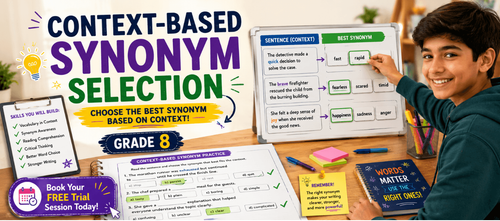

Build Strong Vocabulary Skills with This Grade 8 English Grammar Worksheet on Context-Based Synonym Selection
Learning synonyms helps students improve vocabulary, understand passages better, and communicate ideas more effectively. This Grade 8 English grammar worksheet on Context-Based Synonym Selection is designed to help students identify words with similar meanings by using context clues from sentences. Through engaging exercises, students practice understanding emotions, tone, and sentence meaning while improving grammar and language fluency.
The worksheet includes multiple-choice questions, fill in the blanks, true and false activities, grammar identification exercises, and sentence writing tasks. Students learn how synonyms can improve sentence variety and make communication clearer and more expressive. By practicing these exercises regularly, students can become more confident readers and writers.
Download these English grammar worksheets and practice regularly to strengthen your language skills and build a strong foundation. You can also book a free trial to get expert guidance and improve your reading, writing, and comprehension abilities. The worksheets are designed in a simple and structured way to help K–8 students learn grammar concepts easily and use them confidently in everyday communication.
What Is the Topic?
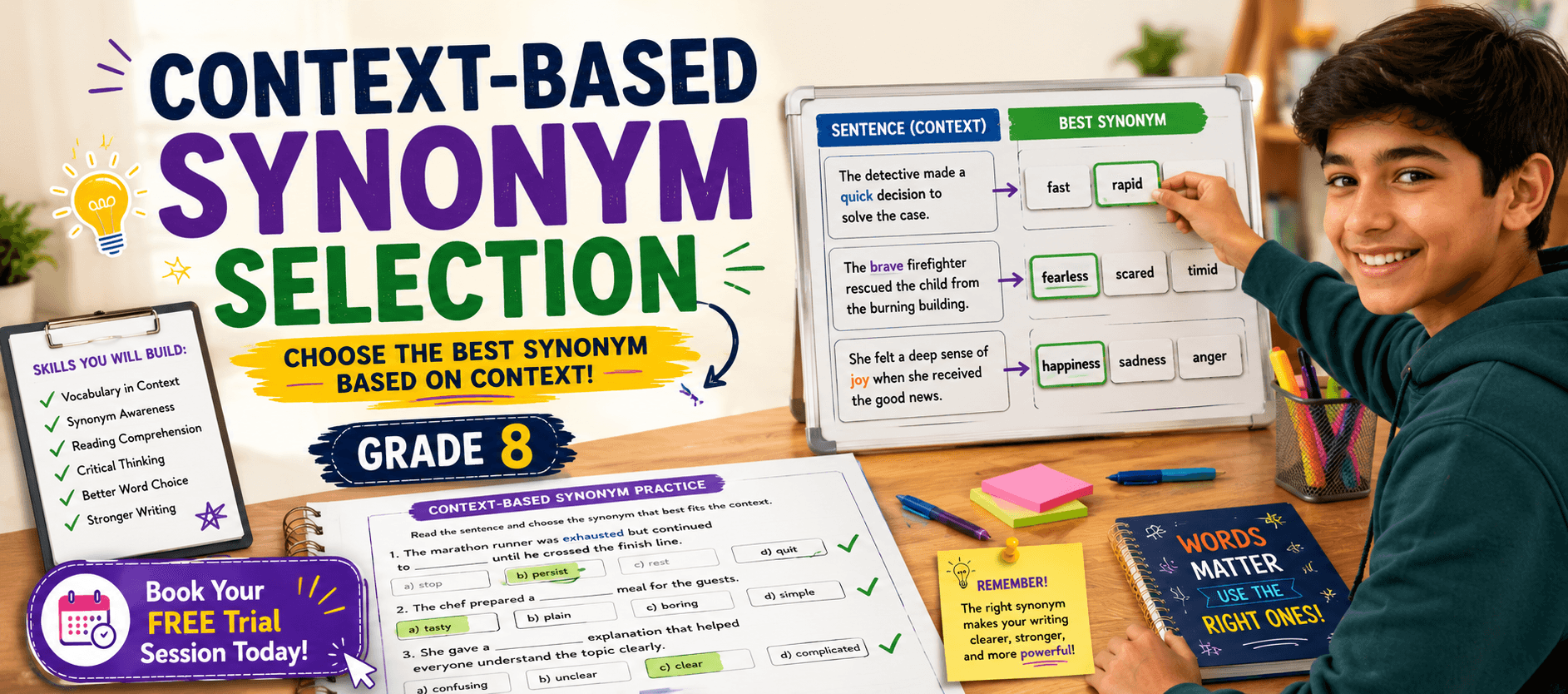
Context-Based Synonym Selection focuses on identifying words with similar meanings according to sentence context. Synonyms are words that share related meanings, but students must carefully choose the most suitable synonym depending on the sentence.
This Grade 8 English grammar worksheet teaches students how to:
- Understand word meanings through context clues
- Identify suitable synonyms in sentences
- Improve vocabulary usage
- Develop stronger comprehension skills
- Use expressive language in writing and speaking
Students also learn how mood, tone, and descriptive vocabulary affect sentence meaning. The worksheet encourages careful reading and vocabulary understanding through structured activities.
What’s in This Worksheet?
1. Multiple-choice questions that help students choose the correct synonym according to sentence meaning.
2. Fill in the blanks activities that strengthen vocabulary understanding using context clues and a word bank.
3. True and false statements that test understanding of synonyms, vocabulary, and sentence meaning.
4. Underline the noun and circle the verb exercises to improve grammar identification skills.
5. Sentence writing activities that help students use vocabulary words correctly in meaningful sentences.
6. Context-based vocabulary practice that improves comprehension and expression skills.
7. Structured exercises that support classroom learning and exam preparation.
Definitions, Examples, Techniques, and Tips
Synonyms are words that have similar meanings. Students use context clues to determine which synonym best fits a sentence.
Examples from the worksheet include:
- joyful
- gloomy
- hopeful
- nervous
- eager
- calm
- fearless
- delighted
The worksheet also teaches students to understand sentence mood and emotional vocabulary.
Examples from the worksheet:
- “The crowd felt ______ after the unexpected announcement.”
- “The conclusion appeared ______ to readers.”
- “The poem created a ______ feeling among readers.”
Context clues help students understand the emotional tone and meaning of the sentence before selecting the correct synonym.
Quick learning tips:
- Read the complete sentence carefully before answering.
- Identify emotional or descriptive clues in the sentence.
- Choose the synonym that best matches the context.
- Practice sentence writing regularly to improve vocabulary usage.
- Pay attention to tone and mood while reading passages.
Why Is It Important to Learn This?
Learning synonyms helps students improve both spoken and written communication. Students can avoid repeating the same words and make their writing more expressive and meaningful.
This topic helps students:
- Improve reading comprehension
- Build a stronger vocabulary
- Understand emotions and tone in passages
- Write more effectively
- Communicate ideas clearly
Context-based synonym practice is also important for grammar exercises, comprehension passages, essays, and classroom discussions. Students who understand vocabulary relationships can read and write with greater confidence.
Where Will This Knowledge Help You?
Students can use synonym skills in many academic and practical situations.
1. Exams and tests
Understanding synonyms helps students answer vocabulary and comprehension questions correctly.
2. Writing activities
Students can improve stories, essays, and paragraphs using better vocabulary choices.
3. Reading comprehension
Context clues and synonym understanding improve passage interpretation.
4. Classroom participation
Students can confidently explain ideas using varied vocabulary.
5. Everyday communication
Better vocabulary helps students express their thoughts more clearly and effectively.
How to Use This Worksheet?
1. Read each sentence carefully before selecting an answer.
2. Attempt all exercises independently first.
3. Use context clues to identify the correct synonym.
4. Review the answer key after completing the worksheet.
5. Compare answers carefully in the exact worksheet order.
6. Correct mistakes and understand why a word fits the sentence.
7. Practice vocabulary words regularly for better fluency.
8. Revise emotional and descriptive words frequently.
9. Focus on understanding sentence mood and meaning.
10. Remember that the solutions follow the exact worksheet order, so students should compare answers carefully.
Important Tips and Tricks
1. Look for emotional clues in the sentence before choosing a synonym.
2. Understand the sentence meaning completely before answering.
3. Do not choose words that sound similar but change the meaning of the sentence.
4. Use context clues to identify the most suitable synonym.
5. Practice vocabulary regularly to improve fluency and confidence.
6. While writing sentences, make sure the word fits naturally in the sentence.
7. Avoid repeating simple words in writing when better vocabulary can be used.
8. Carefully identify nouns and verbs during grammar exercises.
9. Examiners expect students to understand sentence meaning and vocabulary context correctly.
10. Writing practice improves vocabulary retention and sentence formation skills.
Complete Answer Key
Exercise No. 1
1. b) delighted
2. a) sincere
3. a) gloomy
4. a) serious
5. a) hopeful
6. a) nervous
7. a) fearless
8. a) delighted
9. a) eagerly
10. a) joyful
Exercise No. 2
1. joyfulness
2. nervously
3. fearlessly
4. gloominess
5. thankfully
6. carelessly
7. eagerness
8. cheerfully
9. confidently
10. hopefulness
Exercise No. 3
1. True
2. False
3. True
4. True
5. True
6. True
7. False
8. True
9. True
10. True
Exercise No. 4
1. warmly
2. gloomy
3. confidently
4. calmly
5. anxiously
6. proudly
7. joyful
8. tense
9. hopefully
10. cheerfully
Exercise No. 5
1. Write a sentence using the word joyful.
The children felt joyful during the annual celebration.
2. Write a sentence using the word honest.
Ravi gave an honest answer during the discussion.
3. Write a sentence using the word gloomy.
The weather looked gloomy before the storm.
4. Write a sentence using the word nervous.
Meera felt nervous before her performance.
5. Write a sentence using the word bright.
The classroom looked bright in the morning sunlight.
6. Write a sentence using the word calm.
The teacher remained calm during the activity.
7. Write a sentence using the word eager.
Students were eager to participate in the competition.
8. Write a sentence about classroom learning.
Students listened carefully during classroom learning activities.
9. Write a sentence about heavy rainfall.
Heavy rainfall flooded the playground yesterday.
10. Write a sentence about a school competition.
Riya practiced daily for the school competition.
Practicing context-based synonym selection regularly can help students improve vocabulary, comprehension, and writing skills. This Grade 8 English grammar worksheet provides structured activities that encourage students to think carefully about word meanings and sentence context. With regular practice, students can become more confident readers, writers, and communicators.
Book a free trial!