
Contractions vs Possessives: Class 5 Editing Practice (PDF)
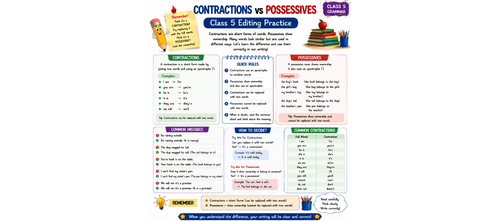

Title: It’s vs Its, They’re vs Their: Grade 5 English Grammar Worksheet on Contractions vs Possessives
Have you ever been confused about whether to write “it’s” or “its”? Or “they’re” or “their”? These are some of the most common grammar mistakes. In Grade 5, learning to avoid incorrect use of contractions vs possessives helps you write clearly and correctly. “It’s” is a contraction meaning “it is” or “it has.” “Its” is the possessive form of “it” (showing ownership). “They’re” is a contraction for “they are.” “Their” is a possessive pronoun meaning “belonging to them.” This Grade 5 English grammar worksheet on editing incorrect use of contractions vs possessives will teach you the difference and help you avoid these common errors.
Download these English grammar worksheets and practice regularly to strengthen your language skills and build a strong foundation. You can also book a free trial to get expert guidance and improve your reading, writing, and comprehension abilities. The worksheets are designed in a simple and structured way to help K–8 students learn grammar concepts easily and use them confidently in everyday communication.
Book a free trial!
What Is the Topic?
The topic of this worksheet is Editing: Incorrect Use of Contractions vs Possessives. Contractions are shortened forms of two words. An apostrophe shows where letters have been left out. For example, “it is” becomes “it’s” (apostrophe replaces the “i” in “is”). “They are” becomes “they’re” (apostrophe replaces the “a”). Possessives show ownership. For most nouns, add an apostrophe + s (‘s) for singular possession. For example, “the dog’s bone” (one dog). For plural nouns ending in s, add only an apostrophe (s’). For example, “the dogs’ toys” (many dogs). The possessive form of “it” is “its” – no apostrophe. “It’s” is the contraction, not the possessive. The possessive form of “they” is “their” – no apostrophe. “They’re” is the contraction. Understanding the difference between contractions and possessives helps you avoid very common writing errors.
Book a free trial!
What’s in This Worksheet?
This worksheet contains five different exercises that help students master the difference between contractions and possessives. Here is what is included:
1. Exercise No. 1 – Multiple Choice Questions – Students read each sentence and choose the correct option (contraction or possessive). This exercise tests basic understanding of common confusing pairs.
2. Exercise No. 2 – True and False – Students read ten statements about contractions and possessives and decide whether each one is true or false. This helps correct common misunderstandings.
3. Exercise No. 3 – Fill in the Blanks – Students read sentences and choose the correct word (it’s/its, they’re/their, etc.) to complete each sentence. This exercise practices applying the rules.
4. Exercise No. 4 – Sentence Rewriting – Students read sentences and correct errors with contractions and possessives. This exercise focuses on identifying and fixing mistakes.
5. Exercise No. 5 – Paragraph Writing – Students read a paragraph and correct any errors related to contractions and possessives. This combines reading comprehension with grammar application.
This worksheet supports exam preparation by covering the most commonly confused pairs: it’s/its, they’re/their, and possessive apostrophes.
Book a free trial!
Definitions, Examples, Techniques, and Tips
Based only on the content of this worksheet, here are the exact definitions and examples students will learn:
Rules for Contractions vs Possessives:
- It’s vs Its: “It’s” is a contraction of “it is” or “it has.” “Its” is the possessive form of “it” (shows ownership). Example: “It’s raining” (it is raining). “The dog wagged its tail” (the tail belongs to the dog).
- They’re vs Their vs There: “They’re” is a contraction of “they are.” “Their” is a possessive pronoun meaning “belonging to them.” “There” refers to a place. Example: “They’re going to the park.” “They parked their car.”
- You’re vs Your: “You’re” is a contraction of “you are.” “Your” is a possessive pronoun meaning “belonging to you.”
- Who’s vs Whose: “Who’s” is a contraction of “who is” or “who has.” “Whose” is a possessive pronoun.
- Possessive nouns: For singular nouns, add ‘s (the boy’s shoes, the dog’s tail). For plural nouns ending in s, add only ‘ (the cats’ toy, the teachers’ book).
Examples taken directly from the worksheet (Exercise No. 1 – multiple choice):
1. (a) It’s raining. (b) Its raining
Correct answer: a) It’s raining.
2. (a) The dog wagged its tail. (b) The dog wagged it’s tail.
Correct answer: a) The dog wagged its tail.
3. (a) She’s my best friend. (b) She’s my best friend. (Both are the same – correct)
Correct answer: a) She’s my best friend.
4. (a) I cant believe it! (b) I can’t believe it!
Correct answer: b) I can’t believe it!
5. (a) The cat licked its paws. (b) The cat licked it’s paws.
Correct answer: a) The cat licked its paws.
6. (a) Im going to the store. (b) I’m going to the store.
Correct answer: b) I’m going to the store.
7. (a) The boy’s shoes are blue. (b) The boys shoes are blue.
Correct answer: a) The boy’s shoes are blue.
8. (a) We’re going to the movies. (b) Were going to the movies.
Correct answer: a) We’re going to the movies.
9. (a) Its the dog’s toy. (b) It’s the dog’s toy.
Correct answer: b) It’s the dog’s toy.
10. (a) They’re friends with my brother. (b) They’re friends with my brother. (Both are the same – correct)
Correct answer: a) They’re friends with my brother.
Key facts from True and False section (Page 5):
- “It’s” is used to show possession. (False – “it’s” is a contraction; “its” shows possession)
- “Its” is a contraction of “it is” or “it has.” (False – “it’s” is the contraction)
- “It’s” always shows ownership. (False – “it’s” means “it is” or “it has”)
- “Its” is the possessive form of “it.” (True)
- Possessive nouns show ownership, like “dog’s bone.” (True)
- The apostrophe in “it’s” indicates possession. (False – it indicates a contraction)
- Contractions always combine two words into one word, with an apostrophe replacing the omitted letters. (True)
- The apostrophe in “boys” shows possession for multiple owners. (False – “boys’” with apostrophe after s shows possession; “boys” without apostrophe is just plural)
- “It’s” can be used for something that belongs to “it.” (False – “its” is used for belonging)
- “It’s” can be used for something that belongs to “it.” (False – repeated)
Examples from Exercise No. 3 – Fill in the blanks (Page 6 – choose correct word):
1. The dog wagged its tail.
2. He said they’re going to the park.
3. The cat lost its collar.
4. She can’t find her keys.
5. It’s the best book I’ve read!
6. The teacher gave his notebook to the student.
7. We went to their house for the party.
8. The girl’s dress was beautiful. Hers was my favorite.
9. The dog’s bone is under the bed. It’s very hard.
10. The dog’s bone is under the bed. It’s very hard.
Examples from Exercise No. 4 – Sentence Rewriting (Pages 7 and 8 – correct errors):
1. They’re going home now.
2. The cat’s toy is under the couch. (assuming one cat – if multiple cats, “cats’ toy”)
3. She said that it’s her book. (No error – correct)
4. The teacher’s book is on the table.
5. I’m not sure if it’s going to rain today.
6. His brother’s toys are scattered around the room. (one brother – if multiple, “brothers’ toys”)
7. It’s your turn to play. (No error)
8. The dog chased its tail. (No error)
9. I don’t know where my keys are.
10. They’re always on time. (No error)
Example from Exercise No. 5 – Paragraph (Page 9) – correct errors:
Original paragraph with errors underlined and corrected:
It was a beautiful Saturday morning, and we were excited for the day ahead. I was supposed to meet my friend at the park, but I couldn’t find my dog’s leash anywhere. I searched the living room, the hallway, and the garage, but it’s (→ it was – or change to “it was”) nowhere to be found. My brother said he hasn’t seen it, but I don’t believe him. He’s always hiding things from me. My dog’s favorite toy is also missing, and I’m worried that it’s lost as well. I’m not sure where its (→ it’s – “it is”) gone. I decided to call my cousin, who always helps me with the dog, and she said that we should check the backyard. “Maybe it’s out there,” she said. We searched the yard, and sure enough, there was the leash hanging from the fence. It was such a relief to find it. We got the dog’s toys, and then we headed to the park to play. It’s his favorite place, and he’s always so happy when we go there.
Other errors in the original: “it’s nowhere to be found” – if meaning “it was,” change to “it was.” If using contraction, “it’s” means “it is,” which could work but slightly changes meaning. “I’m not sure where its gone” – “its” should be “it’s” (it has gone). The corrected paragraph should read:
Corrected paragraph:
It was a beautiful Saturday morning, and we were excited for the day ahead. I was supposed to meet my friend at the park, but I couldn’t find my dog’s leash anywhere. I searched the living room, the hallway, and the garage, but it was nowhere to be found. My brother said he hasn’t seen it, but I don’t believe him. He’s always hiding things from me. My dog’s favorite toy is also missing, and I’m worried that it’s lost as well. I’m not sure where it’s gone. I decided to call my cousin, who always helps me with the dog, and she said that we should check the backyard. “Maybe it’s out there,” she said. We searched the yard, and sure enough, there was the leash hanging from the fence. It was such a relief to find it. We got the dog’s toys, and then we headed to the park to play. It’s his favorite place, and he’s always so happy when we go there.
Quick learning tip: Replace the word with “it is” or “it has.” If the sentence still makes sense, use “it’s.” If not, use “its.” Example: “It’s raining” → “It is raining” (works). “The dog wagged its tail” → “The dog wagged it is tail” (does not work). So “its” is correct.
Book a free trial!
Why Is It Important to Learn This?
Learning about contractions vs possessives is important for several reasons. First, “it’s” is a contraction meaning “it is,” while “its” shows possession. Using “it’s” for possession (“the dog wagged it’s tail”) is a very common mistake. Second, “they’re” means “they are,” while “their” shows possession. “They’re going to their house” – the two different words have different jobs. Third, possessive nouns show ownership, like “dog’s bone.” The apostrophe is in the right place. Fourth, this topic is tested in grammar exams where you may be asked to choose the correct word or correct errors. Finally, using these words correctly makes your writing look professional and avoids confusion.
Book a free trial!
Where Will This Knowledge Help You?
Knowledge of contractions vs possessives will help you in many academic and real-life situations:
1. Grammar exams and language tests – Many questions ask you to choose between “it’s” and “its” or “they’re” and “their.” This worksheet directly prepares you for those questions.
2. Writing essays and stories – Using “its” and “it’s” correctly makes your writing look polished. “The dog wagged its tail” (correct) vs “The dog wagged it’s tail” (incorrect).
3. Avoiding common errors – “It’s” vs “its” is one of the most common mistakes in English writing. Learning the rule helps you stand out as a good writer.
4. Understanding what you read – If you see “it’s,” you know it means “it is” or “it has.” If you see “its,” you know it shows possession.
5. Building a strong grammar foundation – These confusing pairs are basic grammar. Mastering them is essential for good writing.
6. Using apostrophes correctly – Knowing that possessive “its” has no apostrophe, while contraction “it’s” does, helps you understand how apostrophes work in general.
Book a free trial!
How to Use This Worksheet?
Follow these steps to get the most out of this Grade 5 English grammar worksheet on editing incorrect use of contractions vs possessives:
1. Attempt independently first – Without looking at any answers, complete all five exercises in order. Start with Exercise No. 1 (Multiple Choice Questions), then Exercise No. 2 (True and False), then Exercise No. 3 (Fill in the Blanks), then Exercise No. 4 (Sentence Rewriting), and finally Exercise No. 5 (Paragraph Writing – correct errors).
2. Review answers carefully – After you finish all exercises, go to the Complete Answer Key section below. Compare your answers one by one. Pay special attention to Exercise No. 5 – make sure you corrected all the “its/it’s” errors.
3. Correct mistakes – For any answer that is different from the answer key, write the correct answer next to your attempt. Try to understand why you made the mistake. Did you use “it’s” for possession?
4. Practice regularly – Contractions vs possessives take practice. Repeat the worksheet after a few days. For the paragraph correction task (Exercise No. 5), try to find all the errors without looking at the answer key first.
The solutions follow the exact worksheet order. Students should compare their answers carefully.
Book a free trial!
Important Tips and Tricks
Here are important tips and tricks based directly on this worksheet to help you master contractions vs possessives and score full marks:
1. The “it is” test for “it’s” – Replace “it’s” with “it is” or “it has.” If the sentence still makes sense, use “it’s.” If not, use “its.” “It’s raining” → “It is raining” (works). “The dog wagged its tail” → “The dog wagged it is tail” (does not work).
2. “Its” shows possession, no apostrophe – This is the exception to the possessive rule. Most possessives use an apostrophe (dog’s, cat’s, boy’s), but “its” does NOT have an apostrophe. The apostrophe in “it’s” means “it is.”
3. “They’re” vs “their” vs “there” – “They’re” = “they are.” “Their” = belonging to them. “There” = a place. “They’re going to their house over there.”
4. “You’re” vs “your” – “You’re” = “you are.” “Your” = belonging to you. “You’re going to your friend’s house.”
5. “Who’s” vs “whose” – “Who’s” = “who is” or “who has.” “Whose” = belonging to whom. “Who’s coming to the party? Whose book is this?”
6. Possessive apostrophes – For singular nouns, add ‘s (the boy’s shoes, the dog’s tail). For plural nouns ending in s, add only ‘ (the cats’ toys, the teachers’ book). For irregular plurals (children), add ‘s (the children’s toys).
7. What examiners expect – Examiners expect you to know that “it’s” is a contraction for “it is” and “its” is the possessive form of “it.” They expect you to know that “they’re” is a contraction for “they are” and “their” is a possessive pronoun. They expect you to correct errors like “it’s tail” (should be “its tail”) and “its raining” (should be “it’s raining”).
8. How to score full marks – When answering multiple-choice questions, apply the “it is” test. If the sentence works with “it is,” choose “it’s.” If not, choose “its.” For possessives, remember that “dog’s” means belonging to one dog; “dogs’” means belonging to many dogs.
9. For sentence rewriting (Exercise No. 4) – Read each sentence. Look for “it’s” and “its.” If “it’s” is used and “it is” does not fit, change to “its.” If “its” is used and “it is” would fit, change to “it’s.” Also check for “they’re” vs “their” and possessive apostrophes.
10. For paragraph correction (Exercise No. 5) – Read the paragraph slowly. Look for every “its” and “it’s.” Apply the “it is” test. Also look for possessive apostrophes (dog’s, brother’s, etc.) and make sure they are in the right place.
Book a free trial!
Complete Answer Key
Below is the complete answer key for the Grade 5 English grammar worksheet on Editing: Incorrect Use of Contractions vs Possessives. The answers follow the exact order of the worksheet. Section names and question numbers are reproduced exactly as they appear in the worksheet.
Exercise No. 1
Choose the option with the correct use of contraction or possessive.
1. (a) It’s raining. (b) Its raining
Answer: a) It’s raining.
2. (a) The dog wagged its tail. (b) The dog wagged it’s tail.
Answer: a) The dog wagged its tail.
3. (a) She’s my best friend. (b) She’s my best friend.
Answer: a) She’s my best friend.
4. (a) I cant believe it! (b) I can’t believe it!
Answer: b) I can’t believe it!
5. (a) The cat licked its paws. (b) The cat licked it’s paws.
Answer: a) The cat licked its paws.
6. (a) Im going to the store. (b) I’m going to the store.
Answer: b) I’m going to the store.
7. (a) The boy’s shoes are blue. (b) The boys shoes are blue.
Answer: a) The boy’s shoes are blue.
8. (a) We’re going to the movies. (b) Were going to the movies.
Answer: a) We’re going to the movies.
9. (a) Its the dog’s toy. (b) It’s the dog’s toy.
Answer: b) It’s the dog’s toy.
10. (a) They’re friends with my brother. (b) They’re friends with my brother.
Answer: a) They’re friends with my brother.
Exercise No. 2
True and False. Write True or False for each statement.
1. “It’s” is used to show possession.
Answer: False
2. “Its” is a contraction of “it is” or “it has.”
Answer: False
3. “It’s” always shows ownership.
Answer: False
4. “Its” is the possessive form of “it.”
Answer: True
5. Possessive nouns show ownership, like “dog’s bone.”
Answer: True
6. The apostrophe in “it’s” indicates possession.
Answer: False
7. Contractions always combine two words into one word, with an apostrophe replacing the omitted letters.
Answer: True
8. The apostrophe in “boys” shows possession for multiple owners.
Answer: False
9. “It’s” can be used for something that belongs to “it.”
Answer: False
10. “It’s” can be used for something that belongs to “it.”
Answer: False
Exercise No. 3
Choose the correct word to complete each sentence.
1. The dog wagged its tail.
2. He said they’re going to the park.
3. The cat lost its collar.
4. She can’t find her keys.
5. It’s the best book I’ve read!
6. The teacher gave his notebook to the student.
7. We went to their house for the party.
8. The girl’s dress was beautiful. Hers was my favorite.
9. The dog’s bone is under the bed. It’s very hard.
10. The dog’s bone is under the bed. It’s very hard.
Exercise No. 4
Rewrite each sentence correctly.
1. They’re going home now.
2. The cat’s toy is under the couch.
3. She said that it’s her book. (No change)
4. The teacher’s book is on the table.
5. I’m not sure if it’s going to rain today.
6. His brother’s toys are scattered around the room.
7. It’s your turn to play. (No change)
8. The dog chased its tail. (No change)
9. I don’t know where my keys are.
10. They’re always on time. (No change)
Exercise No. 5
Read the paragraph below and correct any errors related to contractions and possessives.
Corrected paragraph:
It was a beautiful Saturday morning, and we were excited for the day ahead. I was supposed to meet my friend at the park, but I couldn’t find my dog’s leash anywhere. I searched the living room, the hallway, and the garage, but it was nowhere to be found. My brother said he hasn’t seen it, but I don’t believe him. He’s always hiding things from me. My dog’s favorite toy is also missing, and I’m worried that it’s lost as well. I’m not sure where it’s gone. I decided to call my cousin, who always helps me with the dog, and she said that we should check the backyard. “Maybe it’s out there,” she said. We searched the yard, and sure enough, there was the leash hanging from the fence. It was such a relief to find it. We got the dog’s toys, and then we headed to the park to play. It’s his favorite place, and he’s always so happy when we go there.
Book a free trial!
You have now completed the entire worksheet on editing incorrect use of contractions vs possessives. “It’s” is a contraction meaning “it is” or “it has.” “Its” is the possessive form of “it” (no apostrophe). “They’re” is a contraction for “they are.” “Their” is a possessive pronoun. Remember the “it is” test: if you can replace the word with “it is” or “it has,” use “it’s.” If not, use “its.” Possessive nouns show ownership: “the dog’s tail” (one dog), “the dogs’ tails” (many dogs). Keep practicing, and soon you will never confuse “it’s” and “its” again. You are building skills that will make your writing correct, clear, and professional in Grade 5 and beyond.
Book a free trial!