
Countable and Uncountable Nouns Practice Exercises for Grade 5
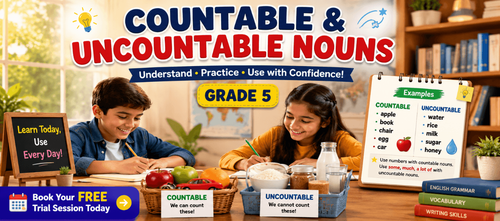

Countable and Uncountable Nouns with This English Grammar Worksheet for Grade 5
Learning countable and uncountable nouns can be fun and exciting when students practice through engaging activities and exercises. This English grammar worksheet for Grade 5 helps students understand how to identify nouns that can be counted and nouns that cannot be counted individually. Through sorting activities, fill in the blanks, sentence correction, and sentence writing tasks, students get plenty of practice using countable and uncountable nouns correctly in everyday English.
This Grade 5 worksheet on Countable and Uncountable Nouns is designed in a simple and student-friendly way so learners can easily understand the topic and improve their grammar skills. By practicing these exercises carefully, students can build confidence in sentence formation, grammar usage, reading, and writing. The activities also help students improve their classroom participation and exam performance.
Download these English grammar worksheets and practice regularly to strengthen your language skills and build a strong foundation. You can also book a free trial to get expert guidance and improve your reading, writing, and comprehension abilities. The worksheets are designed in a simple and structured way to help K–8 students learn grammar concepts easily and use them confidently in everyday communication.
What Is the Topic?
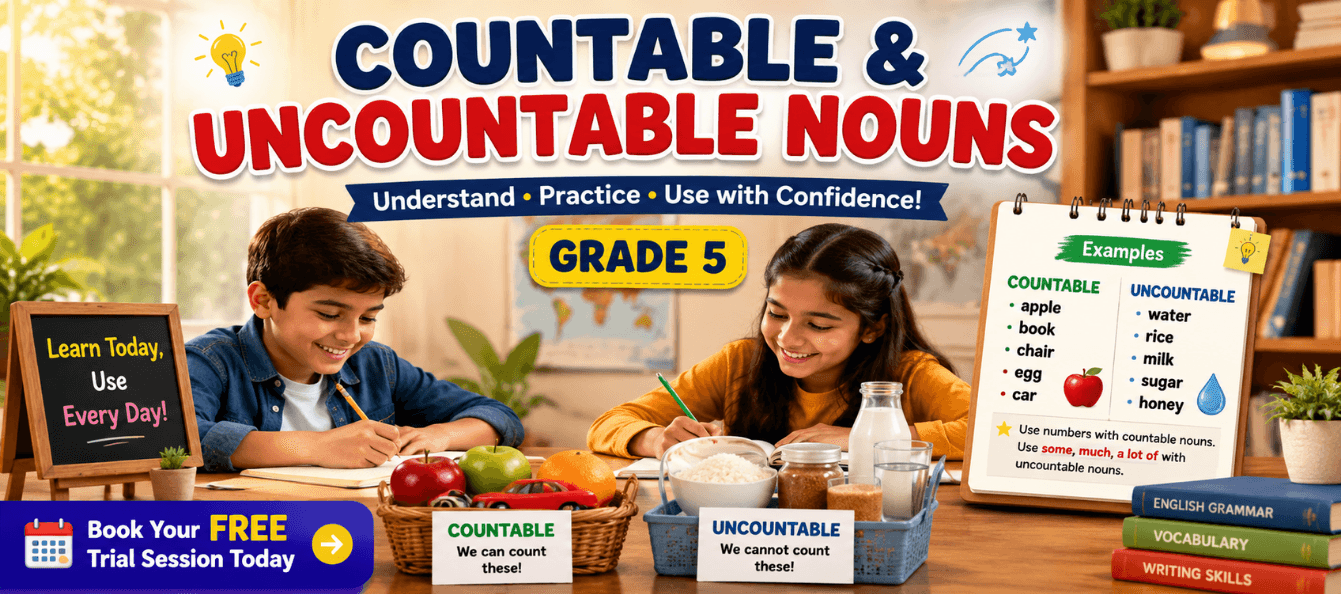
Countable and uncountable nouns are important parts of English grammar. Countable nouns are nouns that can be counted as one, two, three, and more. These nouns usually have singular and plural forms. Examples from the worksheet include pencil, chair, bottle, egg, biscuit, and car.
Uncountable nouns are nouns that cannot be counted individually. These nouns usually do not have plural forms. Examples from the worksheet include water, rice, sugar, milk, honey, and coffee.
In this English grammar worksheet for Grade 5, students learn how to:
• Identify countable nouns
• Identify uncountable nouns
• Use nouns correctly in sentences
• Rewrite incorrect sentences
• Form their own sentences using nouns
• Understand the difference between singular and plural usage
What’s in This Worksheet?
1. Sorting Exercise
Students sort nouns into countable nouns and uncountable nouns using the given word box.
2. Circle and Underline Activity
Students underline the countable nouns and circle the uncountable nouns in sentences.
3. Fill in the Blanks
Students complete sentences using suitable countable or uncountable nouns.
4. Rewrite the Sentences
Students identify incorrect noun usage and rewrite sentences correctly.
5. Sentence Formation
Students choose nouns and write their own sentences using them correctly.
6. Grammar Practice for Exams
The worksheet helps students practice noun identification, sentence correction, and proper grammar usage commonly asked in school exams.
Definitions, Examples, Techniques, and Tips
Definition of Countable Nouns:
Things you can count as one, two, three, etc. come under countable nouns.
Examples:
• notebooks
• apples
• stars
• cows
• eggs
Definition of Uncountable Nouns:
Things you cannot count individually come under uncountable nouns.
Examples:
• water
• rice
• sugar
• milk
• soup
Examples From the Worksheet:
• I have three notebooks in my bag.
• Please give me some water.
Techniques to Learn Easily:
• If you can count something separately, it is usually a countable noun.
• If something cannot be counted individually, it is usually an uncountable noun.
• Countable nouns often use numbers.
• Uncountable nouns often use words like some, much, or a glass of.
Quick Learning Tips:
• Read every sentence carefully.
• Look for clue words like many, some, much, two, five, and a lot of.
• Practice rewriting incorrect sentences regularly.
• Use nouns in your own sentences to remember them better.
Why Is It Important to Learn This?
Learning countable and uncountable nouns is important because these nouns are used in daily communication. Students use them while speaking, reading, and writing English sentences. Understanding noun usage helps students avoid grammar mistakes and improves sentence clarity.
This grammar topic also helps students:
• Write better sentences
• Improve communication skills
• Build confidence in grammar
• Use singular and plural nouns correctly
• Perform better in English exams
Countable and uncountable nouns are commonly used in conversations, essays, worksheets, and comprehension passages. Regular practice helps students become more confident English speakers and writers.
Where Will This Knowledge Help You?
Students will use countable and uncountable nouns in many situations, such as:
• School grammar tests
• Writing paragraphs and essays
• Classroom speaking activities
• Reading comprehension exercises
• Daily English conversations
• Homework assignments
• Sentence correction tasks
Understanding noun usage also helps students speak more clearly and write grammatically correct answers during exams and classroom activities.
How to Use This Worksheet?
1. Read the Instructions Carefully
Go through every question properly before answering.
2. Attempt the Exercises Independently
Try solving each activity on your own first to improve understanding.
3. Follow the Correct Question Order
Answer every question according to the serial number and worksheet order.
4. Review the Answers Carefully
Check countable and uncountable nouns again after completing each exercise.
5. Correct Mistakes
Rewrite incorrect answers neatly and correctly.
6. Practice Regularly
Repeat similar exercises to strengthen grammar skills.
7. Compare Answers Properly
The solutions follow the exact worksheet order, so students should compare answers carefully line by line.
Important Tips and Tricks
1. Countable nouns can usually become plural.
Example: apple → apples
2. Uncountable nouns usually do not take plural forms.
Example: rice, sugar, milk
3. Do not use numbers directly with uncountable nouns.
Incorrect: two waters
Correct: two glasses of water
4. Read clue words carefully.
Words like many and few usually go with countable nouns.
Words like much and some usually go with uncountable nouns.
5. In sentence correction exercises, check whether the noun can actually be counted.
6. In sentence formation activities, underline the noun correctly as instructed.
7. Write neatly and answer in the correct serial number order during exams.
Complete Answer Key
Exercise 1
COUNTABLE NOUNS
book
chair
pencil
orange
bottle
chalk
egg
story
car
biscuit
ball
cake
UNCOUNTABLE NOUNS
milk
cereal
salt
paper
honey
bread
glue
water
rice
sugar
coffee
juice
Exercise 2
1. Mother bought __apples__ and (sugar) from the market.
2. We need (water) and (soap) to clean the floor.
3. There were many __stars__ in the sky.
4. I packed (rice) and __biscuits__ for lunch.
5. The bookshelf has five __storybooks__.
6. Some (juice) spilled on the table.
7. We saw __cows__ grazing in the field.
8. Please give me a glass of (milk).
9. The basket has __eggs__ and __bananas__.
10. The child drank a bowl of (soup).
Exercise 3
1. She added some sugar to the tea.
2. My basket has six fresh oranges.
3. Would you like a glass of juice?
4. I bought a new book to write my story.
5. The child dropped the egg on the floor.
6. We poured the water into a jug.
7. My mother packed two biscuits in my lunch box.
8. Please give me some honey for my toast.
9. We placed the bottle on the shelf.
10. There was a lot of cereal on the table.
Exercise 4
1. She bought some milk from the shop.
2. I saw much furniture in the hall.
3. Please add some bread on the plate.
4. We packed some apples and some juice.
5. There are many cars on the road.
6. He gave me some sugar.
7. I want five pieces of chalk for class.
8. Mother cooked some rice today.
9. We drank some water.
10. She ate an egg and some cereal.
Exercise 5
1. I ate __rice__ for lunch.
2. I read a __book__ before sleeping.
3. Mother added __salt__ to the soup.
4. I spread __honey__ on my bread.
5. The __chair__ is near the table.
Practicing this English grammar worksheet for Grade 5 regularly will help students understand countable and uncountable nouns more clearly and use them confidently in sentences. By solving sorting exercises, sentence correction activities, and fill in the blanks, students can improve their grammar accuracy and writing skills step by step. Continue practicing Countable and Uncountable Nouns to become more confident in English communication and school exams.