
Creative Dialogue Writing Activities Worksheet for Grade 2 Kids
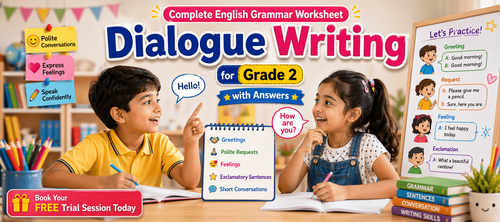

Complete English Grammar Worksheet for Grade 2 on Dialogue Writing with Answers
Learning how to speak politely and express feelings clearly is an important part of communication. This Grade 2 English grammar worksheet on Dialogue Writing helps children practice greetings, polite requests, short conversations, feelings, and exclamatory sentences. These activities build confidence in speaking and writing while teaching children how to use the right words in different situations.
Download these English grammar worksheets and practice regularly to strengthen your language skills and build a strong foundation. You can also book a free trial to get expert guidance and improve your reading, writing, and comprehension abilities. The worksheets are designed in a simple and structured way to help K–8 students learn grammar concepts easily and use them confidently in everyday communication.
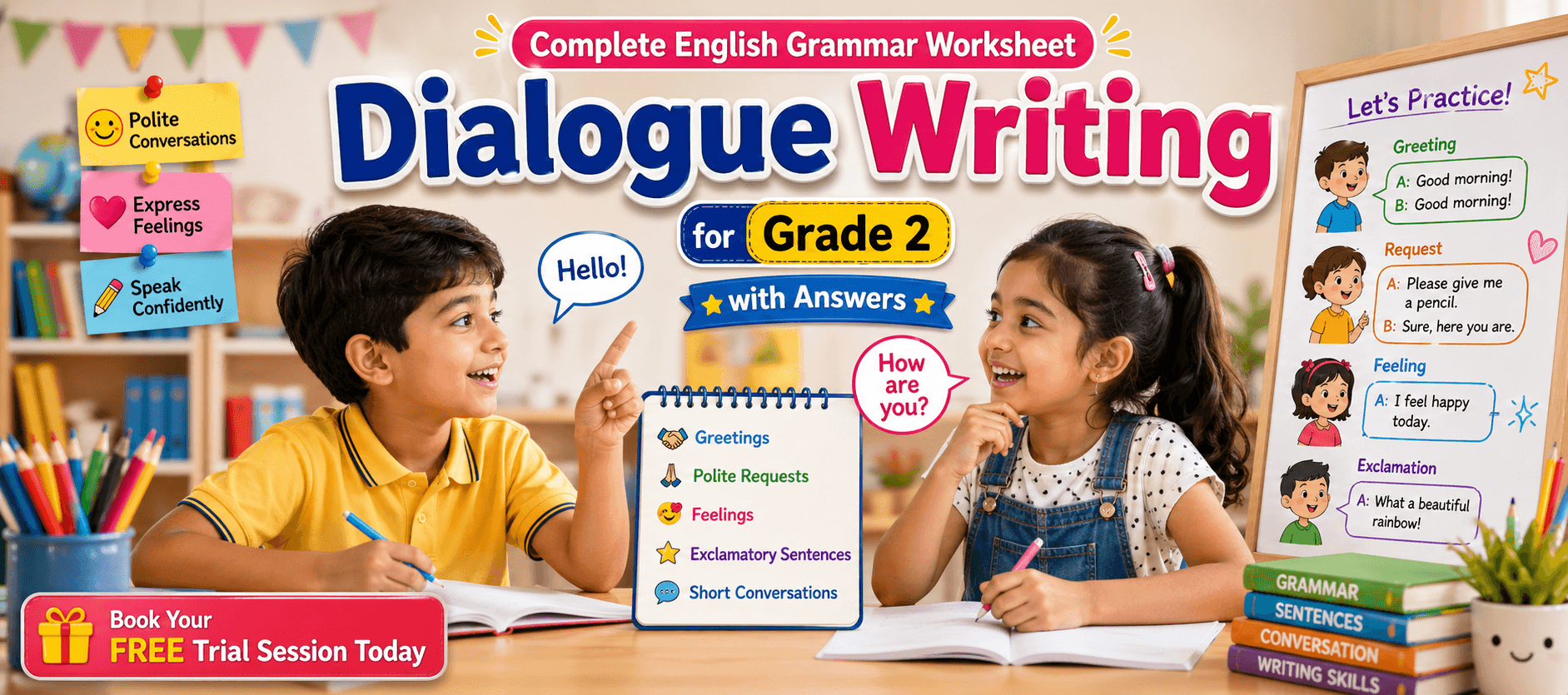
What Is Dialogue Writing?
Dialogue writing means writing conversations between two or more people. It helps children learn how people speak in daily life. In this worksheet, students practice greetings, thank-you sentences, asking for help, showing feelings, and speaking politely. Dialogue writing improves sentence formation, vocabulary, and communication skills.
What’s in This Worksheet?
1. Writing one dialogue sentence for different situations.
2. Writing two-line conversations between characters.
3. Writing exclamatory sentences.
4. Writing sentences to show feelings.
5. Writing polite requests for needs.
6. Building speaking confidence.
7. Improving sentence writing for school tasks.
Definitions, Examples, Techniques, and Tips
Dialogue means conversation between people.
Exclamatory sentences show strong feelings.
Polite sentences use words like please, thank you, and sorry.
Use short and clear sentences.
Think about the situation before answering.
Use suitable emotions like happy, sad, surprised, or thankful.
Why Is It Important to Learn This?
Dialogue writing helps children speak politely and confidently. It teaches how to greet people, ask questions, request help, and express feelings. These are useful life skills for school, home, and friendships. Children also improve grammar, punctuation, and sentence writing through regular practice.
Where Will This Knowledge Help You?
Students use dialogue writing in many places.
Exams: Writing and grammar sections often include dialogue tasks.
School: Children talk to teachers and classmates politely.
Home: Children learn respectful communication.
Daily life: Good speaking habits build confidence.
Creative writing: Stories become better with conversations.
How to Use This Worksheet?
1. Read each situation carefully.
2. Think about what a person would naturally say.
3. Write short and polite sentences.
4. Follow the answer key in exact worksheet order.
5. Compare your answers carefully.
6. Correct grammar and punctuation mistakes.
7. Practice often to improve fluency.
Important Tips and Tricks
1. Use greetings like hello, good morning, and goodbye properly.
2. Use please when asking for something.
3. Use thank you when showing gratitude.
4. Use exclamation marks for surprise or joy.
5. Match the feeling with the situation.
6. Keep conversations short and meaningful.
7. Begin sentences with capital letters.
Complete Answer Key
Exercise No. 1
1. Hello, my friend.
2. Thank you, Mother.
3. What is your name?
4. Goodbye, Teacher.
5. I am sorry, my friend.
6. Happy birthday, my friend.
7. Good morning, Teacher.
8. Please come and play with me.
9. Please help me.
10. Good night, Mother and Father.
Exercise No. 2
1. Child: How are you?
Friend: I am fine.
2. Parent: Please finish your homework.
Child: I will do it now.
3. Doctor: What happened?
Child: I have a fever.
4. Child 1: Let us play.
Child 2: Yes, let us play.
5. Friend 1: Shall we play cricket?
Friend 2: Yes, let us play.
6. Shopkeeper: What do you want?
Child: I want a chocolate.
7. Mother: Have your food.
Child: Yes, Mother.
8. Teacher: Did you complete your work?
Student: Yes, Teacher.
9. Classmate 1: Can I sit here?
Classmate 2: Yes, please sit.
10. Friend 1: Good morning.
Friend 2: Good morning.
Exercise No. 3
1. What a beautiful rainbow!
2. What a big elephant!
3. What a lovely gift!
4. Hurray! I won a prize!
5. I am so happy!
6. Oh! What a surprise!
7. What a beautiful flower!
8. Hurray! I scored full marks!
9. What a fun holiday!
10. Hurray! My best friend is here!
Exercise No. 4
1. I feel happy when I play with my friend.
2. I feel excited when I get a gift.
3. I feel joyful when it is my birthday.
4. I feel sad when I am sick.
5. I feel upset when I lose a toy.
6. I feel happy when I help someone.
7. I feel excited when I go on a picnic.
8. I feel proud when my teacher praises me.
9. I feel sleepy when I am tired.
10. I feel bored when it is raining all day.
Exercise No. 5
1. Please give me some water.
2. Please help me with my homework.
3. Please give me a pencil.
4. May I use the washroom, please?
5. May I play outside, please?
6. Please give me some food.
7. May I speak, please?
8. Please give me a book.
9. May I sit down, please?
10. May I take some rest, please?
This Grade 2 English grammar worksheet on Dialogue Writing helps children speak politely, write clearly, and express feelings confidently. Regular practice of greetings, requests, and conversations makes communication stronger and more natural. Keep practicing and enjoy learning every day.