
Degrees of Adjectives Worksheet for Class 3 – Practice PDF

Degrees of Adjectives Worksheet for Class 3 – Practice PDF
Learning grammar becomes exciting when students begin to notice how words change to compare people, places, and things around them. This English grammar worksheet for Grade 3 focuses on the topic Degrees of Adjectives and helps young learners understand how describing words can show comparison in everyday situations. Through engaging questions and practice tasks, students strengthen their observation skills while building confidence in sentence formation.
Download these English grammar worksheets and practice regularly to strengthen your language skills and build a strong foundation. You can also book a free trial to get expert guidance and improve your reading, writing, and comprehension abilities. The worksheets are designed in a simple and structured way to help K–8 students learn grammar concepts easily and use them confidently in everyday communication.
What Is The Topic?
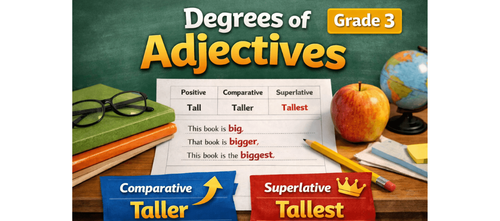
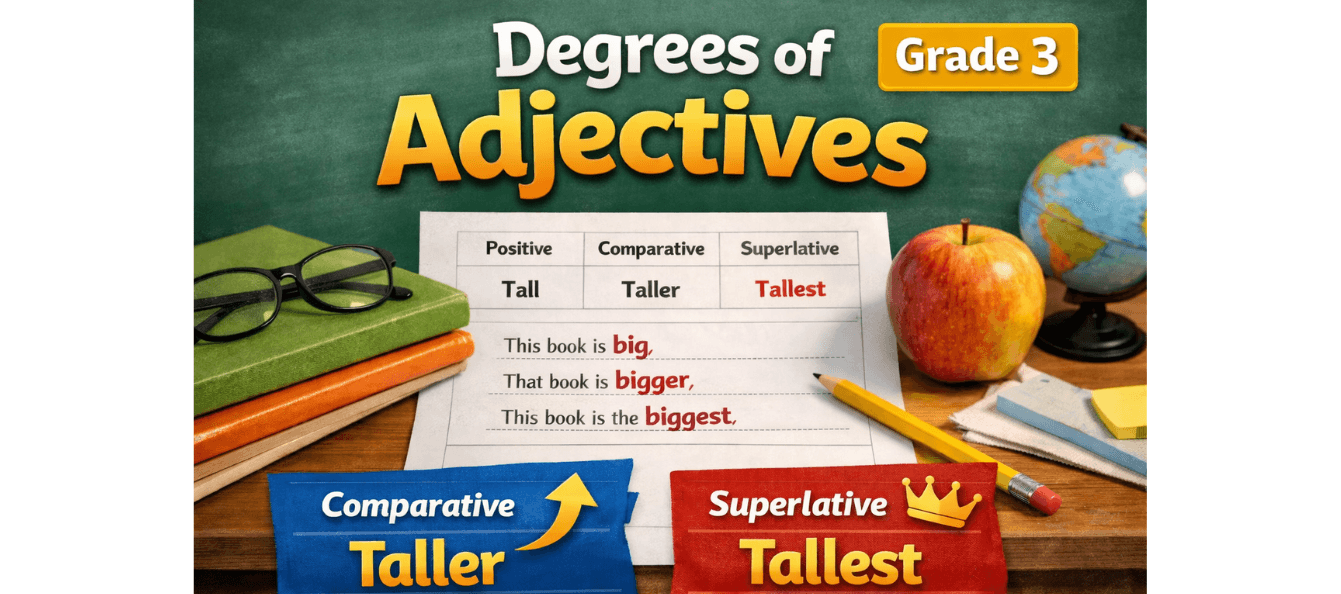
The topic of this English grammar worksheet is Degrees of Adjectives. Adjectives are describing words, and this worksheet teaches how adjectives change when comparing one person or thing with another or when describing something among many.
Students learn how sentences use different forms of adjectives such as basic description, comparison, and highest comparison. The worksheet presents sentences where learners must choose the correct adjective form, complete blanks, match statements, identify incorrect usage, and apply learning through paragraph completion.
By practicing these exercises, Grade 3 students understand how adjectives change depending on meaning and sentence structure. The focus remains on recognizing the correct degree adjective based only on sentence context provided in the worksheet
What’s In This Worksheet?
1. Multiple choice questions where students select the correct adjective of degree to complete sentences.
2. Fill in the blanks using adjective pairs provided beside each sentence.
3. Matching sentences with suitable adjectives of degree.
4. Underlining incorrect adjective forms to identify common mistakes.
5. Paragraph writing practice where suitable adjectives of degree complete a real-life situation.
6. Structured learning that progresses from simple identification to applied usage.
7. Practice designed to build strong grammar skills through repeated exposure.
8. Exercises that support exam preparation by testing recognition, correction, and application skills.
9. Gradual learning from sentence-level understanding to paragraph-level comprehension.
10. Activities that encourage careful reading before selecting answers.
Definitions, Examples, Techniques, And Tips
Definitions
Degrees of Adjectives describe how adjectives change according to comparison in sentences. The worksheet demonstrates how one sentence may compare two people, while another describes someone among many.
Examples From The Worksheet
Sentences such as comparing Ravi with his brother, describing a girl in a class, or identifying the most interesting story help learners see how adjective forms change naturally.
Comparisons like bus ride and walk, summer temperature comparisons between cities, and performance comparisons between students provide practical understanding.
Techniques Used In The Worksheet
Students select correct options from multiple choices.
Students choose between adjective pairs to complete blanks correctly.
Students match sentences with the right adjective degree.
Students identify incorrect adjective usage by underlining wrong words.
Students apply learning by completing a paragraph logically.
Quick Learning Tips
Read each sentence carefully before choosing an adjective.
Notice comparison words like “than” or phrases like “of all.”
Check whether the sentence compares two items or many items.
Practice recognizing patterns through repeated exercises provided in the worksheet.
Why Is It Important To Learn This?
Learning Degrees of Adjectives helps students describe things more clearly. When students know how to compare correctly, their sentences become meaningful and accurate. This skill improves both writing and speaking abilities.
For Grade 3 learners, understanding adjective degrees builds a strong grammar foundation. It helps them express ideas such as who is taller, which story is most interesting, or which event was more exciting. These comparisons appear regularly in school assignments, conversations, and exams.
Mastering this English grammar worksheet strengthens clarity, confidence, and grammatical accuracy.
Where Will This Knowledge Help You?
Students will use this knowledge in school examinations where sentence completion and correction questions appear frequently.
It helps in creative writing tasks where comparisons improve descriptions.
Class discussions become clearer when students compare ideas correctly.
Reading comprehension improves because students understand descriptive differences.
Paragraph writing becomes easier when students can select suitable adjective forms naturally.
How To Use This Worksheet?
1. Attempt all questions independently before checking answers.
2. Read each sentence carefully and understand what comparison is required.
3. Complete multiple choice, matching, and paragraph questions step by step.
4. Review the complete answer key provided below.
5. Compare answers carefully because the solutions follow the exact worksheet order.
6. Correct mistakes immediately to strengthen understanding.
7. Practice regularly using similar exercises to build accuracy and confidence.
Important Tips And Tricks
1. Do not use double comparison forms together in one sentence.
2. Pay attention to words like “than,” which usually indicate comparison between two items.
3. Phrases like “of all” often show the highest degree.
4. Avoid adding extra words that make adjectives incorrect.
5. Read instructions carefully before answering each section.
6. Underlining incorrect words helps identify common grammar errors.
7. In paragraph-based questions, choose adjectives that fit the flow of meaning.
8. Examiners expect correct adjective forms without spelling mistakes.
9. Always check whether the sentence compares one, two, or many subjects.
10. Practice identifying incorrect adjectives because such questions frequently appear in exams.
Complete Answer Key
Exercise No. 1
Choose the option to complete the sentence with the correct degree adjective.
1. taller
2. most interesting
3. brightest
4. better
5. longer
6. prettiest
7. sweetest
8. shorter
9. hotter
10. tallest
Exercise No. 2
Choose one adjective of degree from each pair to fill the blank.
1. taller
2. best
3. easier
4. hotter
5. most
6. higher
7. high
8. longer
9. thickest
10. prettier
Exercise No. 3
Match each sentence to the correct adjective of degree from the right.
1. taller
2. best
3. longer
4. hottest
5. funniest
6. higher
7. better
8. sweetest
9. faster
10. strongest
Exercise No. 4
Underline the incorrect adjective of degree in each sentence.
1. more taller
2. more easier
3. baddest
4. more faster
5. gooder
6. most brightest
7. interestinger
8. most smartest
9. more hottest
10. highiest
Exercise No. 5
Fill the blanks in the below given paragraph with suitable adjectives of degree.
1. tired
2. more
3. most
4. heavier
5. most
6. more
7. larger
Practicing the Degrees of Adjectives through this Grade 3 English grammar worksheet helps students become more confident while forming comparisons correctly. Regular practice using structured exercises like these improves grammar understanding step by step and prepares learners for classroom success. With continued effort and careful revision, students can master adjective usage and express ideas clearly in both writing and speaking.