
Degrees of Comparison Exercises for Class 7 English Grammar
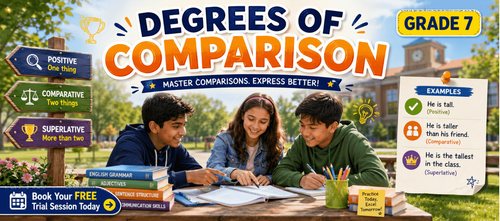

Degrees of Comparison with This Grade 7 English Grammar Worksheet
Learning degrees of comparison helps students describe people, places, and things clearly and correctly. This Grade 7 English grammar worksheet on Degrees of Comparison Exercises helps students improve sentence building, adjective usage, grammar accuracy, and comparison skills through structured practice activities. Students learn how to identify adjectives, use positive, comparative, and superlative degrees properly, rewrite incorrect sentences, complete tables, fill in blanks, and write meaningful paragraphs.
This worksheet includes engaging grammar exercises that support better understanding of sentence structure and comparison forms. By practicing these activities regularly, students can strengthen both writing and speaking skills while building confidence in English grammar.
Download these English grammar worksheets and practice regularly to strengthen your language skills and build a strong foundation. You can also book a free trial to get expert guidance and improve your reading, writing, and comprehension abilities. The worksheets are designed in a simple and structured way to help K–8 students learn grammar concepts easily and use them confidently in everyday communication.
What Is the Topic?
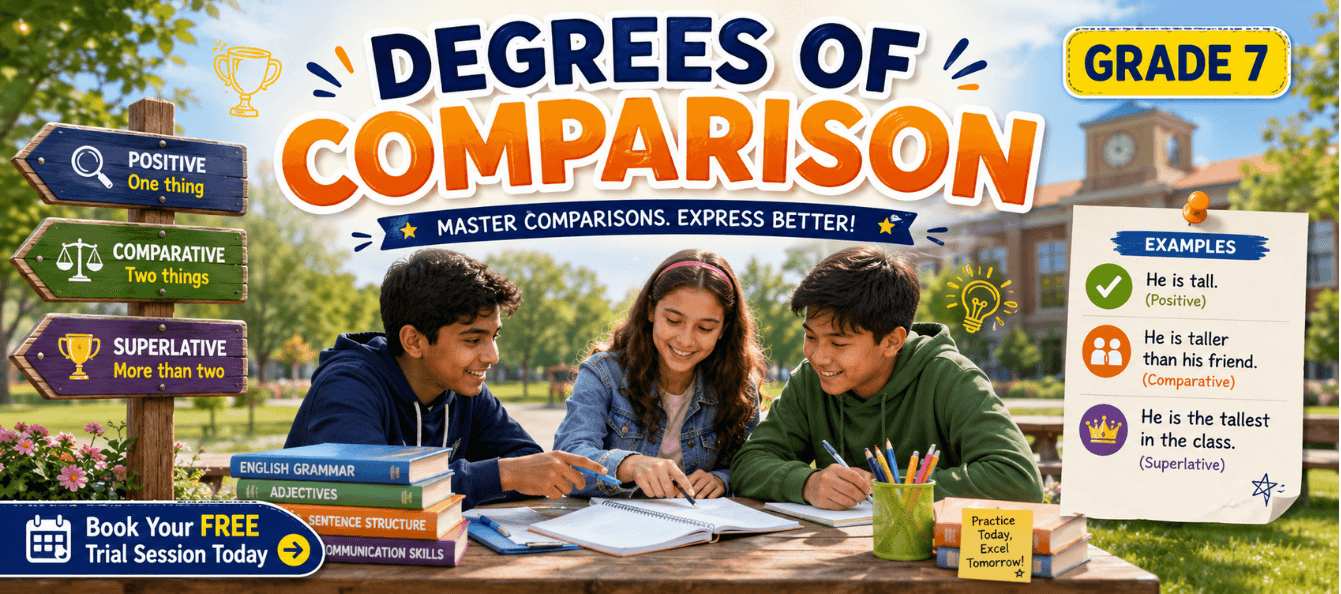
Degrees of comparison are forms of adjectives used to compare nouns. This Grade 7 English grammar worksheet focuses on three types of comparison:
1. Positive degree
2. Comparative degree
3. Superlative degree
Students learn how adjectives change depending on whether one thing, two things, or more than two things are being compared. The worksheet gives students practice in identifying adjective forms, correcting mistakes, completing sentences, and writing using different comparison forms.
What’s in This Worksheet?
1. Underline the adjective activities help students identify adjectives and label their degree of comparison.
2. Table completion exercises improve understanding of positive, comparative, and superlative forms.
3. Fill in the blanks activities help students apply the correct degree of comparison in sentences.
4. Sentence rewriting exercises teach students how to correct comparison errors.
5. Paragraph writing activities help students use all three degrees in meaningful writing.
6. The worksheet improves grammar accuracy, sentence structure, and exam preparation skills.
Definitions, Examples, Techniques, and Tips
Positive Degree
The positive degree describes a quality without making a comparison.
Example:
He is as tall as his father.
Comparative Degree
The comparative degree compares two people, places, or things.
Example:
She is more talented than her brother.
Superlative Degree
The superlative degree compares more than two people, places, or things.
Example:
He is the fastest runner in school.
Examples Included in the Worksheet
1. more talented
2. best
3. clearer
4. fastest
5. heavier
6. narrower
7. most exciting
Quick Learning Tips
1. Comparative degree sentences often include the word “than”.
2. Superlative degree adjectives usually come after “the”.
3. Positive degree sentences may use “as…as”.
4. Read the sentence carefully before choosing the adjective form.
5. Avoid double comparison forms such as “more smarter”.
Why Is It Important to Learn This?
Degrees of comparison are important because they help students compare people, objects, places, and ideas correctly. Learning these grammar forms improves sentence writing, speaking ability, and communication skills. Students also become more confident in grammar-based school activities and examinations.
This topic helps learners write better descriptions and understand adjective forms more clearly. With regular practice, students can avoid common grammar mistakes and improve overall English fluency.
Where Will This Knowledge Help You?
1. School grammar tests
2. Classroom speaking activities
3. Paragraph writing tasks
4. Daily English communication
5. Homework assignments
6. Reading and comprehension tasks
7. English examinations
How to Use This Worksheet?
1. Read each question carefully before answering.
2. Attempt all exercises independently first.
3. Follow the exact question order while solving the worksheet.
4. Compare your answers carefully with the answer key.
5. Correct mistakes and rewrite incorrect answers properly.
6. Practice positive, comparative, and superlative forms regularly.
7. The solutions follow the exact worksheet order, so students should compare answers carefully step by step.
Important Tips and Tricks
1. Do not use incorrect double comparison forms such as “more smarter” or “more higher”.
2. Use “better” instead of “more better”.
3. Use “best” correctly when comparing more than two things.
4. Always check whether the sentence needs positive, comparative, or superlative degree.
5. Superlative degree sentences usually begin with “the”.
6. Comparative degree sentences often use “than”.
7. Read sentence correction questions carefully before rewriting them.
8. While writing paragraphs, include all required comparison forms correctly.
9. Check adjective spellings carefully before finalizing answers.
10. Practice sentence formation regularly to improve grammar confidence.
Complete Answer Key
Exercise 1
1. She is __more talented__ than her brother. – Comparative
2. This is the __best__ day of my life. – Superlative
3. He is __as tall as__ his father. – Positive
4. That was a __good__ idea. – Positive
5. Her answer was __clearer__ than mine. – Comparative
6. It’s the __most exciting__ match ever! – Superlative
7. My backpack is __heavier__ than yours. – Comparative
8. It’s a __hot__ and humid afternoon. – Positive
9. This road is __narrower__ than that one. – Comparative
10. He is the __fastest__ runner in school. – Superlative
Exercise 2
Positive – tall
Comparative – taller
Superlative – tallest
Positive – smart
Comparative – smarter
Superlative – smartest
Positive – beautiful
Comparative – more beautiful
Superlative – most beautiful
Positive – good
Comparative – better
Superlative – best
Positive – bad
Comparative – worse
Superlative – worst
Positive – easy
Comparative – easier
Superlative – easiest
Positive – strong
Comparative – stronger
Superlative – strongest
Positive – helpful
Comparative – more helpful
Superlative – most helpful
Positive – far
Comparative – farther
Superlative – farthest
Positive – cold
Comparative – colder
Superlative – coldest
Exercise 3
1. He is the tallest boy in our class.
2. This task is harder than the last one.
3. That’s a good idea.
4. She runs faster than her brother.
5. It’s the most interesting book I’ve read.
6. He is as tall as his father.
7. This chair is stronger than that one.
8. The weather is pleasant today.
9. That’s the sweetest cake I’ve ever had.
10. Your bag is heavier than mine.
Exercise 4
1. She is the smartest girl in the class.
2. This is better than I expected.
3. He is the best player in the team.
4. Your idea is better than mine.
5. That movie is more interesting than any other movie.
6. This is the most informative documentary of all three.
7. Of the two proposals, her idea was clearer.
8. The Pacific Ocean is deeper than any other ocean.
9. His second novel is better than any other book written by him.
10. Mount Everest is higher than any other peak in the world.
Exercise 5
The three boys are running in the playground. The boy in the blue shirt is as active as the boy in the green shirt. The orange house is as beautiful as the tall building nearby. The boy in the green shirt is faster than the boy behind him. The blue building is taller than the orange house. The boy in the blue shirt is the fastest runner in the group. This is the most exciting race in the playground.
Practicing degrees of comparison regularly helps students improve grammar confidence and sentence formation skills. This Grade 7 English grammar worksheet provides meaningful practice through engaging exercises and structured activities. By solving these exercises carefully and regularly, students can strengthen their understanding of positive, comparative, and superlative degrees and use them correctly in everyday English communication.