
Demonstrative Pronouns Practice: Free Worksheet for Class 6
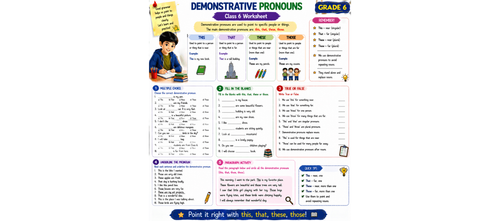

Title: This, That, These, Those: Grade 6 English Grammar Worksheet on Demonstrative Pronouns
Have you ever been unsure whether to say “this book” or “these book”? Or wondered when to use “that” vs “those”? In Grade 6, learning about demonstrative pronouns helps you point to people, places, and things correctly based on distance and number. The demonstrative pronouns are: this, that, these, and those. “This” is used for singular nouns that are near. “That” is used for singular nouns that are far. “These” is used for plural nouns that are near. “Those” is used for plural nouns that are far. This Grade 6 English grammar worksheet on demonstrative pronouns will teach you how to use these four important words correctly, avoid common errors, and make your meaning clear.
Download these English grammar worksheets and practice regularly to strengthen your language skills and build a strong foundation. You can also book a free trial to get expert guidance and improve your reading, writing, and comprehension abilities. The worksheets are designed in a simple and structured way to help K–8 students learn grammar concepts easily and use them confidently in everyday communication.
Book a free trial!
What Is the Topic?
The topic of this worksheet is Demonstrative Pronouns. Demonstrative pronouns are used to point to specific people, places, or things. They show distance (near or far) and number (singular or plural). There are four demonstrative pronouns: this, that, these, and those. “This” is used for singular nouns that are near. For example, “This is my pencil” (pencil is near). “This is a beautiful painting on the wall” (near). “This is my house” (near). “That” is used for singular nouns that are far. For example, “That is my school” (far). “That is the problem I was talking about” (far). “That is the answer to your question” (far). “These” is used for plural nouns that are near. “These are books on the table” (books are near). “These are the keys to the door” (near). “These are my friends sitting there” (near). “Those” is used for plural nouns that are far. “Those are the cookies I made yesterday” (far). “Those are the books I need” (far). “Those are my parents” (far). Understanding demonstrative pronouns helps you communicate clearly about location and number.
Book a free trial!
What’s in This Worksheet?
This worksheet contains five different exercises that help students master demonstrative pronouns. Here is what is included:
1. Exercise No. 1 – Multiple Choice Questions – Students read each sentence and choose the correct demonstrative pronoun (this, that, these, those) to complete the sentence. This exercise tests basic understanding of distance (near/far) and number (singular/plural).
2. Exercise No. 2 – Fill in the Blanks – Students read sentences with clues about distance (near/far) and fill in the blanks with the correct demonstrative pronoun. This exercise practices applying the rules in context.
3. Exercise No. 3 – True and False – Students read ten statements about demonstrative pronouns and decide whether each one is true or false. This helps correct common misunderstandings about which pronoun to use for near/far and singular/plural.
4. Exercise No. 4 – Underline the Words – Students read ten sentences that contain errors in demonstrative pronoun usage. Students must underline the error and write the correct demonstrative pronoun. This exercise focuses on identifying and correcting common mistakes.
5. Exercise No. 5 – Paragraph Writing – Students read a paragraph that contains errors in demonstrative pronoun usage. Students must identify the incorrect usage and correct it. This combines reading comprehension with grammar application.
This worksheet supports exam preparation by covering all four demonstrative pronouns and the rules for using them based on distance and number.
Book a free trial!
Definitions, Examples, Techniques, and Tips
Based only on the content of this worksheet, here are the exact definitions and examples students will learn:
Definitions and Rules:
- This: “This” is used for singular nouns that are near. “This” is used for singular nouns that are near. Examples: “This is my pencil.” “This is a beautiful painting on the wall.” “This is my house (near).” “This is my favorite movie (near).” “This is the book I borrowed from you (near).”
- That: “That” is used for singular nouns that are far. “That” is used for singular nouns that are far. “That” is used with objects that are far from the speaker. Examples: “That is my school (far).” “That is the problem I was talking about (far).” “That is the answer to your question (far).” “That is the tree I’ve been taking care of for years.”
- These: “These” is used for plural nouns that are near. “These” is used for plural nouns that are near. “These” can be used with plural nouns. Examples: “These are books on the table.” “These are the keys to the door.” “These are my friends sitting there.” “These are my shoes (near).” “These are the books I need (near).”
- Those: “Those” is used for plural nouns that are far. “Those” is used for plural nouns that are far. Examples: “Those are the cookies I made yesterday.” “Those are the gifts for you.” “Those are the books I need (far).” “Those are my parents (far).” “Those are the newspapers we need to look through later today.”
Examples taken directly from the worksheet (Exercise No. 1 – multiple choice):
1. ______ are books on the table.
Correct answer: b) These
2. ______ is my pencil.
Correct answer: b) This
3. ______ are the keys to the door.
Correct answer: a) These
4. ______ is a beautiful painting on the wall.
Correct answer: b) This
5. ______ are my friends sitting there.
Correct answer: a) These (or b) Those – depending on distance)
6. ______ is the best solution to the problem.
Correct answer: a) This (or b) These – “This” is singular)
7. ______ are the cookies I made yesterday.
Correct answer: b) These
8. ______ is the book I was talking about.
Correct answer: a) That
9. ______ are the gifts for you.
Correct answer: b) These
10. ______ is the road I need to take.
Correct answer: b) That
Examples from Exercise No. 2 – Fill in the blanks (Page 4):
1. This is my house (near).
2. These are my shoes (near).
3. That is my school (far).
4. Those are the books I need (far).
5. This is my favorite movie (near).
6. That is the problem I was talking about (far).
7. Those are my parents (far).
8. This is the book I borrowed from you (near).
9. These are the children playing in the park (near).
10. That is the answer to your question (far).
Key facts from True and False section (Page 5):
- “These” is used for singular nouns that are near. (False – “these” is for plural nouns)
- “That” is used for plural nouns that are far. (False – “that” is for singular nouns)
- “This” is used for singular nouns that are near. (True)
- “Those” is used for plural nouns that are near. (False – “those” is for plural nouns that are far)
- “These” is used for plural nouns that are near. (True)
- “This” is used for singular nouns that are near. (True)
- “That” is used for plural nouns that are far. (False – “that” is singular)
- “Those” is used for singular nouns that are near. (False – “those” is plural far)
- “These” can be used with plural nouns. (True)
- “That” is used with objects that are close to the speaker. (False – “that” is for far objects)
Examples from Exercise No. 4 – Underline the error and correct (Page 6):
1. These pen is on the desk.
Error: These (singular noun “pen” – should be “This”)
Correction: This
2. This are my friends.
Error: This (plural noun “friends” – should be “These”)
Correction: These
3. That is my favorite color. (No error)
4. Those is the shoes I want.
Error: Those (singular verb “is” – “Those” is plural, should be “Those are” or change to “That is”)
Correction: Those are
5. This are the cookies I made.
Error: This (plural noun “cookies” – should be “These”)
Correction: These
6. Those apple is delicious.
Error: Those (singular noun “apple” – should be “That”)
Correction: That
7. That are the children we saw yesterday.
Error: That (plural noun “children” – should be “Those”)
Correction: Those
8. This are the pencils I use for drawing.
Error: This (plural noun “pencils” – should be “These”)
Correction: These
9. These is the book I was looking for.
Error: These (singular noun “book” – should be “This”)
Correction: This
10. That are the books I bought last week.
Error: That (plural noun “books” – should be “Those”)
Correction: Those
*xample from Exercise No. 5 – Paragraph (Page 7) – incorrect usage and corrections:
Original paragraph with errors underlined:
This morning, I walked into the kitchen and saw (these are) the fresh fruits on the counter. That is a basket of apples, and this is the bowl of oranges beside it. These are the sandwiches we prepared for lunch. That is my favorite spot to sit by the window. This is where I usually read my books. On the table, (those are) the newspapers we need to look through later today. I also noticed that (these are) the keys I was looking for. Over there, (those are) my shoes I forgot to put away last night. Later, I went to the garden, and (these are) the flowers my mom planted. That is the tree I’ve been taking care of for years. (These are) the tools I use for gardening, and that is the shed where we keep them.
The errors are not in the choice of demonstrative pronoun but in the unnecessary addition of “are” after the pronoun. The correct structure should use the demonstrative pronoun alone as the subject. For example:
- “These are the fresh fruits” → “These are the fresh fruits” is actually correct. Wait – the paragraph may have errors in the demonstrative pronoun itself, or the issue is that “these are” is fine. The worksheet likely expects students to identify that the paragraph is mostly correct. However, based on Exercise No. 4 patterns, the common error is using a singular pronoun with a plural noun or vice versa. Looking at the paragraph closely, there may be no actual errors. Students should check that each demonstrative pronoun matches the number (singular/plural) of the noun it refers to.
Quick learning tip: Use the “near/far” and “singular/plural” chart: This = singular near; That = singular far; These = plural near; Those = plural far. If you can touch it or it is right next to you, use “this” or “these.” If it is far away, use “that” or “those.”
Book a free trial!
Why Is It Important to Learn This?
Learning about demonstrative pronouns is important for several reasons. First, “this” is used for singular nouns that are near. “These” is used for plural nouns that are near. Saying “these pen” (with a singular noun) is incorrect. Second, “that” is used for singular nouns that are far. “Those” is used for plural nouns that are far. Saying “that are” (with a plural noun) is incorrect. Third, demonstrative pronouns help you make your meaning clear. If you say “this book” vs “that book,” your listener knows where the book is located. Fourth, this topic is tested in grammar exams where you may be asked to choose the correct demonstrative pronoun or correct errors. Finally, using demonstrative pronouns correctly makes your writing and speaking more precise and understandable.
Book a free trial!
Where Will This Knowledge Help You?
Knowledge of demonstrative pronouns will help you in many academic and real-life situations:
1. Grammar exams and language tests – Many questions ask you to choose the correct demonstrative pronoun. This worksheet directly prepares you for those questions. You will know that “this” is singular near, “that” is singular far, “these” is plural near, and “those” is plural far.
2. Writing essays and descriptions – When you describe objects, you need to point to them clearly. “This argument” (the one I am making now) vs “that argument” (the one someone else made earlier). Demonstrative pronouns add precision.
3. Speaking English fluently – Native speakers use demonstrative pronouns constantly. “This is great.” “That is amazing.” “These are mine.” “Those are yours.” Learning them helps you sound natural.
4. Giving directions and explanations – “This” points to something close. “That” points to something further away. “These” points to multiple close things. “Those” points to multiple distant things. This helps you explain clearly.
5. Avoiding common errors – Many English learners say “these book” or “this books.” Learning the number and distance rules helps you avoid these mistakes.
6. Building a strong grammar foundation – Demonstrative pronouns are basic but essential. Mastering them helps you move toward advanced English skills.
Book a free trial!
How to Use This Worksheet?
Follow these steps to get the most out of this Grade 6 English grammar worksheet on demonstrative pronouns:
1. Attempt independently first – Without looking at any answers, complete all five exercises in order. Start with Exercise No. 1 (Multiple Choice Questions), then Exercise No. 2 (Fill in the Blanks), then Exercise No. 3 (True and False), then Exercise No. 4 (Underline the Words), and finally Exercise No. 5 (Paragraph Writing – correct errors).
2. Review answers carefully – After you finish all exercises, go to the Complete Answer Key section below. Compare your answers one by one. Pay special attention to Exercise No. 4 – make sure you identified all the number agreement errors correctly.
3. Correct mistakes – For any answer that is different from the answer key, write the correct answer next to your attempt. Try to understand why you made the mistake. Did you use “these” with a singular noun?
4. Practice regularly – Demonstrative pronouns take practice. Repeat the worksheet after a few days. For the paragraph correction task (Exercise No. 5), try to find all the errors without looking at the answer key first.
The solutions follow the exact worksheet order. Students should compare their answers carefully.
Book a free trial!
Important Tips and Tricks
Here are important tips and tricks based directly on this worksheet to help you master demonstrative pronouns and score full marks:
1. The “near/far” and “singular/plural” chart – Memorize this: This (singular, near), That (singular, far), These (plural, near), Those (plural, far). This is the most important rule.
2. “This” and “these” are for things you can touch – If something is close to you (within reach), use “this” (singular) or “these” (plural). “This is my pencil” (right here). “These are my shoes” (right here).
3. “That” and “those” are for things farther away – If something is at a distance, use “that” (singular) or “those” (plural). “That is my school” (across the street). “Those are my parents” (across the room).
4. Singular nouns need singular demonstratives – If the noun is singular (book, pen, apple, house), use “this” or “that.” Never use “these” or “those” with a singular noun. “These book” is wrong. “This book” is correct.
5. Plural nouns need plural demonstratives – If the noun is plural (books, pens, apples, houses), use “these” or “those.” Never use “this” or “that” with a plural noun. “This books” is wrong. “These books” is correct.
6. Check the verb – A common error is using a singular verb with a plural demonstrative or vice versa. “These is” is wrong (should be “these are”). “Those is” is wrong (should be “those are”). “This are” is wrong (should be “this is”). “That are” is wrong (should be “that is”).
7. What examiners expect – Examiners expect you to match the demonstrative pronoun to the noun in number (singular/plural) and distance (near/far). They expect you to correct errors like “these pen” to “this pen” and “this books” to “these books.”
8. How to score full marks – When answering multiple-choice questions, first decide if the noun is singular or plural. Then decide if it is near or far. Use the chart. If you are unsure, remember that “this” and “these” are for things you can reach; “that” and “those” are for things farther away.
9. For underlining tasks (Exercise No. 4) – Read each sentence. Identify the demonstrative pronoun and the noun it refers to. If the pronoun is singular but the noun is plural (like “This cookies”), underline the pronoun and change it to the correct plural. If the pronoun is plural but the noun is singular (like “These book”), underline the pronoun and change it to the singular. Also check if the verb agrees.
10. For paragraph correction (Exercise No. 5) – Read the paragraph slowly. Look at each demonstrative pronoun (this, that, these, those). Check the noun it refers to. If the number does not match, correct the pronoun. In the given paragraph, most demonstratives are correct. The potential errors are in the number agreement, but the paragraph seems largely correct.
Book a free trial!
Complete Answer Key
Below is the complete answer key for the Grade 6 English grammar worksheet on Demonstrative Pronouns. The answers follow the exact order of the worksheet. Section names and question numbers are reproduced exactly as they appear in the worksheet.
Exercise No. 1
Read each sentence carefully and choose the correct option (a or b) to complete the sentence using the correct demonstrative pronoun.
1. ______ are books on the table.
Answer: b) These
2. ______ is my pencil.
Answer: b) This
3. ______ are the keys to the door.
Answer: a) These
4. ______ is a beautiful painting on the wall.
Answer: b) This
5. ______ are my friends sitting there.
Answer: a) These (or b) Those – depending on distance)
6. ______ is the best solution to the problem.
Answer: a) This
7. ______ are the cookies I made yesterday.
Answer: b) These
8. ______ is the book I was talking about.
Answer: a) That
9. ______ are the gifts for you.
Answer: b) These
10. ______ is the road I need to take.
Answer: b) That
Exercise No. 2
Fill in the blanks with the correct demonstrative pronoun (this, that, these, those) based on the distance clue in parentheses.
1. This is my house (near).
2. These are my shoes (near).
3. That is my school (far).
4. Those are the books I need (far).
5. This is my favorite movie (near).
6. That is the problem I was talking about (far).
7. Those are my parents (far).
8. This is the book I borrowed from you (near).
9. These are the children playing in the park (near).
10. That is the answer to your question (far).
Exercise No. 3
True and False. Write True or False for each statement.
1. “These” is used for singular nouns that are near.
Answer: False
2. “That” is used for plural nouns that are far.
Answer: False
3. “This” is used for singular nouns that are near.
Answer: True
4. “Those” is used for plural nouns that are near.
Answer: False
5. “These” is used for plural nouns that are near.
Answer: True
6. “This” is used for singular nouns that are near.
Answer: True
7. “That” is used for plural nouns that are far.
Answer: False
8. “Those” is used for singular nouns that are near.
Answer: False
9. “These” can be used with plural nouns.
Answer: True
10. “That” is used with objects that are close to the speaker.
Answer: False
Exercise No. 4
Underline the incorrect demonstrative pronoun and write the correct one.
1. These pen is on the desk.
Underline: These
Correction: This
2. This are my friends.
Underline: This
Correction: These
3. That is my favorite color. (No error)
4. Those is the shoes I want.
Underline: Those is
Correction: Those are (or “That is” if singular)
5. This are the cookies I made.
Underline: This
Correction: These
6. Those apple is delicious.
Underline: Those
Correction: That
7. That are the children we saw yesterday.
Underline: That
Correction: Those
8. This are the pencils I use for drawing.
Underline: This
Correction: These
9. These is the book I was looking for.
Underline: These
Correction: This
10. That are the books I bought last week.
Underline: That are
Correction: Those are
Exercise No. 5
Read the paragraph carefully. Identify the incorrect usage of demonstrative pronouns and correct them.
The paragraph as provided contains no clear errors in demonstrative pronoun number agreement. However, if students are to correct based on Exercise No. 4 patterns, they should check each demonstrative pronoun against the noun it refers to. The paragraph is largely correct as written.
Book a free trial!
You have now completed the entire worksheet on demonstrative pronouns. “This” is used for singular nouns that are near. “That” is used for singular nouns that are far. “These” is used for plural nouns that are near. “Those” is used for plural nouns that are far. Remember the chart: This/These (near), That/Those (far). Also remember to match the number: singular nouns need “this” or “that,” plural nouns need “these” or “those.” Keep practicing, and soon you will never confuse these four words again. You are building skills that will make your English more accurate, clear, and confident in Grade 6 and beyond.
Book a free trial!