
Descriptive Adjectives Worksheet for Creative Writing Skills
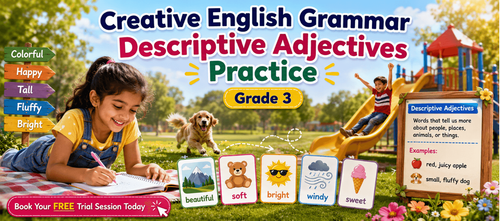

Creative English Grammar Worksheet for Grade 3 Descriptive Adjectives Practice
Descriptive adjectives make sentences more colorful, meaningful, and fun to read. When students learn how to describe people, places, animals, and things using descriptive words, they become more confident in speaking and writing. This Grade 3 English grammar worksheet on descriptive adjectives helps children understand how describing words improve communication and creative writing skills. Through fun exercises like underlining adjectives, filling in the blanks, rewriting sentences, and picture description activities, students get hands-on practice using descriptive adjectives correctly in sentences.
Download these English grammar worksheets and practice regularly to strengthen your language skills and build a strong foundation. You can also book a free trial to get expert guidance and improve your reading, writing, and comprehension abilities. The worksheets are designed in a simple and structured way to help K–8 students learn grammar concepts easily and use them confidently in everyday communication.
What Is Descriptive Adjectives?
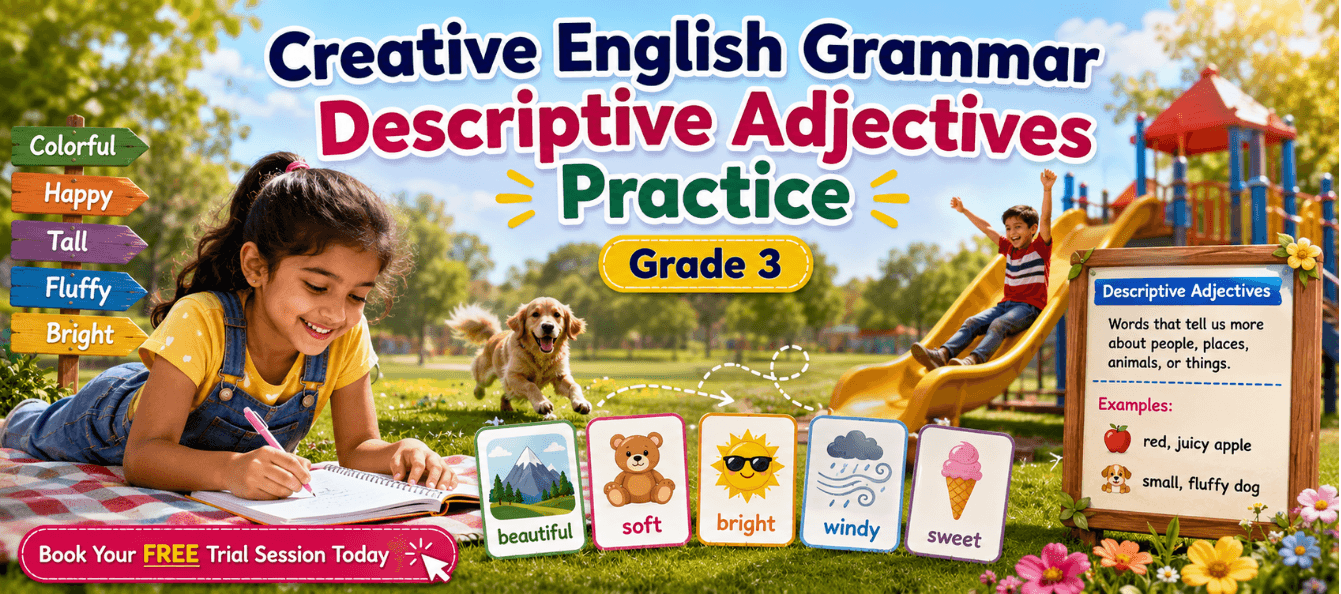
A descriptive adjective is a word that tells us more about a person, place, animal, or thing. It helps us describe how something looks, feels, smells, tastes, or sounds. These words make sentences more interesting and meaningful.
Examples from the worksheet:
I have a small, fluffy dog.
She ate a red, juicy apple.
Students learn how to:
1. Identify descriptive adjectives in sentences
2. Use describing words correctly
3. Improve sentence writing
4. Add details to their writing
5. Describe pictures using suitable adjectives
What’s in This Worksheet?
1. Color the adjectives activity where students identify words that describe people, places, animals, or things.
2. Underline the adjectives activity where students find and underline descriptive words in complete sentences.
3. Fill in the blanks section where students complete sentences using suitable descriptive adjectives.
4. Rewrite the sentences activity where students add describing words and improve simple sentences.
5. Picture description activity where students write descriptive sentences based on a picture.
6. Grammar practice that improves vocabulary, sentence structure, reading, and writing skills.
7. Exercises that help students prepare for school grammar tests and classroom activities.
Definitions, Examples, Techniques, and Tips
Definition:
A descriptive adjective is a word that tells us more about a person, place, animal, or thing.
Examples:
small, fluffy dog
red, juicy apple
Techniques:
1. Read the sentence carefully and identify the noun.
2. Look for the word that describes the noun.
3. Use describing words that tell about color, size, shape, feeling, or sound.
4. Add adjectives to make simple sentences more interesting.
Quick Learning Tips:
1. Descriptive adjectives usually come before nouns.
2. Read the sentence aloud to check if it sounds meaningful.
3. Use colorful and clear describing words while writing.
4. Practice describing everyday objects around you.
Why Is It Important to Learn This?
Learning descriptive adjectives helps students write better and speak more clearly. These words make communication more interesting and expressive. Students can explain ideas in a more detailed way when they know how to use describing words correctly.
Descriptive adjectives also help improve creative writing and reading comprehension. They allow students to paint a clear picture using words. This grammar topic is important for school assignments, classroom speaking, storytelling, and everyday communication.
Where Will This Knowledge Help You?
1. In grammar exams and class tests
2. During creative writing activities
3. While writing stories and paragraphs
4. In classroom discussions and speaking activities
5. During reading comprehension exercises
6. While describing pictures, people, places, or objects
7. In improving vocabulary and sentence writing skills
How to Use This Worksheet?
1. Read every question carefully before answering.
2. Attempt each exercise independently first.
3. Follow the exact order of the worksheet questions while answering.
4. Underline, fill, rewrite, or describe exactly as instructed.
5. Review your answers carefully after completing each exercise.
6. Compare your responses with the correct solutions in the same order.
7. Practice descriptive adjectives regularly to improve grammar and writing skills.
8. The solutions follow the exact worksheet order, so students should compare answers carefully.
Important Tips and Tricks
1. Always identify the noun first before choosing the adjective.
2. Use adjectives that clearly describe color, size, shape, feeling, or sound.
3. Avoid using unrelated words that do not describe the noun.
4. Read the sentence fully before filling in the blank.
5. In rewriting exercises, add suitable adjectives that make the sentence more meaningful.
6. In picture description activities, observe the picture carefully before writing sentences.
7. Underline only the descriptive adjective asked in the question.
8. Write neat and complete sentences to score full marks in grammar exercises.
Complete Answer Key
Exercise 1
Color all the words that tell us more about how a person, place, animal, or thing looks, feels, or sounds.
brave
kind
clean
tall
funny
red
cold
bright
smart
happy
soft
strong
shiny
fast
sweet
Exercise 2
Underline the words that tell us what the person, animal, place, or thing is like.
1. The _tiny_ kitten slept on the rug.
2. She has _long_ hair that touches her back.
3. We walked through the _dark_ tunnel.
4. The _round_ table was in the middle of the room.
5. The road was _bumpy_ after the rain.
6. The baby gave a _cheerful_ laugh.
7. The _colorful_ kites danced in the sky.
8. He ate a _thin_ slice of cake.
9. He was wearing a _blue_ pant.
10. His shoes were _wet_ after jumping in puddles.
Exercise 3
Fill in the blanks with words that tell what the person, place, animal, or thing is like.
1. The LITTLE baby slept all afternoon.
2. I saw a colorful bird sitting on the tree.
3. She wore a beautiful dress for the show.
4. The dog barked at the black cat.
5. We walked on the muddy road after the rain.
6. My brother has a soft teddy bear.
7. The teacher told us a funny story.
8. That is a very pretty flower.
9. He gave me a warm hug.
10. The strong wind made the leaves dance.
Exercise 4
Rewrite each sentence by adding a word that tells what the person, animal, place, or thing is like. Underline the word you added.
1. He has a _yellow_ pencil.
2. We ate _sweet_ grapes at lunch.
3. My grandfather told us a _funny_ story.
4. The _happy_ girl is smiling.
5. She wore a _beautiful_ hat.
6. I drank _cold_ milk.
7. There is a _tall_ tree in the garden.
8. The _white_ rabbit jumped over the log.
9. They saw a _brown_ dog at the park.
10. I found a _silver_ coin under the table.
Exercise 5
Write 5 sentences that describe what someone or something in the given picture looks like, feels like, or sounds like. Underline the descriptive adjective in each sentence.
1. The _happy_ children are playing in the park.
2. The boy is sliding down the _yellow_ slide.
3. The _playful_ dogs are running on the grass.
4. The girl has a _bright_ smile.
5. The _green_ trees look beautiful in the park.
This Grade 3 English grammar worksheet on descriptive adjectives is a wonderful way for students to improve their grammar and creative writing skills. Regular practice with descriptive adjectives helps children write clearer, more interesting, and more expressive sentences. Keep practicing these fun grammar activities to become more confident in speaking and writing every day.