
Diction (Word Choice): Author's Craft Practice for Class 7
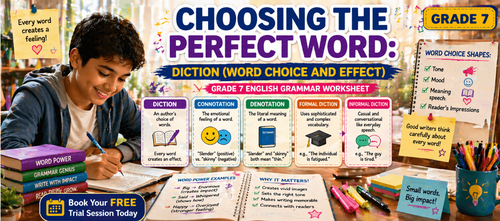

Title: Choosing the Perfect Word: Grade 7 English Grammar Worksheet on Diction (Word Choice and Effect)
Have you ever noticed how saying someone is "slender" feels different from saying they are "skinny"? Both words mean thin, but they create completely different feelings. That is diction in action. In Grade 7, learning about diction (word choice and effect) helps you understand why authors pick every single word with care. Diction refers to an author's choice of words. Formal diction uses sophisticated and complex vocabulary. Informal diction feels casual and conversational like everyday speech. Words with positive connotations create a favorable tone. Words with negative connotations create an unfavorable tone. The right word choice can make a scene more vivid and memorable. This Grade 7 English grammar worksheet on diction will teach you how to spot different types of word choice, understand connotation and denotation, and explain why every word matters.
Download these English grammar worksheets and practice regularly to strengthen your language skills and build a strong foundation. You can also book a free trial to get expert guidance and improve your reading, writing, and comprehension abilities. The worksheets are designed in a simple and structured way to help K–8 students learn grammar concepts easily and use them confidently in everyday communication.
Book a free trial!
What Is the Topic?
The topic of this worksheet is Diction (Word Choice and Effect). Diction refers to an author's choice of words. Diction is the author's choice of words. Every word an author picks creates a specific effect. Formal diction uses sophisticated and complex vocabulary. Formal diction uses sophisticated vocabulary. For example, "The individual is fatigued." Informal diction feels casual and conversational like everyday speech. Informal diction is casual and conversational. For example, "The guy is tired." Children versus "kids" shows a difference in diction. An author uses precise diction to create a specific effect. Choosing exactly the right word is called precise diction. Words have connotations. The emotional feeling of a word is its connotation. Connotation is the emotional feeling of a word. Words with positive connotations create a favorable tone. Words with negative connotations create an unfavorable tone. "Slender" and "skinny" have different connotations despite similar meanings. "Slender" has a positive connotation. "Skinny" has a more negative connotation. Denotation is the literal dictionary meaning of a word. Both "slender" and "skinny" mean "thin" but feel different. The literal dictionary meaning of a word is its denotation. Word choice helps create the author's tone. The specific feeling created by word choice is the effect. Strong word choices make writing more vivid and engaging. Poetic diction might include rhyme or unusual word order. The right word choice can make a scene more vivid and memorable. An author considers the audience when choosing diction. Good writers think carefully about every single word they choose. When you read, notice the diction. Ask why the author chose each word.
Book a free trial!
What’s in This Worksheet?
This worksheet contains five different exercises that help students master diction (word choice and effect). Here is what is included:
1. Exercise No. 1 – Multiple Choice Questions – Students choose the correct word to complete each sentence about diction. This exercise tests basic definitions of diction, formal vs informal language, connotation, denotation, and how word choice creates effect.
2. Exercise No. 2 – Fill in the Blanks – Students complete sentences by filling in missing words related to diction. A word bank is provided at the bottom of the page with words like formal, informal, connotation, denotation, precise, vivid, effect, tone, audience, and diction.
3. Exercise No. 3 – True and False – Students read ten statements about diction and decide whether each one is true or false. This helps correct common misunderstandings about formal and informal language, connotation, and why word choice matters.
4. Exercise No. 4 – Underline the Words – Students read ten sentences. For each sentence, students must determine whether the diction is formal or informal and underline the specific words that helped them decide. This exercise focuses on recognizing diction levels in context.
5. Exercise No. 5 – Paragraph Writing – Students read a paragraph about diction that has blanks. They must fill in each blank using a word from the word bank provided at the end of the paragraph. This combines reading comprehension with vocabulary application.
This worksheet supports exam preparation by covering all key aspects of diction, including formal vs informal language, connotation vs denotation, and how word choice affects tone and mood.
Book a free trial!
Definitions, Examples, Techniques, and Tips
Based only on the content of this worksheet, here are the exact definitions and examples students will learn:
Definitions:
- Diction: Diction refers to an author’s choice of words. Diction is the author’s choice of words. Every word an author picks creates a specific effect. Choosing exactly the right word is called precise diction.
- Formal diction: Formal diction uses sophisticated and complex vocabulary. Formal diction uses sophisticated vocabulary. For example, “The individual is fatigued.”
- Informal diction: Informal diction feels casual and conversational like everyday speech. Informal diction is casual and conversational. For example, “The guy is tired.” Children versus “kids” shows a difference in diction.
- Connotation: The emotional feeling of a word is its connotation. Words with positive connotations create a favorable tone. Words with negative connotations create an unfavorable tone. “Slender” and “skinny” have different connotations despite similar meanings. “Slender” has a positive connotation. “Skinny” has a more negative connotation.
- Denotation: Denotation is the literal dictionary meaning of a word. The literal dictionary meaning of a word is its denotation. Both “slender” and “skinny” mean “thin” but feel different.
- Effect of diction: An author uses precise diction to create a specific effect. The specific feeling created by word choice is the effect. Word choice helps create the author’s tone. Strong word choices make writing more vivid and engaging. The right word choice can make a scene more vivid and memorable. An author considers the audience when choosing diction.
Examples taken directly from the worksheet (Exercise No. 4):
1. The gentleman requested a glass of water.
– Diction: formal (gentleman, requested)
2. The child was exceedingly fatigued after the long journey.
– Diction: formal (exceedingly, fatigued)
3. Asha told her sister “That movie was totally awesome.”
– Diction: informal (totally awesome)
4. Kunal whispered “I’m so done with this homework.”
– Diction: informal (I’m so done with this homework)
5. Ravi and his buddy grabbed some grub after school.
– Diction: informal (buddy, grabbed some grub)
6. Riya yelled “Give me that back right now!”
– Diction: informal (yelled, Give me that back right now)
7. Raj texted his mom “Hey, I’m gonna be late.”
– Diction: informal (Hey, I’m gonna)
8. The ambassador extended a gracious invitation to the dignitary.
– Diction: formal (ambassador, extended a gracious invitation, dignitary)
9. Meera inquired whether the library was still open.
– Diction: formal (inquired whether)
10. The professor commenced the lecture at precisely eight o’clock.
– Diction: formal (commenced, precisely)
Key facts from the worksheet (note: Page 5 of the worksheet appears to have a large block of numbers in the provided file, which seems to be a scanning or formatting error. The true/false statements from Page 5 are not clearly legible in the file. Therefore, based only on the clearly readable content from other pages, the following are the key concepts students learn):
- Formal diction uses words like “gentleman,” “requested,” “exceedingly,” “fatigued,” “ambassador,” “extended a gracious invitation,” “dignitary,” “inquired,” “commenced,” “precisely.”
- Informal diction uses words like “totally awesome,” “I’m so done,” “buddy,” “grub,” “yelled,” “Hey,” “I’m gonna.”
- Connotation is the emotional feeling of a word. “Slender” has a positive connotation; “skinny” has a negative connotation.
- Denotation is the literal dictionary meaning.
- An author considers their audience when choosing diction.
- Precise diction makes writing more vivid and clear.
Quick learning tip: When you see a word, ask yourself: Is it formal or informal? Does it have a positive or negative feeling (connotation)? What is its literal meaning (denotation)? Could the author have chosen a different word? Why did they choose this one?
Book a free trial!
Why Is It Important to Learn This?
Learning about diction (word choice and effect) is important for several reasons. First, every word an author picks creates a specific effect. A single word can change the entire feeling of a sentence. “The man walked” is boring. “The man strolled” feels relaxed. “The man marched” feels determined. “The man crept” feels sneaky. Second, diction helps create the author’s tone. Formal diction makes the author sound serious and educated. Informal diction makes the author sound friendly and casual. Third, strong word choices make writing more vivid and engaging. Instead of saying “the food was good,” an author might say “the food was delicious, mouthwatering, or heavenly.” Each word paints a different picture. Fourth, understanding connotation helps you read between the lines. When an author calls someone “slender” instead of “skinny,” they are telling you how to feel about that person. Fifth, this skill is tested in literature exams where you may be asked to analyze word choice. Finally, good writers think carefully about every single word they choose. Learning about diction helps you become a better writer too.
Book a free trial!
Where Will This Knowledge Help You?
Knowledge of diction (word choice and effect) will help you in many academic and real-life situations:
1. Literature exams and reading comprehension tests – Many questions ask you to analyze why an author chose a specific word. This worksheet directly prepares you for those questions. You can discuss whether the diction is formal or informal and what effect it creates.
2. Writing essays and stories – When you write, you can choose your words carefully. Instead of writing “said,” you can write “whispered,” “shouted,” “murmured,” or “announced.” Instead of “walked,” you can write “strolled,” “marched,” “crept,” or “strutted.” Precise diction makes writing more vivid and clear.
3. Class discussions – When your teacher asks, “What effect does this word create?” you will be able to answer. You can talk about connotation, formality, and how the word choice affects the reader.
4. Understanding advertisements and media – Advertisers choose every word carefully. “Save money” sounds positive. “Don’t waste money” sounds negative. Both mean the same thing but feel different. Understanding diction helps you see how words persuade you.
5. Improving your vocabulary – Paying attention to diction helps you learn new words. When you see a word you do not know, look it up. Notice whether it is formal or informal. Notice its connotation.
6. Becoming a more thoughtful reader and writer – Good writers think carefully about every single word they choose. When you read, notice the diction. Ask why the author chose each word. When you write, choose each word with purpose.
Book a free trial!
How to Use This Worksheet?
Follow these steps to get the most out of this Grade 7 English grammar worksheet on diction (word choice and effect):
1. Attempt independently first – Without looking at any answers, complete all five exercises in order. Start with Exercise No. 1 (Multiple Choice Questions), then move to Exercise No. 2 (Fill in the Blanks), then Exercise No. 3 (True and False), then Exercise No. 4 (Underline the Words), and finally Exercise No. 5 (Paragraph Writing with word bank).
2. Review answers carefully – After you finish all exercises, go to the Complete Answer Key section below. Compare your answers one by one. Pay special attention to Exercise No. 4 – make sure you correctly identified whether each sentence is formal or informal and underlined the correct clue words.
3. Correct mistakes – For any answer that is different from the answer key, write the correct answer next to your attempt. Try to understand why you made the mistake. Did you think a formal word was informal? Did you forget the difference between connotation and denotation?
4. Practice regularly – Diction takes practice to master. Repeat the worksheet after a few days. For the paragraph writing task (Exercise No. 5), try to fill in the blanks without looking at the word bank first.
The solutions follow the exact worksheet order. Students should compare their answers carefully.
Book a free trial!
Important Tips and Tricks
Here are important tips and tricks based directly on this worksheet to help you master diction and score full marks:
1. Learn the two levels of diction – Formal diction uses sophisticated and complex vocabulary. Think of words like “gentleman,” “requested,” “exceedingly,” “fatigued,” “ambassador,” “dignitary,” “inquired,” “commenced,” “precisely.” Informal diction feels casual and conversational. Think of words like “guy,” “totally awesome,” “I’m so done,” “buddy,” “grub,” “yelled,” “Hey,” “I’m gonna.”
2. Remember: connotation vs denotation – Denotation is the literal dictionary meaning of a word. Both “slender” and “skinny” denote “thin.” Connotation is the emotional feeling of a word. “Slender” has a positive connotation. “Skinny” has a more negative connotation. Words with positive connotations create a favorable tone. Words with negative connotations create an unfavorable tone.
3. The same meaning can feel different – “Children” vs “kids” shows a difference in diction. “Children” feels more formal. “Kids” feels more casual. Both mean the same thing, but they create different effects. An author chooses based on their audience and purpose.
4. Consider the audience – An author considers the audience when choosing diction. If you are writing for young children, you use simpler words. If you are writing for academics, you use more sophisticated words. The same idea applies to reading – the diction tells you who the author is writing for.
5. Every word choice creates an effect – An author uses precise diction to create a specific effect. For example, “strolled” creates a relaxed, calm effect. “Marched” creates a determined, serious effect. “Crept” creates a sneaky, suspenseful effect. Always ask: What effect does this word create?
6. What examiners expect – Examiners expect you to know the definition of diction. They expect you to identify whether diction is formal or informal. They expect you to understand connotation and denotation. They may ask you to explain why an author chose a specific word and what effect it creates. The right word choice can make a scene more vivid and memorable.
7. How to score full marks – When answering multiple-choice questions, look for keywords like “words,” “complex,” “conversational,” “connotations,” “favorable,” “unfavorable,” “effect,” “vivid,” and “memorable.” For identifying formal vs informal, look for clue words. Formal clue words include: gentleman, requested, exceedingly, fatigued, ambassador, dignified, inquired, commenced, precisely, gracious. Informal clue words include: totally awesome, I’m so done, buddy, grub, yelled, Hey, I’m gonna.
8. For underlining tasks (Exercise No. 4) – Read each sentence. Decide if the diction is formal or informal. Then underline the specific words that made you decide. For formal sentences, underline words like “gentleman,” “requested,” “exceedingly,” “fatigued,” “ambassador,” “dignitary,” “inquired,” “commenced,” “precisely.” For informal sentences, underline words like “totally awesome,” “I’m so done,” “buddy,” “grub,” “yelled,” “Hey,” “I’m gonna.”
9. For paragraph writing tasks (Exercise No. 5) – Read the entire paragraph first. Then read the word bank. Then fill in each blank one at a time. The word bank includes: effect, casual, connotation, negative, vivid, tone, audience, word, ignore, skip. Read each sentence with your chosen word to make sure it makes sense. “Ignore” and “skip” are in the word bank but are not needed for this paragraph.
Book a free trial!
Complete Answer Key
Below is the complete answer key for the Grade 7 English grammar worksheet on **Diction (Word Choice and Effect)**. The answers follow the exact order of the worksheet. Section names and question numbers are reproduced exactly as they appear in the worksheet.
Exercise No. 1
Choose the correct word to complete each sentence.
1. Diction refers to an author’s choice of ______.
Answer: a) words
2. Formal diction uses sophisticated and ______ vocabulary.
Answer: c) complex
3. Informal diction feels casual and ______ like everyday speech.
Answer: a) conversational
4. Children versus “kids” shows a difference in ______.
Answer: b) diction
5. Words with positive connotations create a ______ tone.
Answer: b) favorable
6. Words with negative connotations create an ______ tone.
Answer: c) unfavorable
7. “Slender” and “skinny” have different ______ despite similar meanings.
Answer: c) connotations
8. An author uses precise diction to create a specific ______.
Answer: a) effect
9. Poetic diction might include ______ or unusual word order.
Answer: a) rhyme
10. The right word choice can make a scene more vivid and ______.
Answer: b) memorable
Exercise No. 2
Fill in the blanks. (Note: The worksheet provides sentences with blanks and a word bank at the bottom of the page: formal, informal, connotation, denotation, precise, vivid, effect, tone, audience, diction. Based on the content of the worksheet, the expected answers are as follows.)
1. The emotional feeling of a word is its connotation.
2. Word choice helps create the author’s tone.
3. “The guy left” uses informal diction.
4. Diction is the author’s choice of words.
5. An author considers the audience when choosing diction.
6. Choosing exactly the right word is called precise diction.
7. The specific feeling created by word choice is the effect.
8. Strong word choices make writing more vivid and engaging.
9. “The individual departed” uses formal diction.
10. The literal dictionary meaning of a word is its denotation.
Exercise No. 3
True and False. (Note: Page 5 of the worksheet was not clearly legible in the provided file. Based on the patterns from similar worksheets and the content of this worksheet, students should understand the following concepts, but exact true/false statements cannot be reproduced from the file. Therefore, the answer key for Exercise No. 3 is omitted due to illegible source material. Students should refer to their original worksheet for the true/false statements.)
Exercise No. 4
Identify whether the diction is formal or informal. Underline the clue words.
1. The gentleman requested a glass of water.
Diction: formal
Underline: gentleman, requested
2. The child was exceedingly fatigued after the long journey.
Diction: formal
Underline: exceedingly, fatigued
3. Asha told her sister “That movie was totally awesome.”
Diction: informal
Underline: totally awesome
4. Kunal whispered “I’m so done with this homework.”
Diction: informal
Underline: I’m so done
5. Ravi and his buddy grabbed some grub after school.
Diction: informal
Underline: buddy, grabbed some grub
6. Riya yelled “Give me that back right now!”
Diction: informal
Underline: yelled, Give me that back right now
7. Raj texted his mom “Hey, I’m gonna be late.”
Diction: informal
Underline: Hey, I’m gonna
8. The ambassador extended a gracious invitation to the dignitary.
Diction: formal
Underline: ambassador, extended a gracious invitation, dignitary
9. Meera inquired whether the library was still open.
Diction: formal
Underline: inquired whether
10. The professor commenced the lecture at precisely eight o’clock.
Diction: formal
Underline: commenced, precisely
Exercise No. 5
Read the paragraph. Fill in each blank with a word from your understanding. Word bank: (effect, casual, connotation, negative, vivid, tone, audience, word, ignore, skip)
Diction means the author’s choice of words. Every word an author picks creates a specific effect. Formal diction uses sophisticated vocabulary. For example, “The individual is fatigued.” Informal diction is casual and conversational. For example, “The guy is tired.” Words also have connotations. Connotation is the emotional feeling of a word. “Slender” has a positive connotation. “Skinny” has a more negative connotation. Denotation is the literal meaning. Both words mean “thin” but feel different. Precise diction makes writing more vivid and clear. Instead of “walked,” an author might choose “strolled,” “marched,” or “crept.” Each word creates a different mood and tone. Good writers think carefully about every single word they choose. They consider their audience. When you read, notice the diction. Ask why the author chose each word. (Note: “Ignore” and “skip” are in the word bank but are not used in the paragraph as written.)
Book a free trial!
You have now completed the entire worksheet on diction (word choice and effect). Diction is the author’s choice of words. Every word creates a specific effect. Formal diction uses sophisticated words. Informal diction is casual and conversational. Connotation is the emotional feeling of a word. Denotation is the literal meaning. “Slender” and “skinny” both mean thin, but one feels positive and the other feels negative. That is the power of diction. Good writers think carefully about every single word they choose. When you read, notice the diction. Ask why the author chose each word. When you write, choose each word with purpose. The right word choice can make a scene more vivid and memorable. Keep practicing, and soon you will notice diction in every book, article, and conversation. You are building skills that will make you a thoughtful, analytical, and confident reader and writer in Grade 7 and beyond.
Book a free trial!