
Direct and Indirect Objects Grammar Practice Grade 5 PDF
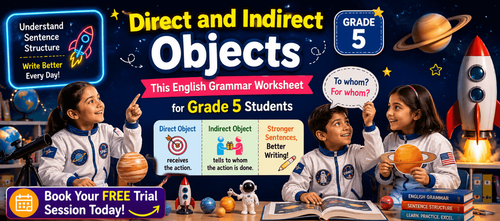

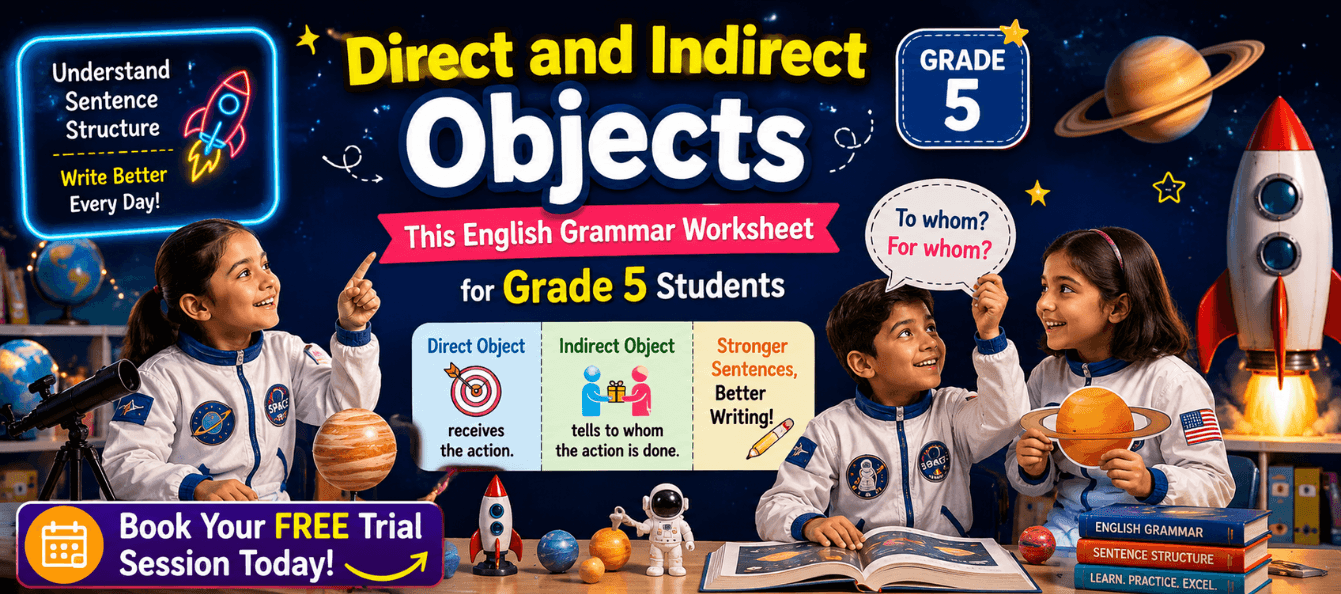
Direct and Indirect Objects with This English Grammar Worksheet for Grade 5 Students
Learning grammar becomes more exciting when students can understand how words work together in sentences. This Direct and Indirect Objects English grammar worksheet for Grade 5 helps learners practice sentence structure in a simple and engaging way. Through underlining activities, multiple-choice questions, sentence rewriting, fill-in-the-blanks, and paragraph writing, students get the opportunity to build stronger grammar skills step by step.
This worksheet is designed especially for Grade 5 students who want to improve their understanding of direct and indirect objects in everyday sentences. The activities encourage careful reading, sentence analysis, and writing practice. By solving these exercises regularly, students can become more confident while speaking and writing English.
Download these English grammar worksheets and practice regularly to strengthen your language skills and build a strong foundation. You can also book a free trial to get expert guidance and improve your reading, writing, and comprehension abilities. The worksheets are designed in a simple and structured way to help K–8 students learn grammar concepts easily and use them confidently in everyday communication.
What Is the Topic?
Direct and indirect objects are important parts of sentence structure. A direct object receives the action in a sentence, while an indirect object tells to whom or for whom the action is done. This Grade 5 English grammar worksheet helps students identify and use direct and indirect objects correctly.
Students are expected to:
• Identify direct objects in sentences
• Identify indirect objects in sentences
• Rewrite sentences correctly
• Practice grammar through multiple-choice questions
• Improve sentence-writing skills using direct objects
The worksheet uses easy examples and structured exercises to help learners understand how direct and indirect objects are used in daily communication.
What’s in This Worksheet?
1. Underline and circle activities to identify direct and indirect objects in sentences.
2. Multiple-choice questions that test understanding of direct and indirect objects.
3. Sentence rewriting exercises that help students apply grammar rules correctly.
4. Fill-in-the-blanks activities to improve vocabulary and sentence understanding.
5. Paragraph writing practice using sentences with direct objects.
6. Structured grammar exercises that support school learning and exam preparation.
7. Activities designed to improve reading, writing, and grammar accuracy.
Definitions, Examples, Techniques, and Tips
A direct object receives the action in a sentence.
Example:
Kabir ate an apple.
Direct object: an apple
An indirect object tells who receives the direct object.
Example:
Tara gave Mira a note.
Indirect object: Mira
Students can improve their grammar skills by:
• Reading sentences carefully
• Finding the action word first
• Asking “what?” to identify the direct object
• Asking “to whom?” or “for whom?” to identify the indirect object
The worksheet also helps students practice sentence structure through rewriting and paragraph-writing activities.
Why Is It Important to Learn This?
Learning direct and indirect objects helps students create clearer and more meaningful sentences. It improves grammar understanding and supports better writing skills. Students who understand sentence structure can communicate ideas more effectively in school and everyday conversations.
This topic is also important because it:
• Builds strong grammar foundations
• Improves sentence-writing skills
• Helps students understand English structure better
• Supports reading comprehension
• Makes writing more organized and accurate
Where Will This Knowledge Help You?
Students can use this knowledge in many areas of learning and communication.
• School grammar exams
• Creative writing tasks
• Classroom activities
• Reading comprehension exercises
• Daily speaking and writing
• Homework assignments
• Paragraph and sentence writing
Understanding direct and indirect objects also helps students write complete and grammatically correct sentences confidently.
How to Use This Worksheet?
1. Read each sentence carefully before answering.
2. Attempt all activities independently first.
3. Follow the exact order of questions while solving.
4. Underline the direct objects correctly wherever required.
5. Circle the indirect objects carefully in each sentence.
6. Compare your answers with the answer key in the same worksheet order.
7. Correct mistakes and rewrite incorrect answers neatly.
8. Practice regularly to improve grammar accuracy and confidence.
9. Review sentence structures again to strengthen understanding.
10. The solutions follow the exact worksheet order, so students should compare answers carefully.
Important Tips and Tricks
1. Find the action verb first before identifying objects.
2. The direct object usually answers “what?” after the verb.
3. The indirect object usually answers “to whom?” or “for whom?”
4. Read every sentence fully before choosing an answer in multiple-choice questions.
5. Avoid mixing the direct object with the subject of the sentence.
6. In rewriting exercises, pay attention to the instructions carefully.
7. While writing paragraphs, use clear and complete sentences.
8. Practice sentence identification regularly to improve speed and accuracy.
9. Examiners expect neat grammar usage and correct sentence structure.
10. Double-check all answers before submission to avoid small mistakes.
Complete Answer Key
Exercise No. 1
1. My mom made (me) __a sandwich__.
2. The teacher gave (the student) __a pencil__.
3. I bought (my dog) __a new toy__.
4. She wrote (her grandmother) __a letter__.
5. The pitcher threw (him) __the ball__.
6. Dad told (us) __a funny story__.
7. We sent (Sarah) __a birthday card__.
8. The baker sold (the man) __a cake__.
9. My friend showed (me) __his collection__.
10. He offered (the guest) __a glass of water__.
Exercise No. 2
1. Identify the direct object: Kabir ate an apple.
✓ a) an apple
2. Identify the indirect object: Tara gave Mira a note.
✓ c) Mira
3. Identify the direct object: Ishaan cleaned the board.
✓ b) the board
4. Identify the indirect object: Anya sent Dev a message.
✓ a) Dev
5. Identify the direct object: Sana found a marble.
✓ c) a marble
6. Identify the indirect object: Leela told Arav a story.
✓ b) Arav
7. Identify the direct object: Vikram drew a kite.
✓ c) a kite
8. Identify the indirect object: Mira showed Kabir her craft.
✓ a) Kabir
9. Identify the direct object: Tara washed the cup.
✓ b) the cup
10. Identify the indirect object: Dev brought Anya a gift.
✓ c) Anya
Exercise No. 3
1. Kabir read Mira a story.
Indirect object: Mira
2. Tara handed Ishaan a pen.
Direct object: a pen
3. Dev sent Leela a note.
Indirect object: Leela
4. Sana showed Arav a card.
Direct object: a card
5. Anya passed Vikram a ball.
Indirect object: Vikram
6. Mira lent Kabir a book.
Indirect object: Kabir
7. Ishaan brought Tara a flower.
Indirect object: Tara
8. Leela gave Sana a sticker.
Direct object: a sticker
9. Arav mailed Dev a letter.
Indirect object: Dev
10. Vikram bought Mira a toy.
Direct object: a toy
Exercise No. 4
Kabir walked into the activity room, excited to see what the class had prepared for the day. A cool breeze moved through the open windows, making the colourful charts on the wall flutter softly. Tara pointed to a decorated box on the table, its lid decorated with bits of shiny paper from yesterday’s craft session. Near the art shelf, Mira held up a colourful craft she had made in class, proudly showing the neat folds and bright colours. Ishaan paused for a moment as a loud bell echoed from the corridor, reminding everyone that the next period was about to begin. A few students gathered near the corner to arrange scattered materials that were scattered across the floor. On the opposite side, Kabir noticed clean brushes drying on a stand after being washed. Just then, Tara spotted a shiny sticker sheet under the chair, and everyone helped tidy the room before leaving.
Exercise No. 5
Friendship makes life happier and more meaningful. My best friend shares stories with me every day. I give my friend support during difficult times. We play games after school and enjoy many activities together. My friend always tells me funny jokes that make me laugh. I wrote my friend a birthday card last week. Good friends bring joy and kindness into our lives.
Practicing direct and indirect objects regularly can help Grade 5 students become stronger and more confident in English grammar. This Direct and Indirect Objects English grammar worksheet gives students many opportunities to improve sentence understanding, writing skills, and grammar accuracy. By practicing carefully and reviewing answers regularly, students can continue building excellent communication skills for school and daily life.