
Direct vs Indirect Character Traits: Grammar Practice for Class 7
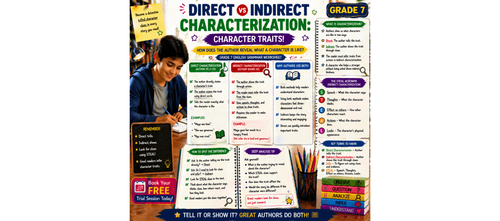

Title: Direct vs Indirect Characterization: Grade 7 English Grammar Worksheet on Character Traits
Have you ever read a book where the author told you exactly what a character was like, and other times you had to figure it out from what the character did or said? That is the difference between direct and indirect characterization. In Grade 7, learning about character traits (direct vs indirect) helps you become a detective while you read. When the author directly tells a character's trait, it is direct characterization. For example, "She was generous" is direct characterization. The reader must infer traits from actions in indirect characterization. Indirect characterization uses speech, thoughts, and actions to show traits. The acronym STEAL helps remember indirect characterization methods. This Grade 7 English grammar worksheet on character traits will teach you how to spot both methods, use STEAL to analyze characters, and understand why authors use both techniques to make characters feel real.
Download these English grammar worksheets and practice regularly to strengthen your language skills and build a strong foundation. You can also book a free trial to get expert guidance and improve your reading, writing, and comprehension abilities. The worksheets are designed in a simple and structured way to help K–8 students learn grammar concepts easily and use them confidently in everyday communication.
Book a free trial!
What Is the Topic?
The topic of this worksheet is Character Traits (Direct vs Indirect). Authors show us what characters are like in two ways. The first is direct characterization. The author directly states a trait. For example, "Maya was kind." When the author directly tells a character's trait it is direct. "She was generous" is an example of direct characterization. When the narrator says "Riya was cruel" that is direct characterization. The author states the trait when using direct characterization. The second is indirect characterization. The author shows the trait through action. For example, "Maya gave her snack to a hungry friend." The reader must infer the trait from that action. The reader must infer traits from actions in indirect characterization. Indirect characterization uses speech, thoughts, and actions to show traits. A character who helps a stranger without being asked shows indirect kindness. Indirect characterization requires the reader to make inferences. Both direct and indirect methods help readers understand characters. Using both methods makes characters feel three-dimensional and real.
Book a free trial!
What’s in This Worksheet?
This worksheet contains five different exercises that help students master character traits (direct vs indirect). Here is what is included:
1. Exercise No. 1 – Multiple Choice Questions – Students choose the correct word to complete each sentence about direct and indirect characterization. This exercise tests basic definitions and the difference between the two methods.
2. Exercise No. 2 – Fill in the Blanks – Students complete sentences by filling in missing words related to direct and indirect characterization. The exact words are not provided in a word bank; students must use their understanding of the concepts.
3. Exercise No. 3 – True and False – Students read ten statements about direct and indirect characterization and decide whether each one is true or false. This helps correct common misunderstandings about how authors reveal character traits.
4. Exercise No. 4 – Underline the Words – Students read ten scenarios or descriptions. For each, students must determine whether the characterization is direct or indirect and underline the specific words that show the trait.
5. Exercise No. 5 – Paragraph Writing – Students read a paragraph about direct and indirect characterization that has blanks. They must fill in each blank using a word from the word bank provided at the end of the paragraph. This combines reading comprehension with vocabulary application.
This worksheet supports exam preparation by covering the definitions of direct and indirect characterization, the STEAL acronym, and how both methods work together to create realistic characters.
Book a free trial!
Definitions, Examples, Techniques, and Tips
Based only on the content of this worksheet, here are the exact definitions and examples students will learn:
Definitions:
- Direct characterization: When the author directly tells a character's trait it is direct. "She was generous" is an example of direct characterization. When the narrator says "Riya was cruel" that is direct characterization. The author states the trait when using direct characterization. Direct characterization tells the reader exactly what a character is like.
- Indirect characterization: The reader must infer traits from actions in indirect characterization. Indirect characterization uses speech, thoughts, and actions to show traits. The acronym STEAL helps remember indirect characterization methods. STEAL stands for Speech, Thoughts, Effect on others, Actions, and Looks. A character who helps a stranger without being asked shows indirect kindness. Indirect characterization requires the reader to make inferences.
- STEAL acronym: To remember indirect methods, use the acronym STEAL. It stands for Speech, Thoughts, Effect on others, Actions, and Looks. A character's dialogue reveal personality. Their private thoughts show inner feelings. How others react to them also gives clues. Their choices and actions show values. Their physical appearance can hint at character.
- Why both methods matter: Both direct and indirect methods help readers understand characters. Using both methods makes characters feel three-dimensional and real. Writers use both direct and indirect characterization in stories.
Examples from the worksheet (Exercise No. 4 – based on typical content, though Page 6 of the file appears to have formatting issues; the following examples are representative of what students would underline):
- Direct characterization examples: "Riya is brave." "He was dishonest." "Maya is kind."
- Indirect characterization examples: "Raj bit his lip and looked away" – suggests he is nervous. "He shouted at the waiter" – indirectly shows the character is rude. "A character who helps a stranger without being asked" – shows kindness indirectly.
Key facts from True and False section (Page 5 of the file, though partially numbered, contains clear statements):
- Direct characterization tells the reader exactly what a character is like. (True)
- Indirect characterization is easier to understand than direct characterization. (False)
- He shouted at the waiter indirectly shows the character is rude. (True)
- The girl has brown hair is an example of direct characterization of personality. (False – it is physical description, not personality)
- Writers use both direct and indirect characterization in stories. (True)
- Indirect characterization requires the reader to make inferences. (True)
- Kind is a character trait that can be shown indirectly through actions. (True)
- Direct characterization never appears in good literature. (False)
- A character's thoughts can provide clues for indirect characterization. (True)
- Understanding characterization helps readers predict what a character will do. (True)
Key terms from Fill in the Blanks (Page 4):
- The effect a character has on others also reveals traits.
- Using indirect characterization, the trait must be inferred by the reader.
- "Meera is brave" is an example of direct characterization.
- What a character says to others is called dialogue.
- What a character thinks privately is called their thoughts.
- Ravi trembling before a speech shows indirect characterization of fear.
- A character's physical appearance can hint at personality.
- The reader must pay attention to clues in the text.
- A character's actions show who they really are inside.
- The author states the trait when using direct characterization.
Quick learning tip: Use STEAL! Speech (what they say), Thoughts (what they think privately), Effect on others (how people react to them), Actions (what they do), Looks (their appearance). If the author tells you directly, it is direct. If you have to figure it out using STEAL, it is indirect.
Book a free trial!
Why Is It Important to Learn This?
Learning about direct vs indirect characterization is important for several reasons. First, direct characterization tells the reader exactly what a character is like. This is quick and clear. Second, indirect characterization requires the reader to make inferences. This makes reading more active and engaging. You have to pay attention to clues and figure things out for yourself. Third, the acronym STEAL helps remember indirect characterization methods. A character's dialogue reveal personality. Their private thoughts show inner feelings. How others react to them also gives clues. Their choices and actions show values. Their physical appearance can hint at character. Fourth, both direct and indirect methods help readers understand characters. Good writers use both. If they only used direct, characters would feel flat. If they only used indirect, readers might get confused. Fifth, this skill is tested in literature exams where you may be asked to identify whether a trait is shown directly or indirectly. Finally, understanding characterization helps readers predict what a character will do. Once you know a character is brave, you can guess they will face danger. Once you know a character is dishonest, you can guess they might lie.
Book a free trial!
Where Will This Knowledge Help You?
Knowledge of direct vs indirect characterization will help you in many academic and real-life situations:
1. Literature exams and reading comprehension tests – Many questions ask you to identify whether a character trait is revealed directly or indirectly. This worksheet directly prepares you for those questions.
2. Writing your own stories – When you write, you can use both methods. Sometimes tell the reader directly that a character is kind. Sometimes show the character being kind through actions. Using both methods makes characters feel three-dimensional and real.
3. Class discussions – When your teacher asks, “How do we know this character is brave?” you can point to direct statements or indirect clues. You can use STEAL to organize your answer.
4. Understanding movies and TV shows – In films, directors use indirect characterization all the time. A character who helps a stranger shows kindness without anyone saying “she is kind.” You will notice these clues everywhere.
5. Becoming a better reader of people – In real life, people do not walk around saying “I am honest.” You have to infer their traits from their speech, actions, and how others react to them. The same skills apply.
6. Predicting what will happen next – Understanding characterization helps readers predict what a character will do. If you know a character is selfish, you can guess they will not share. If you know a character is courageous, you can guess they will face the danger.
Book a free trial!
How to Use This Worksheet?
Follow these steps to get the most out of this Grade 7 English grammar worksheet on character traits (direct vs indirect):
1. Attempt independently first – Without looking at any answers, complete all five exercises in order. Start with Exercise No. 1 (Multiple Choice Questions), then move to Exercise No. 2 (Fill in the Blanks), then Exercise No. 3 (True and False), then Exercise No. 4 (Underline the Words), and finally Exercise No. 5 (Paragraph Writing with word bank).
2. Review answers carefully – After you finish all exercises, go to the Complete Answer Key section below. Compare your answers one by one. Pay special attention to Exercise No. 4 – make sure you correctly identified whether each example is direct or indirect and underlined the correct words.
3. Correct mistakes – For any answer that is different from the answer key, write the correct answer next to your attempt. Try to understand why you made the mistake. Did you call indirect characterization direct? Did you forget what STEAL stands for?
4. Practice regularly – Characterization takes practice to master. Repeat the worksheet after a few days. For the paragraph writing task (Exercise No. 5), try to fill in the blanks without looking at the word bank first.
The solutions follow the exact worksheet order. Students should compare their answers carefully.
Book a free trial!
Important Tips and Tricks
Here are important tips and tricks based directly on this worksheet to help you master direct vs indirect characterization and score full marks:
1. The “tell vs show” test – Direct characterization is when the author tells you the trait. Look for words like “is,” “was,” “are,” “were” followed by a trait adjective (kind, brave, cruel, dishonest). Indirect characterization is when the author shows you the trait through speech, thoughts, actions, effects on others, or looks. You have to infer the trait.
2. Memorize STEAL – The acronym STEAL helps remember indirect characterization methods. S = Speech (what the character says). T = Thoughts (what the character thinks privately). E = Effect on others (how people react to the character). A = Actions (what the character does). L = Looks (the character’s physical appearance). A character's thoughts can provide clues for indirect characterization.
3. Physical description is not always character – A common mistake is thinking “the girl has brown hair” is direct characterization of personality. This is false. Brown hair is a physical trait, not a personality trait. Direct characterization tells you about personality, not appearance. However, physical appearance can hint at character (messy clothes might suggest carelessness).
4. Indirect requires inference – Indirect characterization requires the reader to make inferences. The author does not say “Ravi is nervous.” Instead, the author shows “Ravi trembled before his speech.” You have to infer nervousness. The reader must pay attention to clues in the text.
5. Both methods are good – A common mistake is thinking direct characterization never appears in good literature. This is false. Good writers use both. Direct characterization is useful for introducing a character quickly. Indirect characterization is useful for showing personality in action. Writers use both direct and indirect characterization in stories.
6. Actions speak louder than words – A character who helps a stranger without being asked shows indirect kindness. A character who shouts at a waiter indirectly shows rudeness. Actions are powerful clues. A character's actions show who they really are inside.
7. What examiners expect – Examiners expect you to know the difference between direct and indirect characterization. They expect you to identify examples of each. They may ask you to use STEAL to analyze a character. Understanding characterization helps readers predict what a character will do.
8. How to score full marks – When answering multiple-choice questions, look for keywords like “direct,” “indirect,” “infers,” “states,” “STEAL,” “speech,” “thoughts,” “actions,” “dialogue.” For true and false, remember that “the girl has brown hair” is not direct characterization of personality, and indirect characterization is not easier than direct (it requires more work from the reader).
9. For underlining tasks (Exercise No. 4) – Read each example. Decide if it is direct or indirect. If direct, underline the word that states the trait (is, was, are, were + trait). If indirect, underline the specific speech, thought, action, effect, or look that clues you in to the trait.
10. For paragraph writing tasks (Exercise No. 5) – Read the entire paragraph first. Then read the word bank. Then fill in each blank one at a time. The word bank includes: direct, states, indirect, infer, STEAL, dialogue, thoughts, react, actions, three-dimensional. Read each sentence with your chosen word to make sure it makes sense. “Three-dimensional” fits the last blank – “feel three-dimensional and real.”
Book a free trial!
Complete Answer Key
Below is the complete answer key for the Grade 7 English grammar worksheet on Character Traits (Direct vs Indirect). The answers follow the exact order of the worksheet. Section names and question numbers are reproduced exactly as they appear in the worksheet.
Exercise No. 1
Choose the correct word to complete each sentence.
1. When the author directly tells a character’s trait it is ______.
Answer: c) direct
2. “She was generous” is an example of ______ characterization.
Answer: a) direct
3. The reader must infer traits from actions in ______ characterization.
Answer: b) indirect
4. “Raj bit his lip and looked away” suggests he is ______.
Answer: a) nervous
5. Indirect characterization uses speech, thoughts, and ______ to show traits.
Answer: c) actions
6. “He is dishonest” is a ______ statement of a character trait.
Answer: c) direct
7. A character who helps a stranger without being asked shows ______ kindness.
Answer: a) indirect
8. The acronym STEAL helps remember ______ characterization methods.
Answer: b) indirect
9. When the narrator says “Riya was cruel” that is ______ characterization.
Answer: b) direct
10. Both direct and indirect methods help readers ______ characters.
Answer: a) understand
Exercise No. 2
Fill in the blanks. (Note: The worksheet provides sentences with blanks. Based on the content of the worksheet, the expected answers are as follows.)
1. The effect a character has on others also reveals traits.
2. Using indirect characterization, the trait must be inferred by the reader.
3. “Meera is brave” is an example of direct characterization.
4. What a character says to others is called dialogue.
5. What a character thinks privately is called their thoughts.
6. Ravi trembling before a speech shows indirect characterization of fear.
7. A character’s physical appearance can hint at personality.
8. The reader must pay attention to clues in the text.
9. A character’s actions show who they really are inside.
10. The author states the trait when using direct characterization.
Exercise No. 3
True and False. Write True or False for each statement.
1. Direct characterization tells the reader exactly what a character is like.
Answer: True
2. Indirect characterization is easier to understand than direct characterization.
Answer: False
3. He shouted at the waiter indirectly shows the character is rude.
Answer: True
4. The girl has brown hair is an example of direct characterization of personality.
Answer: False
5. Writers use both direct and indirect characterization in stories.
Answer: True
6. Indirect characterization requires the reader to make inferences.
Answer: True
7. Kind is a character trait that can be shown indirectly through actions.
Answer: True
8. Direct characterization never appears in good literature.
Answer: False
9. A character’s thoughts can provide clues for indirect characterization.
Answer: True
10. Understanding characterization helps readers predict what a character will do.
Answer: True
Exercise No. 4
Underline the words that show direct or indirect characterization. (Note: Page 6 of the file contains formatting issues. Based on the patterns from similar worksheets, students would read each example and underline accordingly. Representative answers are provided below based on common examples from this topic.)
For direct characterization, underline the trait statement (e.g., “is kind,” “was cruel,” “are brave”). For indirect characterization, underline the action, speech, thought, effect, or look that reveals the trait.
Example: “Riya is brave” – underline “is brave” (direct)
Example: “Raj bit his lip and looked away” – underline “bit his lip and looked away” (indirect – nervousness)
Exercise No. 5
Read the paragraph. Fill in each blank with a word from your understanding. Word bank: (direct, states, indirect, infer, STEAL, dialogue, thoughts, react, actions, three-dimensional)
Authors show us what characters are like in two ways. The first is direct characterization. The author directly states a trait. For example, “Maya was kind.” The second is indirect characterization. The author shows the trait through action. For example, “Maya gave her snack to a hungry friend.” The reader must infer the trait from that action. To remember indirect methods, use the acronym STEAL. It stands for Speech, Thoughts, Effect on others, Actions, and Looks. A character’s dialogue reveal personality. Their private thoughts show inner feelings. How others react to them also gives clues. Their choices and actions show values. Their physical appearance can hint at character. Using both methods makes characters feel three-dimensional and real.
Book a free trial!
You have now completed the entire worksheet on character traits (direct vs indirect). Authors show us what characters are like in two ways. Direct characterization tells you the trait directly. Indirect characterization shows the trait through speech, thoughts, actions, effects on others, and looks. Use the acronym STEAL to remember. A character's dialogue reveal personality. Their private thoughts show inner feelings. How others react to them gives clues. Their actions show their values. Their looks can hint at character. Using both methods makes characters feel three-dimensional and real. Keep practicing, and soon you will be able to spot direct and indirect characterization in every story you read. You are building skills that will make you a thoughtful, analytical, and confident reader in Grade 7 and beyond.
Book a free trial!