
Easy Homophones Practice Worksheet for Grade 1 Learners
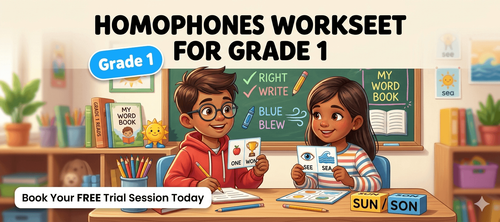

Improve Vocabulary Skills with an English grammar worksheet for Grade 1 on Homophones
Learning new words becomes even more exciting when children discover that some words sound the same but have different meanings. In Grade 1, students begin recognizing these special word pairs called homophones. Understanding homophones helps young learners improve spelling, reading comprehension, and sentence understanding.
This English grammar worksheet for Grade 1 on Homophones introduces children to commonly used homophone pairs through engaging activities. Students match words, sort word pairs, complete sentences using correct homophones, choose correct options, and rewrite sentences accurately. Each activity strengthens vocabulary skills while helping learners understand how meaning changes depending on spelling.
Download these English grammar worksheets and practice regularly to strengthen your language skills and build a strong foundation. You can also book a free trial to get expert guidance and improve your reading, writing, and comprehension abilities. The worksheets are designed in a simple and structured way to help K–8 students learn grammar concepts easily and use them confidently in everyday communication.
What Is the Topic?
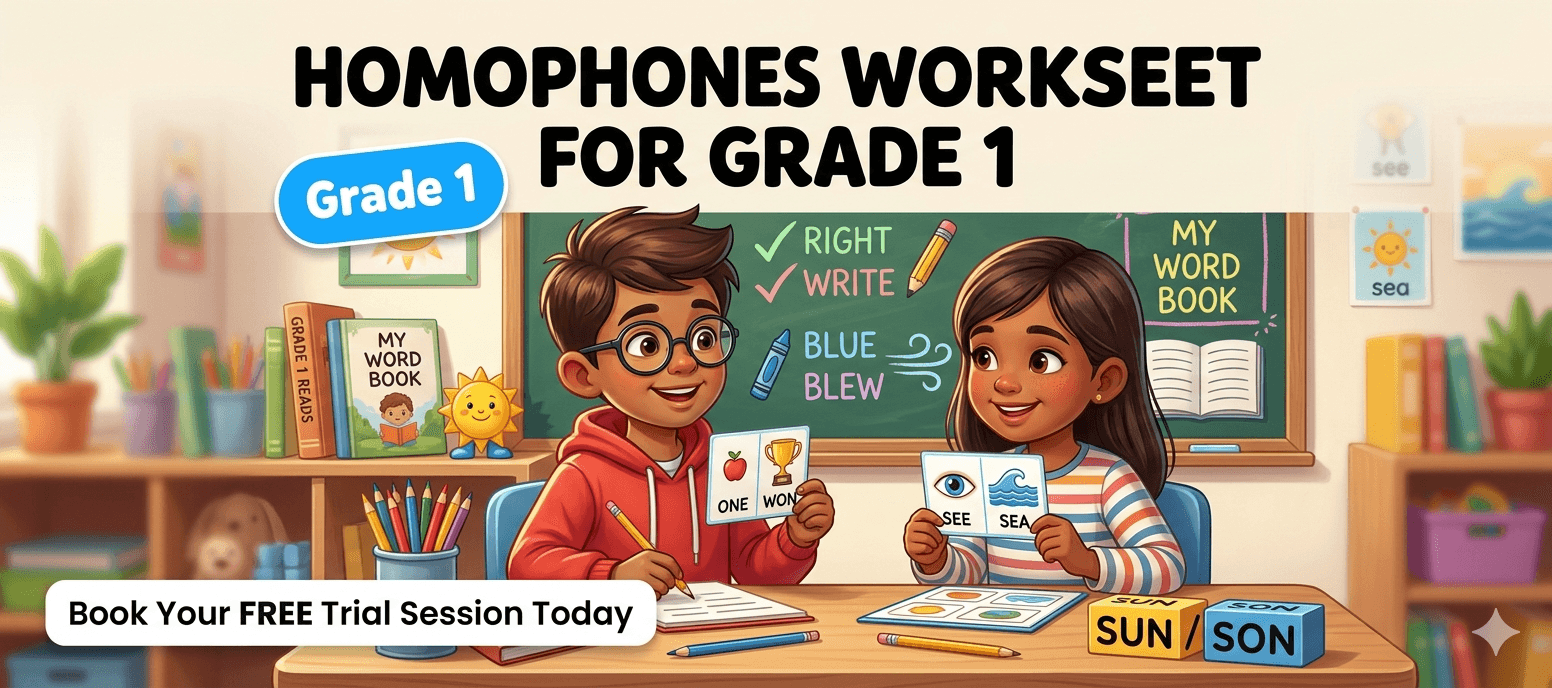
Homophones are words that sound the same when spoken but have different spellings and meanings. Grade 1 students learn to identify these words and use them correctly in sentences.
The worksheet focuses on helping students understand how the same sound can represent different ideas. Learners observe word pairs, match them correctly, and select suitable words based on sentence meaning.
By practicing homophones, students learn to read carefully, understand context, and choose accurate spellings while writing.
What’s in This Worksheet?
1. Matching homophone pairs.
2. Sorting word pairs into homophones and not homophones.
3. Filling in blanks using correct homophones.
4. Multiple choice questions based on sentence meaning.
5. Sentence rewriting activities using correct homophones.
6. Progressive exercises designed to strengthen spelling, comprehension, and vocabulary understanding.
Definitions, Examples, Techniques, and Tips
Definitions
Homophones are words that sound alike but have different meanings and spellings.
Examples from the worksheet
see and sea
right and write
blue and blew
sun and son
here and hear
one and won
flour and flower
pair and pear
wait and weight
dear and deer
Techniques
Read each sentence carefully before selecting a word.
Think about the meaning of the sentence, not just the sound of the word.
Check spelling after choosing a homophone.
Quick learning tips
Listen carefully to word sounds.
Understand sentence meaning before answering.
Practice reading sentences aloud to notice differences in meaning.
Why Is It Important to Learn This?
Learning homophones helps students avoid spelling mistakes and improves reading comprehension. When children understand that similar sounds can carry different meanings, they become more accurate writers and readers.
Homophones also strengthen vocabulary development and help learners understand sentences more clearly. Early practice builds confidence in communication and supports overall grammar learning.
Where Will This Knowledge Help You?
Students use homophones while writing sentences and stories.
They help improve spelling accuracy in school exams.
Understanding homophones improves reading comprehension and listening skills.
These skills also help students follow classroom instructions correctly.
How to Use This Worksheet?
1. Read each question carefully before answering.
2. Attempt every exercise independently.
3. Focus on sentence meaning while choosing homophones.
4. Compare answers carefully with the answer key below.
5. The solutions follow the exact worksheet order, so check each answer step by step.
Important Tips and Tricks
1. Do not choose a word only because it sounds correct.
2. Always read the entire sentence to understand meaning.
3. Watch for commonly confused homophones.
4. Practice rewriting sentences carefully to improve spelling accuracy.
5. Review mistakes to strengthen understanding.
Complete Answer Key
Exercise No. 1
Match each word on the left to the correct homophone on the right.
see – sea
right – write
blue – blew
sun – son
here – hear
one – won
flour – flower
dear – deer
pair – pear
wait – weight
Exercise No. 2
Sort the word pairs into Homophones and Not homophones.
Homophones
blue / blew
right / write
here / hear
one / won
sun / son
to / too
sail / sale
flour / flower
Not homophones
king / kingly
pen / pan
rain / train
cat / cot
bat / bad
map / nap
fork / form
Exercise No. 3
Choose one homophone from each pair to complete the blank.
1. sea
2. hear
3. write
4. sun
5. won
6. pear
7. flour
8. too
9. wait
10. deer
Exercise No. 4
Choose the correct option so the homophone fits the sentence.
1. hear
2. write
3. bow
4. sun
5. won
6. pear
7. through
8. be
9. lift
10. dear
Exercise No. 5
Rewrite each sentence using the correct homophone for the underlined word.
1. Riya went to the sea with friends.
2. He could not hear the school bell.
3. The son set and the sun greeted us.
4. Please write your name at the desk.
5. She ate a pear and had a pair left.
6. The baker used flour in the cake.
7. Ravi threw the ball through the gate.
8. Do not lift the bag, it has much weight.
9. There are too many books in the bag.
10. The letter was very dear to him.
Practicing with this English grammar worksheet for Grade 1 on Homophones helps students understand word meanings, improve spelling accuracy, and develop strong reading skills. Regular practice allows young learners to recognize sound patterns, understand sentence context, and communicate ideas clearly with confidence.