
Easy Prediction and Inference Worksheet for Class 1 Students
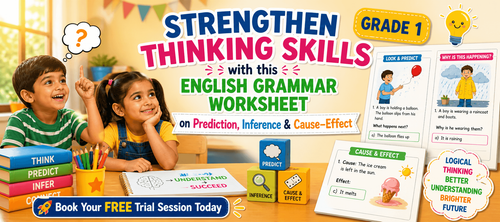

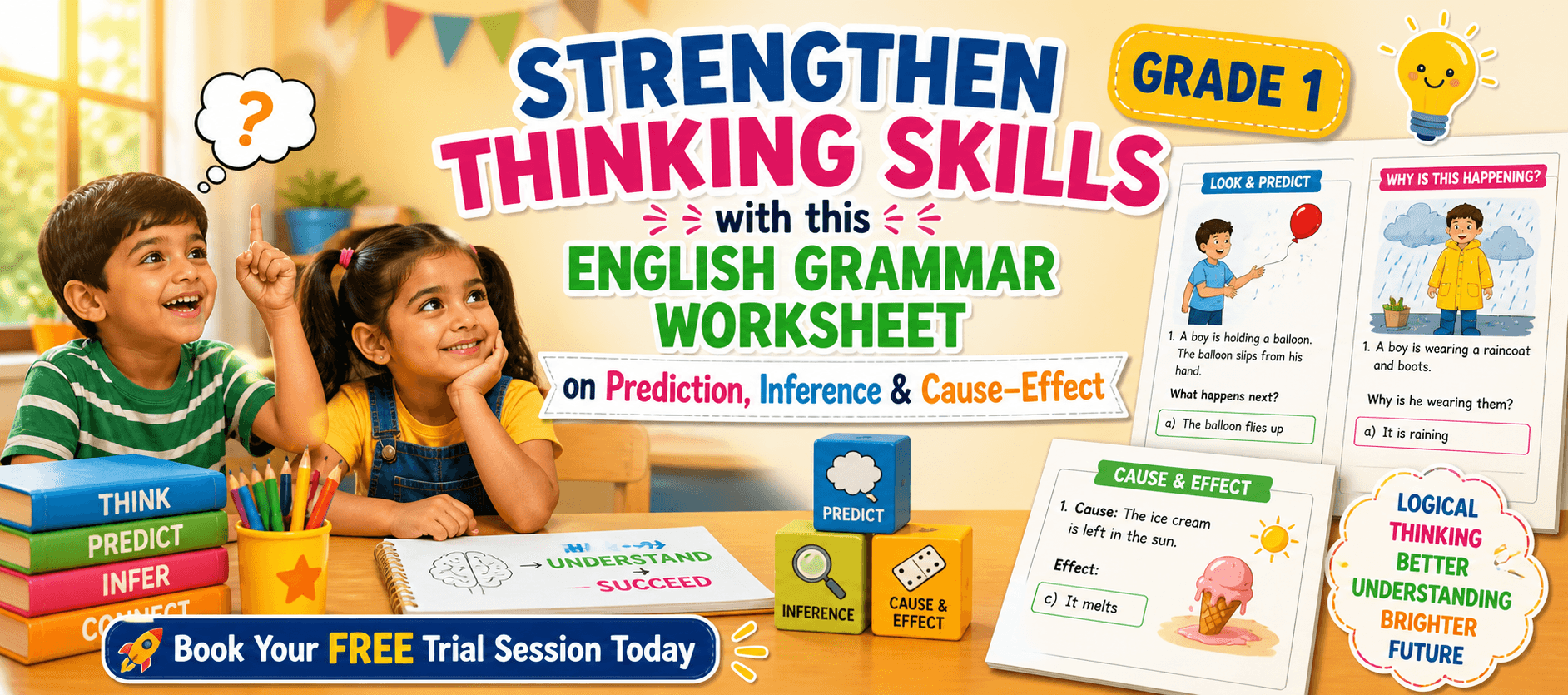
Strengthen Thinking Skills with This English Grammar Worksheet for Grade 1 on Prediction, Inference & Cause–Effect
Have you ever tried to guess what will happen next in a situation? Or wondered why something happens? This English grammar worksheet for Grade 1 on Prediction, Inference & Cause–Effect helps young learners develop these important thinking skills. It teaches children how to observe situations, predict outcomes, understand reasons, and connect actions with results.
Through simple picture-based questions, students learn how to think logically. Whether it is predicting what happens when a balloon slips, understanding why someone wears a raincoat, or identifying the result of leaving ice cream in the sun, this worksheet makes learning engaging and meaningful.
Download these English grammar worksheets and practice regularly to strengthen your language skills and build a strong foundation. You can also book a free trial to get expert guidance and improve your reading, writing, and comprehension abilities. The worksheets are designed in a simple and structured way to help K–8 students learn grammar concepts easily and use them confidently in everyday communication.
What Is The Topic?
Prediction, Inference, and Cause–Effect help students understand situations better by thinking about what might happen next, why something happens, and what result follows an action.
In this topic, students learn to:
• Predict what will happen next
• Understand reasons behind actions
• Identify cause and effect relationships
• Observe and think logically
This improves comprehension and reasoning skills.
What’s In This Worksheet?
1. Questions to predict what happens next in a situation
2. Picture-based prediction questions
3. Questions to understand reasons behind actions
4. Cause and effect matching questions
5. Sentence completion tasks based on pictures
The worksheet is structured to move from simple predictions to deeper understanding of cause and effect.
Definitions, Examples, Techniques, And Tips
Definitions
Prediction means guessing what will happen next.
Inference means understanding why something happens.
Cause means the reason something happens.
Effect means the result of an action.
Examples
A balloon slips from a hand and flies up.
Ice cream melts in the sun.
Dark clouds bring rain.
Techniques
Look carefully at the situation.
Think about real-life experiences.
Choose the most logical answer.
Tips
Read each question slowly.
Do not guess randomly.
Think about cause and result clearly.
Why Is It Important To Learn This?
This topic helps students develop logical thinking and understanding. It improves comprehension and helps children connect ideas. These skills are important for reading, writing, and everyday decision-making.
Where Will This Knowledge Help You?
This knowledge helps in:
• Answering comprehension questions
• Understanding stories and situations
• Improving reasoning skills
• Performing better in exams
How To Use This Worksheet?
1. Read each situation carefully
2. Observe the picture or description
3. Think about what happens next or why it happens
4. Choose the most logical answer
5. Compare answers in the exact worksheet order
The solutions follow the exact worksheet order, so students should check answers carefully.
Important Tips And Tricks
1. Focus on cause and result
2. Think about real-life situations
3. Identify clues in the question
4. Avoid unrealistic options
5. Double-check your answers
Complete Answer Key
Exercise No. 1
Look At The Picture Choose What Happens Next.
1. A boy is holding a balloon. The balloon slips from his hand.
(a) The balloon flies up
2. A boy is about to kick a ball. What happens next?
(a) The ball rolls
3. A child is holding an ice cream on a hot day. What happens next?
(c) The ice cream melts
4. A girl is standing under a tree. Apples are falling. What happens next?
(b) An apple falls down
5. A girl is standing at the top of a slide. What happens next?
(b) She slides down
Exercise No. 2
Picture-Based Predictions: Look At The Picture. What Will Happen Next?
1. A dog is standing near an open food bowl. What will happen next?
(a) The dog eats the food
2. A child is standing near a puddle with bare feet. What will happen next?
(b) The child steps in the water
3. A kite is flying high, and the string breaks. What will happen next?
(c) The kite falls down
4. A glass is at the edge of a table. What will happen next?
(a) It may fall
5. Dark clouds are in the sky. A child is outside. What will happen next?
(b) It will rain
Exercise No. 3
Picture Inferences - Look At The picture. Choose The Best Answer.
1. A boy is wearing a raincoat and boots. Why is he wearing them?
(a) It is raining
2. A girl is rubbing her eyes and yawning. Why is she doing this?
(b) She is tired
3. A boy is wiping sweat from his face on a sunny day. Why is he doing this?
(c) He is hot
4. A girl is hugging a teddy bear in bed. Why is she doing this?
(a) She is going to sleep
5. A boy is covering his ears near a loud drum. Why is he doing this?
(b) The sound is loud
Exercise No. 4
Cause And Effect Using Pictures
1. Cause: The ice cream is left in the sun.
Effect:
(c) It melts
2. Cause: A child forgets to water the plant.
Effect:
(a) The plant dries
3. Cause: A girl eats too much candy.
Effect:
(b) His tummy hurts
4. Cause: A boy leaves his toys outside at night.
Effect:
(a) The toys get dirty
Exercise No. 5
Look At The Pictures. Complete The Sentences.
Cause: A child steps on a wet floor.
Cause: A boy kicks a ball into a glass window.
With regular practice using this English grammar worksheet for Grade 1 on Prediction, Inference & Cause–Effect, students can improve their thinking and understanding skills. It helps them make better predictions and understand reasons clearly, making learning more effective and enjoyable.