
Easy Subject and Predicate Exercises for Class 3 PDF
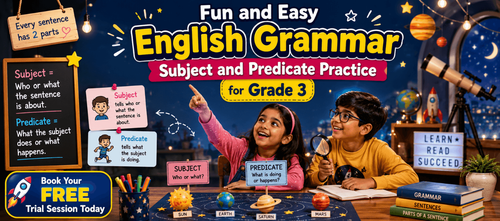

Fun and Easy English Grammar Worksheet for Grade 3 Subject and Predicate Practice
Learning sentence formation becomes exciting when children understand how subjects and predicates work together. This English grammar worksheet for Grade 3 helps students identify the subject and predicate in simple sentences through engaging activities like circling, underlining, matching, coloring, and fill-in-the-blanks. The worksheet is designed in a fun and structured format so that students can practice grammar concepts step by step while improving their sentence-building skills.
This Grade 3 worksheet on Subject and Predicate includes multiple types of exercises that help children recognize who or what the sentence is about and what action is happening in the sentence. Students get the opportunity to read carefully, think logically, and improve their grammar confidence through interactive tasks.
Download these English grammar worksheets and practice regularly to strengthen your language skills and build a strong foundation. You can also book a free trial to get expert guidance and improve your reading, writing, and comprehension abilities. The worksheets are designed in a simple and structured way to help K–8 students learn grammar concepts easily and use them confidently in everyday communication.
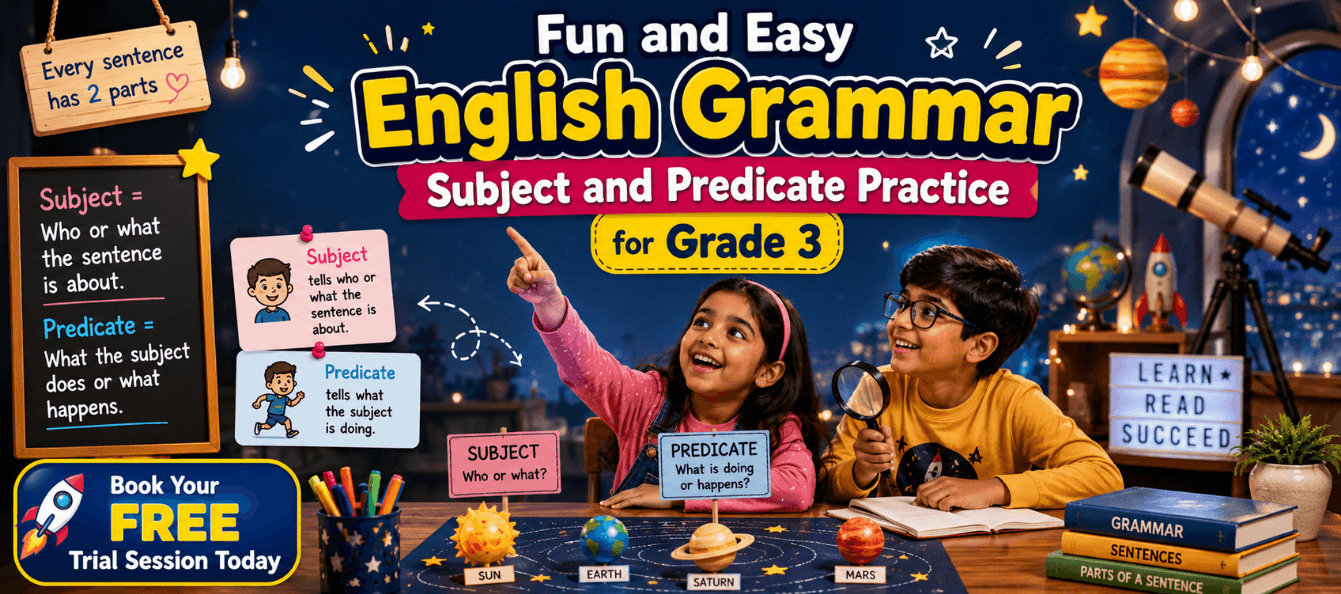
What Is Subject and Predicate?
Every complete sentence has two main parts:
1. Subject: The subject is the part of the sentence that tells who or what the sentence is about.
2. Predicate: The predicate is the part of the sentence that tells what the subject is doing or what is happening.
Examples:
1. The birds are flying in the sky.
2. My brother plays football.
3. We went to the zoo.
This Grade 3 English grammar worksheet teaches students how to identify these two important parts of a sentence correctly. Students learn to separate the naming part of the sentence from the action part of the sentence.
What’s in This Worksheet?
1. Circle and underline activities where students identify subjects and predicates in sentences.
2. Matching exercises that help students connect subjects with suitable predicates to form complete sentences.
3. Fill in the blanks questions that encourage sentence completion practice.
4. Coloring activities where students identify subject and predicate parts using different colors.
5. Practice sentences that improve reading, understanding, and sentence formation skills.
6. Exercises arranged in a simple and structured order for easy learning.
7. Grammar-based activities that support school exams and classroom practice.
Definitions, Examples, Techniques, and Tips
Definitions
1. Subject: The subject is the part of the sentence that tells who or what the sentence is about.
2. Predicate: The predicate is the part of the sentence that tells what the subject is doing or what is happening.
Examples
1. The birds are flying in the sky.
Subject: The birds
Predicate: are flying in the sky
2. My brother plays football.
Subject: My brother
Predicate: plays football
3. We went to the zoo.
Subject: We
Predicate: went to the zoo
Techniques
1. Read the sentence carefully from beginning to end.
2. Find the naming word or person in the sentence. That part is the subject.
3. Find the action or information about the subject. That part is the predicate.
4. Practice matching subjects with suitable predicates to understand sentence structure better.
Quick Learning Tips
1. The subject usually comes before the predicate.
2. Every complete sentence needs both a subject and a predicate.
3. Action words help identify the predicate easily.
4. Read the sentence aloud to understand its meaning properly.
Why Is It Important to Learn This?
Learning subjects and predicates is important because it helps students understand sentence structure clearly. It improves grammar accuracy and helps children write complete sentences correctly. This topic also strengthens reading comprehension and speaking skills.
Students who understand subject and predicate can identify sentence meaning more easily. It also helps them communicate better in class, during writing activities, and in daily conversations.
Where Will This Knowledge Help You?
1. In grammar exams and class tests.
2. During sentence writing activities.
3. While reading stories and comprehension passages.
4. In classroom discussions and speaking activities.
5. During paragraph writing and creative writing tasks.
6. While understanding complete and meaningful sentences.
How to Use This Worksheet?
1. Read every sentence carefully before answering.
2. Attempt all activities independently first.
3. Circle the subject and underline the predicate carefully in the correct order.
4. Match each subject with the correct predicate properly.
5. Fill in the blanks using suitable words to complete the sentence.
6. Review all answers carefully after completing the worksheet.
7. Compare your answers with the complete answer key given below.
8. Practice regularly to improve sentence formation skills.
9. The solutions follow the exact worksheet order, so students should compare answers carefully.
Important Tips and Tricks
1. Always identify who or what the sentence is about first.
2. Look for action words to identify the predicate.
3. Read the complete sentence before choosing answers.
4. Avoid mixing subjects and predicates incorrectly.
5. Match the sentence meaning properly while solving matching exercises.
6. In fill in the blanks exercises, make sure the completed sentence sounds meaningful.
7. Use neat underlining and circling while practicing.
8. Examiners expect complete and correct sentence understanding.
9. Practice identifying sentence parts daily to score full marks in grammar exercises.
Complete Answer Key
Exercise 1
Circle the subject and underline the predicate in each sentence.
1. The dog / barked loudly at the stranger.
Subject: The dog
Predicate: barked loudly at the stranger.
2. The birds / are flying in the sky.
Subject: The birds
Predicate: are flying in the sky.
3. Homework / was given to us by our teacher.
Subject: Homework
Predicate: was given to us by our teacher.
4. The cat / slept on the couch.
Subject: The cat
Predicate: slept on the couch.
5. Those kids / are running in the hall.
Subject: Those kids
Predicate: are running in the hall.
6. My mother / made a cake for me.
Subject: My mother
Predicate: made a cake for me.
7. The sun / rises in the east.
Subject: The sun
Predicate: rises in the east.
8. A song / was sung by the children.
Subject: A song
Predicate: was sung by the children.
9. My brother / is playing with his toys.
Subject: My brother
Predicate: is playing with his toys.
10. Her shoes / are under the bed.
Subject: Her shoes
Predicate: are under the bed.
Exercise 2
Match each subject in Column A with a suitable predicate from Column B to make a complete sentence.
1. The elephant — ate a banana.
2. My father — drives a red car.
3. The students — are reading quietly.
4. A monkey — climbed the tree.
5. The flowers — smell very sweet.
6. Her baby brother — sleeps during the day.
7. My best friend — lives next door.
8. Those books — belong to the library.
Exercise 3
Complete the sentence by adding the missing subject or predicate.
1. The children are playing in the garden.
2. The dog barked loudly.
3. My friends are going to school.
4. The food was very tasty.
5. The students are standing in a line.
6. The little girl is dancing happily.
7. The boy is jumping over the rope.
8. That big truck carries heavy boxes.
9. The airplane flew across the sky.
10. The old man walked slowly.
Exercise 4
Color the subject part with pink color and the predicate with blue color.
1. Subject: The rabbit
Predicate: hopped across the field.
2. Subject: Cookies
Predicate: are being baked by my sister.
3. Subject: That boy
Predicate: won the race.
4. Subject: The books
Predicate: are on the table.
5. Subject: Our family
Predicate: went to the zoo.
6. Subject: The mouse
Predicate: was chased by the cat.
7. Subject: They
Predicate: are singing loudly.
8. Subject: My lunch
Predicate: was packed by Mom.
9. Subject: His friends
Predicate: play soccer every weekend.
10. Subject: The stars
Predicate: shine brightly at night.
This English grammar worksheet for Grade 3 on Subject and Predicate is a great way to improve sentence formation skills in a simple and enjoyable manner. By practicing these exercises regularly, students can become more confident in identifying sentence parts and writing complete sentences correctly. Consistent grammar practice helps children build stronger communication and writing skills for school and everyday use.