
Editing Sentences and Correcting Mistakes Grade 3 Worksheet
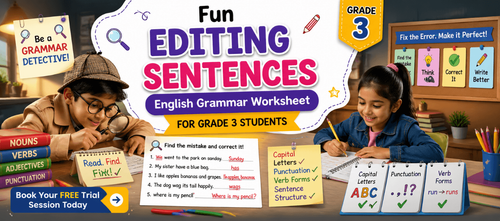

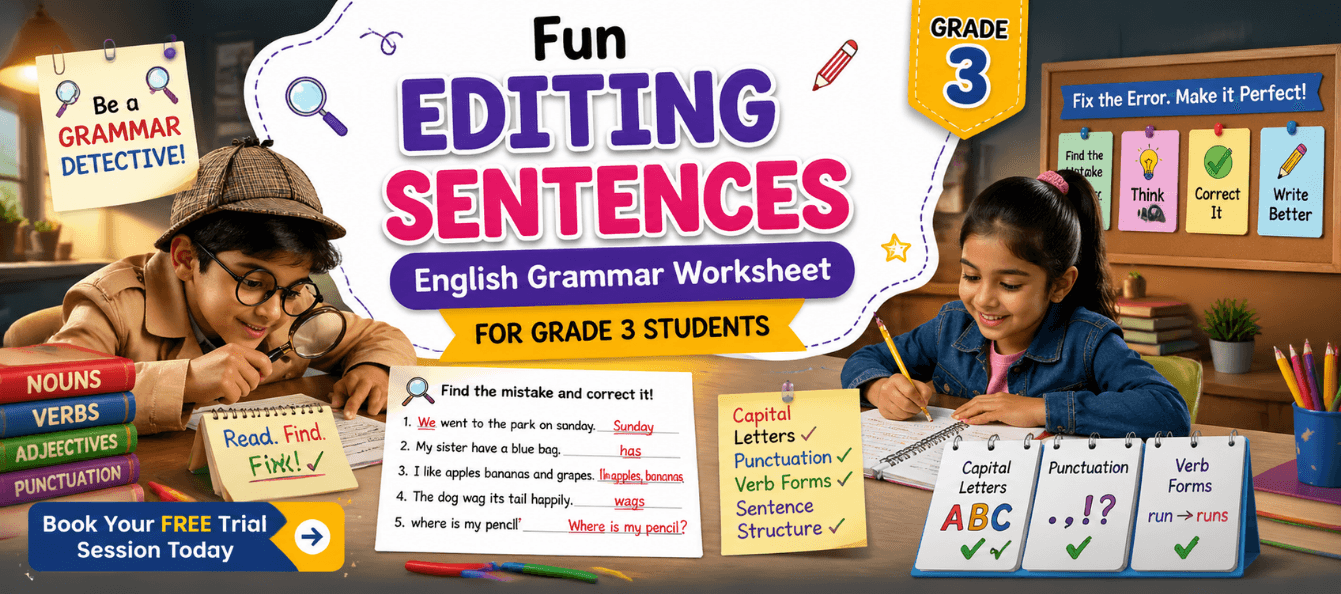
Fun Editing Sentences English Grammar Worksheet for Grade 3 Students
Editing sentences is like being a grammar detective! In this English grammar worksheet for Grade 3, students carefully read each sentence, find mistakes, and correct them. From capital letters to punctuation and verb forms, every small detail matters. This worksheet makes learning fun by giving different types of exercises that help students improve their grammar step by step.
This Grade 3 worksheet on editing sentences helps students build strong language skills by practicing real examples. It encourages children to observe, think, and correct errors confidently, making their writing clearer and more accurate.
Download these English grammar worksheets and practice regularly to strengthen your language skills and build a strong foundation. You can also book a free trial to get expert guidance and improve your reading, writing, and comprehension abilities. The worksheets are designed in a simple and structured way to help K–8 students learn grammar concepts easily and use them confidently in everyday communication.
What Is Editing Sentences?
Editing sentences means identifying mistakes in a sentence and correcting them. These mistakes can include incorrect verb forms, missing capital letters, wrong punctuation, or unclear sentence structure. In this worksheet, students learn how to carefully read sentences, spot errors, and fix them correctly.
Students are expected to understand what is wrong in a sentence and make it correct by rewriting or choosing the right option. This improves both their grammar and writing skills.
What’s in This Worksheet?
1. Underline the Words – Students identify and underline the incorrect part of each sentence.
2. Multiple Choice Question – Students select the correct edited sentence from given options.
3. Sentence Rewriting – Students rewrite sentences by correcting the errors.
4. Fill in the Blanks – Students complete a passage with suitable corrections.
5. Paragraph Writing – Students write a paragraph based on a topic.
Definitions, Examples, Techniques, and Tips
Definitions:
Editing sentences means correcting mistakes in grammar, punctuation, and sentence structure.
Examples:
Students correct sentences by fixing verbs, adding capital letters, or correcting punctuation.
Techniques:
Read the sentence carefully.
Look for errors in verbs and punctuation.
Check if the sentence makes sense.
Quick learning tips:
Always begin sentences with capital letters.
Use correct verb forms.
End sentences with proper punctuation.
Why Is It Important to Learn This?
Learning to edit sentences helps students write correctly and clearly. It improves grammar skills and helps in avoiding common mistakes. It also builds confidence in writing and speaking.
Where Will This Knowledge Help You?
This knowledge helps in school exams, writing assignments, and daily communication. It also improves classroom participation and understanding of grammar rules.
How to Use This Worksheet?
1. Attempt all questions on your own.
2. Read each sentence carefully before answering.
3. Compare your answers with the correct answers.
4. Practice regularly.
The solutions follow the exact worksheet order. Students should compare answers carefully.
Important Tips and Tricks
1. Always check for capital letters at the beginning.
2. Look for punctuation errors.
3. Match verbs correctly with the subject.
4. Read the corrected sentence again.
Complete Answer Key
Exercise No. 1
1. __we__ went to the park on __sunday__.
2. My sister __have__ a blue bag.
3. I like apples __bananas__ and grapes.
4. The dog __wag__ its tail happily.
5. __where__ is my pencil
6. She is the tallest girl in our __classs__.
7. __Riya and me__ are best friends.
8. He __don’t__ like cold milk.
9. The cat slept on the sofa.
10. Please close the door.
Exercise No. 2
1. b) Riya went to Delhi yesterday.
2. a) The cat is under the table.
3. c) Ravi has a new bag.
4. a) Where is my pencil?
5. c)The teacher marks tests.
6. c) We are going to the park.
7. a) The bus came late today.
8. a) Meera likes to draw pictures.
9. c) Is this your pen?
10. b) They were playing outside.
Exercise No. 3
1. Riya likes mangoes
2. Ravi is going to school now
3. The dog runs fast
4. The teacher is kind
5. Meera has a pencil
6. Neha is writing a story
7. The books are heavy
8. Why are you late today?
9. We play in the ground
10. The class was noisy
Exercise No. 4
Yesterday, I wrote a short story for my class, but some of my sentences were not correct. My teacher said,
“Check your sentences carefully,” so I started checking my work carefully. At first, I noticed that one sentence began without a capital letter, so I rewrote it as The sentence begins with a capital letter. Then I found another sentence that had no full stop, so I changed it to The sentence ends with a full stop. I also saw a sentence that had extra words, and I fixed it by writing A clear and correct sentence instead. While reading again, I realised one sentence did not make sense, so I edited it to A meaningful sentence. My teacher encouraged me to improve my writing, so I added a better sentence like This is a well-written sentence. Finally, I checked the whole paragraph once more and made sure every sentence was neat and clear by writing A full stop at the end.
Exercise No. 5
A Day Without Electricity
One day, there was no electricity in my house. It was very difficult to do daily activities. I could not watch television or use the fan. It was very hot, and I felt uncomfortable. In the evening, we lit candles to see clearly. My family spent time talking and playing games together. It was a different experience, but I learned how important electricity is in our daily life.
Practicing this English grammar worksheet for Grade 3 on editing sentences will help students improve their grammar and writing skills. With regular practice, students can easily identify and correct mistakes and become confident writers.