
Editing vs Proofreading for Grade 7: Grammar Worksheet [Printable PDF]
![Editing vs Proofreading for Grade 7: Grammar Worksheet [Printable PDF]](https://cdn5.planetspark.in/media/small_Class_7_English_Grammar_Worksheet_on_Editing_vs_Proofreading_570dde1b9f.png)

English Grammar Worksheet Grade 7: Editing vs Proofreading
Editing and proofreading are crucial steps in the writing process. While they may seem similar, they serve distinct purposes in ensuring that writing is clear, polished, and error-free. In this Grade 7 worksheet on "Editing vs Proofreading," students will explore the differences between these two processes and practice applying them to improve their writing.
Download these English grammar worksheets and practice regularly to strengthen your language skills and build a strong foundation. You can also book a free trial to get expert guidance and improve your reading, writing, and comprehension abilities. The worksheets are designed in a simple and structured way to help K–8 students learn grammar concepts easily and use them confidently in everyday communication.
Book a free trial!
## What is the topic?
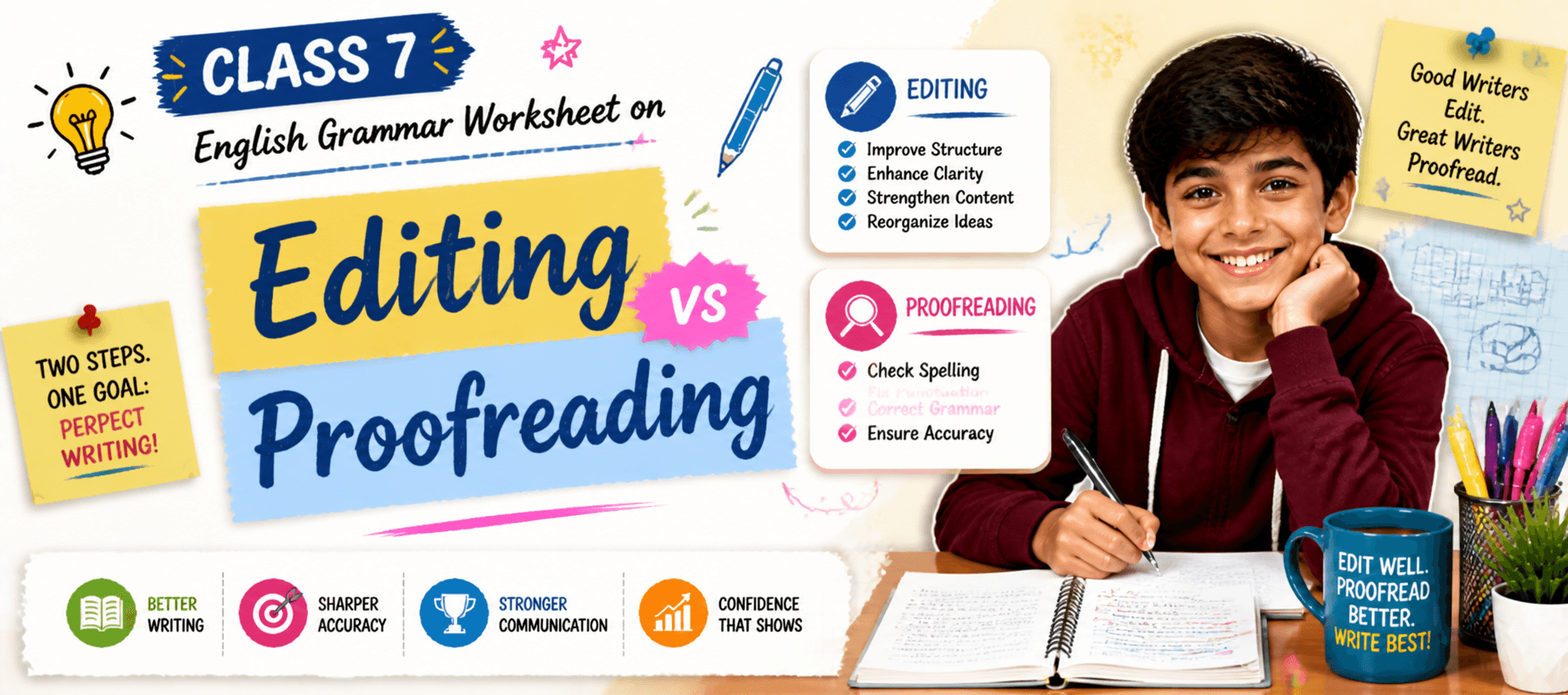
This worksheet helps students understand the difference between editing and proofreading. Editing involves making changes to improve the overall quality of the writing, including checking grammar, structure, and clarity. Proofreading, on the other hand, focuses on identifying and correcting surface-level errors such as spelling, punctuation, and grammar mistakes.
Students will learn:
- The key differences between editing and proofreading.
- How to apply editing and proofreading techniques to improve their writing.
- Why both processes are necessary for producing high-quality writing.
## What’s in this worksheet?
The worksheet contains a variety of exercises to help students practice both editing and proofreading. These exercises include:
1. **Multiple choice questions** – Identifying the correct answer about editing and proofreading tasks.
2. **Fill in the blanks** – Completing sentences with the appropriate grammar or punctuation.
3. **True and false** – Determining whether statements about editing and proofreading are accurate.
4. **Underline the words** – Identifying grammar or punctuation errors in sentences.
5. **Sentence writing** – Writing or rewriting sentences with the correct grammar, punctuation, and structure.
By completing these exercises, students will become more adept at editing and proofreading their own writing and the writing of others.
## Definitions, examples, techniques, and tips
- **Editing Definition**: Editing involves reviewing the writing for clarity, structure, and content. It includes correcting grammar errors, improving sentence structure, and ensuring that the writing flows logically.
- **Example**: "She plays well tennis" → "She plays tennis well."
- Editing ensures the writing is clear and coherent.
- **Proofreading Definition**: Proofreading focuses on finding and correcting surface-level mistakes, such as spelling errors, punctuation mistakes, and typographical issues.
- **Example**: "She playd well tennis." → "She played well tennis."
- Proofreading ensures that the writing is error-free at the surface level.
- **Techniques for editing**:
1. Review the writing for grammatical errors, including subject-verb agreement and proper tense usage.
2. Look for sentence structure issues and awkward phrasing.
3. Improve clarity and flow by adjusting word choice and reordering sentences.
- **Techniques for proofreading**:
1. Carefully read the writing for spelling and punctuation errors.
2. Check for typographical mistakes, such as missing or extra spaces, incorrect capitalization, and missing periods.
3. Look for commonly confused words, such as "their" vs. "there" or "its" vs. "it's."
- **Quick learning tips**:
- Editing is about improving the content, while proofreading focuses on fixing minor mistakes.
- Always proofread after editing to catch any overlooked errors.
- Read your writing out loud to catch awkward phrasing or overlooked errors.
## Why is it important to learn this?
Understanding and applying editing and proofreading techniques is essential because:
- **Effective communication**: Both processes help ensure that writing is clear, coherent, and free from mistakes, making it easier for the reader to understand the message.
- **Academic success**: Most assignments require careful editing and proofreading to meet academic standards and avoid losing marks for minor errors.
- **Professional writing**: Whether writing emails, reports, or presentations, strong editing and proofreading skills ensure that the writing is polished and professional.
For Grade 7 students, mastering both skills is crucial as they tackle more complex writing assignments in school.
## Where will this knowledge help you?
This knowledge will be useful in:
- **Exams**: Many writing tasks in exams require students to demonstrate good grammar, structure, and clarity.
- **Writing tasks**: Editing and proofreading are essential for completing essays, reports, and creative writing assignments.
- **Class participation**: Clear and error-free writing improves communication during class presentations, discussions, and assignments.
# How to use this worksheet?
1. **Attempt independently first**: Read each sentence or paragraph and identify areas that require editing or proofreading.
2. **Review answers carefully**: After making changes, check that the writing is error-free and flows logically.
3. **Correct mistakes**: If the sentence or paragraph feels unclear or has errors, adjust it to improve grammar, structure, or punctuation.
4. **Practice regularly**: Continue practicing editing and proofreading techniques to develop strong writing habits.
The solutions follow the exact worksheet order. Compare your answers carefully to ensure accuracy.
## Important tips and tricks
- **Common mistakes**:
- Overlooking punctuation mistakes, such as missing commas or periods.
- Focusing too much on one type of error and missing others (e.g., concentrating on spelling but missing grammar issues).
- **What examiners expect**:
- Writing that is grammatically correct, clear, and well-structured.
- Careful proofreading to ensure no surface-level mistakes, such as spelling or punctuation errors.
- **How to score full marks**:
- Focus on clarity and coherence when editing, making sure the message is easy to understand.
- Carefully proofread to ensure that all spelling, punctuation, and grammatical errors are corrected.
- **How to approach activity-based or writing-based tasks**:
- For editing tasks, focus on the overall structure and clarity of the writing.
- For proofreading, pay attention to detail and make sure all minor errors are corrected.
## Complete Answer Key
**Exercise No. 1:**
- What is editing? (Underline: editing)
- What do proofreading checks focus on? (Underline: proofreading checks)
- Which of these tasks is related to editing? (Underline: related)
- Which task is associated with proofreading? (Underline: proofreading)
**Exercise No. 2:**
1. **Editing** improves the clarity of the text.
2. **Proofreading** focuses on correcting spelling mistakes.
3. **Grammar** is the process of reviewing and correcting grammar.
4. **Clarity** makes sure that content is clear and effective.
5. **Proofreading** ensures that the text is free of grammatical errors.
6. **Editing** is focused on making the text more readable.
7. **Punctuation** focuses on improving sentence structure.
8. **Rewriting** makes sure the content flows logically.
9. **Editing** corrects the content to make it more readable.
**Exercise No. 3:**
1. Proofreading ensures that the text is free of grammar mistakes. (True)
2. Editing helps improve the overall readability of a text. (True)
3. Editing focuses on content errors. (True)
4. Proofreading improves clarity of the text. (False)
5. Editing ensures that the content is logically structured. (True)
6. Proofreading checks for punctuation mistakes. (True)
7. Editing focuses only on grammar and punctuation. (False)
8. Proofreading involves revising sentences to improve meaning. (False)
9. Editing is focused on correcting spelling. (False)
10. Proofreading makes sure the text flows smoothly. (True)
**Exercise No. 4:**
1. She is writing an essay for school.
2. The teacher will check the grammar errors in the text.
3. He quickly reads the book, but he doesn't understand it.
4. You should proofread the document before you submit it.
5. The paragraph is good, but the spelling mistakes need editing.
6. Proofreading helps to improve the clarity of the text.
7. She quickly fixes the spelling error.
8. We are learning editing and proofreading in class.
9. The editor reviewed the manuscript for errors and made suggestions.
10. The essay was good, but it needs more content and better structure.
## Outro
By learning the differences between editing and proofreading, students will enhance their writing by ensuring it is both grammatically correct and logically coherent. Mastering these skills will improve academic performance and communication in both formal and informal writing contexts.
Book a free trial!