
English Grammar Noun Worksheet for Class 2 with Examples

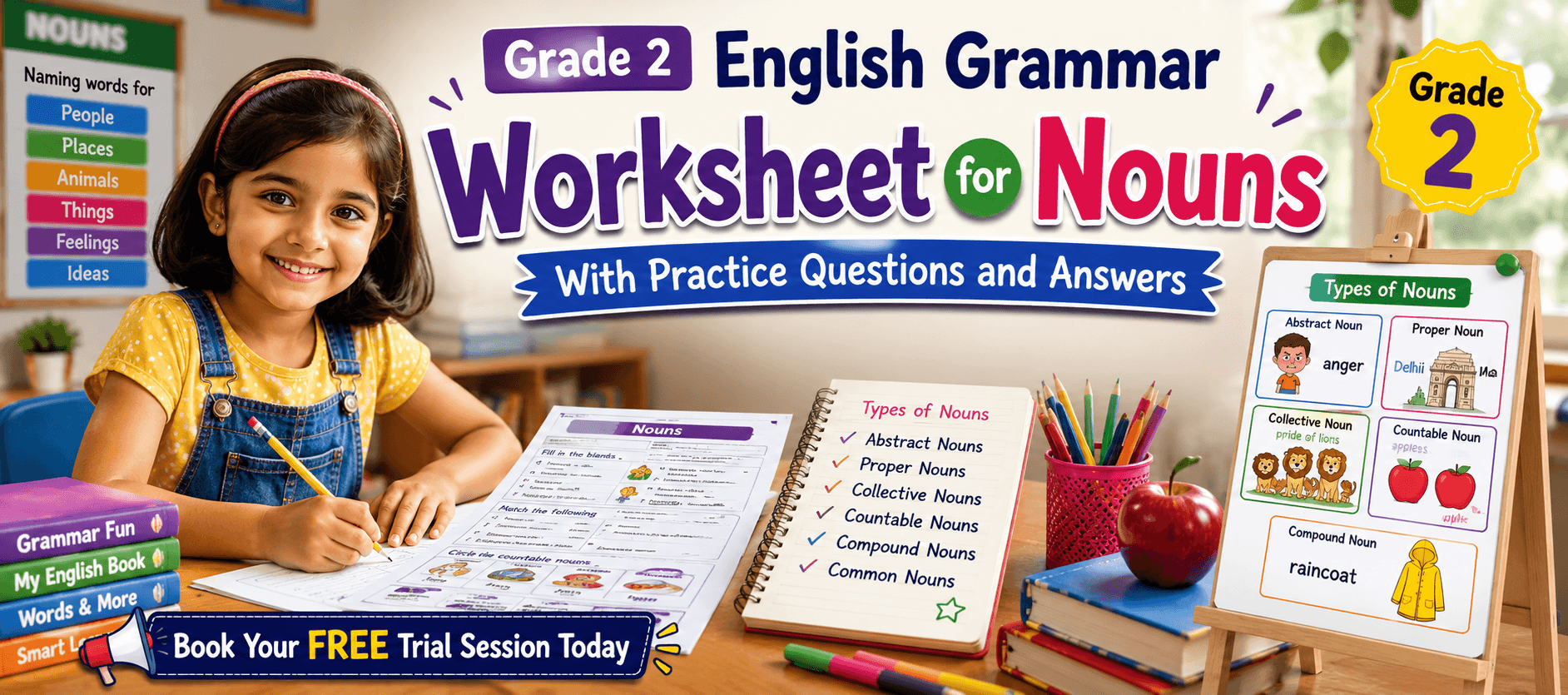
Grade 2 English Grammar Worksheet for Nouns With Practice Questions and Answers
Learning nouns becomes more exciting when students practice different grammar activities in one worksheet. This English grammar worksheet for Grade 2 on Nouns helps children strengthen their understanding of naming words through fun and meaningful exercises. Students practice abstract nouns, proper nouns, collective nouns, countable nouns, and compound nouns in a simple and structured format.
In Grade 2, students begin learning how grammar rules work in real sentences. Nouns are one of the most important grammar topics because they help children identify people, places, animals, objects, feelings, and groups correctly. This worksheet gives students an opportunity to improve grammar accuracy while practicing sentence-based activities and vocabulary-building exercises.
Download these English grammar worksheets and practice regularly to strengthen your language skills and build a strong foundation. You can also book a free trial to get expert guidance and improve your reading, writing, and comprehension abilities. The worksheets are designed in a simple and structured way to help K–8 students learn grammar concepts easily and use them confidently in everyday communication.
What Is the Topic?
A noun is a word that names a person, place, animal, thing, feeling, or idea. This English grammar worksheet for Grade 2 on Nouns includes practice exercises that help students identify and use different types of nouns correctly.
The worksheet focuses on:
• Abstract nouns
• Proper nouns
• Collective nouns
• Countable nouns
• Compound nouns
• Common nouns
Students are expected to:
• Choose correct nouns in sentences
• Rewrite sentences using capital letters correctly
• Match collective nouns properly
• Identify countable nouns
• Form compound nouns
• Recognize common nouns
The worksheet helps students understand grammar concepts through simple exercises and everyday examples.
What’s in This Worksheet?
1. Fill in the Blanks
Students choose the correct noun from the brackets to complete sentences properly.
2. Proper Noun Capitalization Practice
The worksheet helps students learn where capital letters should be used in proper nouns.
3. Collective Noun Matching
Students match groups with their correct collective nouns.
4. Countable Noun Identification
Students identify countable nouns from a word box.
5. Compound Noun Formation
Children join smaller words together to make compound nouns.
6. Common Noun Practice
Students identify and write common nouns based on pictures.
7. Grammar Revision Activities
The worksheet combines multiple noun concepts together for effective revision and exam preparation.
Definitions, Examples, Techniques, and Tips
Definition of Nouns
A noun is a naming word used for people, places, animals, things, feelings, or ideas.
Examples From the Worksheet
• anger
• happiness
• honesty
• wisdom
• bravery
• Delhi
• Mumbai
• Diwali
• lions
• singers
• raincoat
• playground
Abstract Nouns
Abstract nouns are feelings, qualities, or ideas.
Examples from the worksheet:
• anger
• happiness
• honesty
• bravery
• wisdom
Proper Nouns
Proper nouns are special names and always begin with capital letters.
Examples from the worksheet:
• Priya
• Delhi
• Taj Mahal
• Mumbai
• Diwali
Collective Nouns
Collective nouns are words used for groups.
Examples from the worksheet:
• pride of lions
• choir of singers
• swarm of bees
Compound Nouns
Compound nouns are formed by joining two smaller words.
Examples from the worksheet:
• raincoat
• cupcake
• playground
• notebook
• blackboard
Techniques to Solve Noun Questions
• Read the sentence carefully before choosing the noun.
• Check whether the noun names a feeling, person, place, or object.
• Use capital letters correctly for proper nouns.
• Look carefully at both words before forming compound nouns.
Quick Learning Tips
• Proper nouns always begin with capital letters.
• Collective nouns describe groups.
• Countable nouns can be counted one by one.
• Compound nouns are made by joining two words together.
• Read every question slowly before answering.
Why Is It Important to Learn This?
Learning nouns is important because nouns are used in almost every sentence we speak or write. Understanding nouns helps students communicate clearly and form meaningful sentences.
This English grammar worksheet for Grade 2 on Nouns helps students improve grammar understanding through practice-based learning. Children become more confident in identifying naming words and using them correctly in different situations.
Learning nouns also helps students:
• Improve writing skills
• Build stronger vocabulary
• Read sentences more easily
• Understand grammar rules better
• Perform well in school exams
Grammar practice becomes easier and more enjoyable when students regularly solve worksheets and revise concepts carefully.
Where Will This Knowledge Help You?
1. Grammar Exams
Noun questions are commonly included in school tests and English worksheets.
2. Writing Activities
Students use nouns while writing stories, paragraphs, and classroom assignments.
3. Reading Practice
Understanding nouns improves sentence comprehension and reading fluency.
4. Daily Conversations
Children use nouns every day while speaking with teachers, family, and friends.
5. Classroom Participation
Correct grammar helps students answer questions confidently during classroom activities.
How to Use This Worksheet?
1. Read Every Question Carefully
Students should understand the sentence before selecting the correct noun.
2. Solve the Worksheet Independently
Attempt all exercises carefully without skipping questions.
3. Compare Answers Properly
The solutions follow the exact worksheet order, so students should compare answers carefully.
4. Correct Mistakes Neatly
If an answer is incorrect, students should rewrite the correct answer after checking carefully.
5. Practice Capital Letters Regularly
Proper noun exercises should be practiced multiple times to improve accuracy.
6. Revise Noun Types Often
Repeated practice helps students remember grammar rules more confidently.
Important Tips and Tricks
1. Use Capital Letters Correctly
Names of people, places, festivals, and monuments always begin with capital letters.
2. Read Bracket Options Carefully
Choose the noun that best matches the sentence meaning.
3. Learn Common Collective Nouns
Words such as pride, swarm, choir, and pile are important grammar words.
4. Countable Nouns Can Be Counted
Objects such as apple, chair, pen, and toy are countable nouns.
5. Compound Nouns Need Two Words
Join both words carefully to form the correct compound noun.
6. Practice Daily
Daily grammar practice improves writing accuracy and confidence.
Complete Answer Key
Exercise 1
Choose the word from the bracket that best fits the sentence.
1. He felt anger when his toy broke.
2. We should always speak with honesty.
3. She was full of fear before going on stage.
4. Grandma shares stories full of wisdom.
5. Everyone clapped for their bravery.
Exercise 2
Rewrite each sentence by fixing the proper noun with a capital letter.
1. I met Priya at the park.
2. We are going to Delhi tomorrow.
3. The Taj Mahal is very beautiful.
4. My cousin lives in Mumbai.
5. We celebrate Diwali every year.
Exercise 3
Match the words with the correct collective noun.
1. Lions → pride
2. Books → pile
3. Chairs → sets
4. Singers → choir
5. Bees → swarm
Exercise 4
Circle the countable nouns from the box below.
APPLE
CHAIR
PEN
CAKE
BANANA
EGG
BOOK
ORANGE
TOY
FLOWER
MAN
SHOES
SPOON
CAT
TREE
Exercise 5
Join the two words to make a compound noun.
1. Rain + coat → raincoat
2. Cup + cake → cupcake
3. Play + ground → playground
4. Note + book → notebook
5. Black + board → blackboard
Exercise 6
Write the correct common noun under each picture.
1. Answers based on the pictures provided in the worksheet.
Practicing nouns regularly helps students improve grammar, vocabulary, and sentence-building skills. This English grammar worksheet for Grade 2 on Nouns provides structured practice through different types of noun exercises that strengthen reading and writing abilities. By solving these activities carefully, students can become more confident in using nouns correctly during school exams, classroom activities, and everyday communication.