
English Imperative Sentences Practice for Class 3 Students
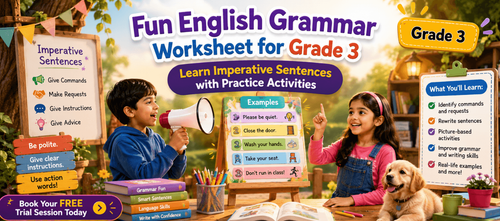

Fun English Grammar Worksheet for Grade 3: Learn Imperative Sentences with Practice Activities
Learning imperative sentences can be exciting when children practice through fun activities, commands, and real-life examples. This English grammar worksheet for Grade 3 helps students understand how imperative sentences are used in daily communication. From giving instructions to making polite requests, this worksheet introduces imperative sentences in a simple and engaging way for young learners.
In this Grade 3 imperative sentences worksheet, students will practice identifying commands, rewriting sentences, sorting imperative and non-imperative sentences, and creating their own imperative sentences from pictures. These activities help children improve grammar, sentence formation, reading, and writing skills in an interactive manner.
Download these English grammar worksheets and practice regularly to strengthen your language skills and build a strong foundation. You can also book a free trial to get expert guidance and improve your reading, writing, and comprehension abilities. The worksheets are designed in a simple and structured way to help K–8 students learn grammar concepts easily and use them confidently in everyday communication.
What Is Imperative Sentences?
Imperative sentences are used when we tell someone to do something. They can be used to give commands, instructions, requests, or advice. These sentences usually begin with an action word and may end with a full stop or an exclamation mark.
Examples from the worksheet:
1. Please be quiet in the library.
2. Don’t shout!
Students are expected to learn how to:
1. Identify imperative sentences
2. Understand commands and requests
3. Rewrite sentences into imperative form
4. Use imperative sentences in everyday communication
What’s in This Worksheet?
1. Students read sentences and identify whether they are imperative or not imperative.
2. Students find and write sentences that give commands or requests.
3. Students read short stories and underline sentences that give commands or requests.
4. Students rewrite sentences to make them imperative sentences.
5. Students observe a picture and write imperative sentences related to the scene.
6. The worksheet helps students improve grammar, sentence formation, reading comprehension, and writing skills.
7. The activities support school exams and classroom learning through practical exercises.
Definitions, Examples, Techniques, and Tips
Definition:
Imperative sentences are used when we tell someone to do something.
They can be:
1. A command
2. A polite request
3. Advice
Examples:
1. Be careful on the stairs.
2. Take your seat now.
3. Clean your room today.
4. Open your books now.
5. Be careful while running.
Techniques:
1. Look for action words at the beginning of the sentence.
2. Check if the sentence is giving an instruction or request.
3. Notice punctuation marks like full stops or exclamation marks.
Quick Learning Tips:
1. Commands usually tell someone what to do.
2. Requests often use polite words like “please”.
3. Imperative sentences often begin with verbs such as open, clean, wash, or take.
Why Is It Important to Learn This?
Learning imperative sentences is important because they are used in everyday communication. Students use them while speaking to friends, teachers, and family members. Imperative sentences help children give instructions clearly and understand directions properly.
This grammar topic also improves writing and speaking skills. Students learn how to express requests politely and give commands correctly. Understanding imperative sentences helps children perform better in grammar exercises, classroom activities, and school exams.
Where Will This Knowledge Help You?
1. In classroom instructions given by teachers
2. During speaking and conversation practice
3. In grammar worksheets and school exams
4. While writing instructions and directions
5. During group activities and classroom participation
6. In everyday communication at home and school
How to Use This Worksheet?
1. Read each question carefully before answering.
2. Attempt every exercise independently first.
3. Identify whether the sentence is giving a command, request, or instruction.
4. Compare your answers carefully with the solutions.
5. Review mistakes and practice rewriting sentences correctly.
6. Follow the exact worksheet order while checking answers.
7. Practice regularly to become confident in using imperative sentences.
Important Tips and Tricks
1. Imperative sentences usually begin with action words.
2. Read the sentence carefully to check whether someone is being told to do something.
3. Do not confuse questions with commands.
4. Polite requests can also be imperative sentences.
5. Examiners expect correct sentence formation and punctuation.
6. While rewriting sentences, make sure the sentence clearly gives a command or request.
7. In picture-based activities, write meaningful command sentences related to the picture.
Complete Answer Key
Exercise 1
Read each sentence and write “Imperative” or “Not Imperative”.
1. Be careful on the stairs. – Imperative
2. Take your seat now. – Imperative
3. What a big elephant! – Not Imperative
4. Clean your shoes before coming inside. – Imperative
5. Wash your hands before eating. – Imperative
6. My mother cooks delicious food. – Not Imperative
7. Is this your water bottle? – Not Imperative
8. Where do you live? – Not Imperative
9. Open your books to page five. – Imperative
10. Did you complete the worksheet from yesterday? – Not Imperative
Exercise 2
Find and write all the sentences that give a command or request from the box below.
1. Pass me the salt.
2. Clean your room today.
3. Put the books neatly on the shelf.
4. Come here quickly!
5. Be careful while running.
Exercise 3
Read the short stories and underline the sentences that give a command or request. Write the underlined sentences in the space given below.
1. Cut the carrot slowly.
2. Open your books now.
Exercise 4
Rewrite each sentence so it gives a command or makes a request.
1. Can you help me with this?
Please help me with this.
2. You are reading a book.
Read the book.
3. Why is the door open?
Close the door.
4. He is watching TV.
Turn off the TV.
5. Shall we sit there?
Please sit there.
6. Is she ready for school?
Get ready for school.
7. The room is messy.
Clean the room.
8. Do you want water?
Please drink water.
9. The clothes are dirty.
Wash the clothes.
10. How clean the floor is!
Keep the floor clean!
Exercise 5
Write 5 sentences that give a command or tell someone what to do in the picture.
1. Clean the table properly.
2. Put the toys on the shelf.
3. Feed the dog carefully.
4. Arrange the books neatly.
5. Wipe the floor carefully.
Practicing imperative sentences regularly helps Grade 3 students become more confident in speaking and writing. This English grammar worksheet on imperative sentences gives children a clear understanding of commands, requests, and instructions through enjoyable activities and exercises. Keep practicing sentence formation daily to improve grammar skills and communicate more clearly in everyday situations.