
English Phonics Word Building Practice for Class 1 Learners
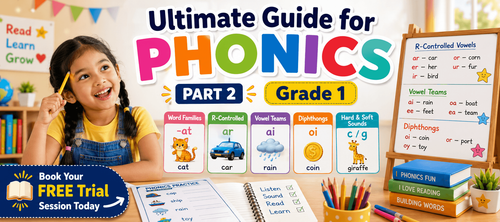

Ultimate Guide for Phonics Part 2 English Grammar Worksheet for Grade 1
Learning phonics becomes more exciting when students start recognizing word patterns, vowel sounds, blends, and special letter combinations. This English grammar worksheet for Grade 1 on Ultimate Guide for Phonics Part 2 helps children strengthen reading and pronunciation skills through engaging phonics activities and structured exercises. By practicing different sound patterns, students improve fluency, spelling, and confidence while reading English words.
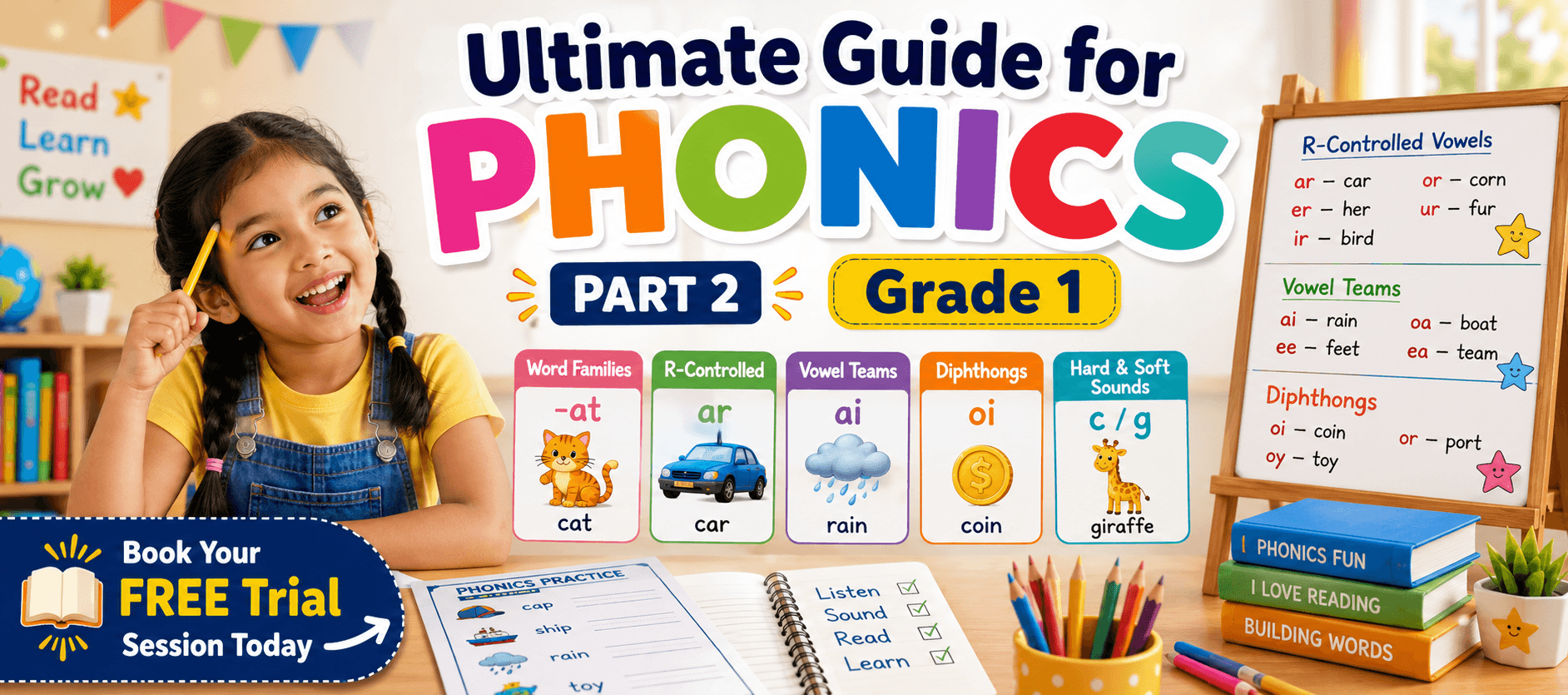
In this worksheet, Grade 1 learners practice word families, r-controlled vowels, vowel teams, diphthongs, and hard and soft sounds of c and g. The activities are designed in a simple and enjoyable format that helps students recognize sound patterns and improve reading accuracy. Through regular phonics practice, children develop stronger language skills and become more confident readers.
Download these English grammar worksheets and practice regularly to strengthen your language skills and build a strong foundation. You can also book a free trial to get expert guidance and improve your reading, writing, and comprehension abilities. The worksheets are designed in a simple and structured way to help K–8 students learn grammar concepts easily and use them confidently in everyday communication.
What Is the Topic?
This English grammar worksheet for Grade 1 focuses on phonics concepts such as word families, r-controlled vowels, vowel teams, diphthongs, and hard and soft sounds of c and g.
The worksheet explains that phonics is learning how letters and sounds go together to make words.
Phonics helps children:
Sound out new words independently
Improve spelling and pronunciation
Build reading fluency and confidence
The worksheet introduces important sound patterns through simple explanations and examples.
Examples given in the worksheet include:
b /b/ bat /b/ /a/ /t/ = bat
sh /sh/ ship /sh/ /i/ /p/ = ship
ch /ch/ chat /ch/ /a/ /t/ = chat
oi /oi/ coin /k/ /oi/ /n/ = coin
What’s in This Worksheet?
1. Introduction to phonics and sound patterns.
2. Practice activities on word families ending with at, an, and ig.
3. Exercises on r-controlled vowels.
4. Activities on vowel teams and long vowel sounds.
5. Diphthong practice using oi, oy, and or.
6. Hard and soft sound recognition for the letters c and g.
7. Fill-in-the-blank, coloring, and sorting exercises.
8. Word recognition and pronunciation practice.
9. Structured phonics activities for reading fluency.
10. Exercises that support classroom learning and grammar development.
Definitions, Examples, Techniques, and Tips
Definition
Phonics is learning how letters and sounds go together to make words.
Word Families
Word families share a common ending, making it easier to learn groups of rhyming words.
Examples :
-at : cat, hat, mat
-an : man, pan, can
-ig : pig, wig, big
R-Controlled Vowels
Vowel sounds that are changed when followed by the letter ‘r’.
Examples :
ar in car
er in her
ir in bird
or in corn
ur in fur
Vowel Teams
Two vowels that work together to make one long vowel sound.
Examples :
ai in rain
ee in feet
oa in boat
ea in team
Diphthongs
Two vowels combined to make a gliding sound in one syllable.
Examples :
oi in coin
oy in toy
or in port
Hard And Soft Sounds Of C
Letter ‘c’ make two kinds of sounds:
Hard sound before a, o, u
Soft sound before e, i, y
Examples :
Hard c: cat, cup
Soft c: city, face
Hard And Soft Sounds Of G
Letter ‘g’ make two kinds of sounds:
Hard sound before a, o, u
Soft sound before e, i, y
Examples :
Hard g: goat, gum
Soft g: giraffe, gem
Quick Learning Tips
1. Say each sound clearly while reading words.
2. Practice rhyming word families regularly.
3. Focus carefully on vowel sounds in words.
4. Read phonics words aloud every day.
5. Practice recognizing hard and soft sounds carefully.
Why Is It Important to Learn This?
Learning phonics is important because it helps children become fluent readers and confident speakers. Understanding sound patterns improves pronunciation, spelling, and reading accuracy.
Phonics also helps students decode new words independently and improves listening skills. Through regular practice, students recognize word patterns more easily and build stronger reading confidence.
For Grade 1 students, phonics creates a strong language foundation that supports grammar, comprehension, reading, and writing development in future classes.
Where Will This Knowledge Help You?
Students will use phonics skills in many classroom and daily activities.
1. Reading storybooks and classroom texts.
2. Improving pronunciation and fluency.
3. Identifying sound patterns in words.
4. Completing English grammar worksheets and homework.
5. Building confidence in classroom reading activities.
6. Improving spelling and word recognition skills.
7. Understanding new vocabulary more easily.
8. Developing stronger communication skills.
How to Use This Worksheet?
1. Read all examples carefully before solving the exercises.
2. Practice saying the sounds aloud while reading words.
3. Attempt every exercise independently first.
4. Focus carefully on vowel sounds and sound patterns.
5. Compare your answers carefully with the complete answer key in the exact worksheet order.
6. Correct mistakes and practice difficult words again.
7. Revise phonics sounds and patterns daily.
8. Practice reading words aloud regularly for better fluency.
Important Tips and Tricks
1. Listen carefully to the sound made by each letter group.
2. Read words slowly while identifying vowel sounds.
3. Practice rhyming word families regularly.
4. Remember that vowel teams work together to make one sound.
5. Diphthongs create a gliding sound in words.
6. Focus carefully on hard and soft sounds of c and g.
7. Read every question carefully before answering.
8. Practice phonics words daily to improve reading confidence.
9. Check spelling carefully while writing answers.
10. Examiners expect correct sound recognition and word classification skills.
Complete Answer Key
PHONICS
Why Is Phonics Important?
Phonics helps children:
Sound out new words independently
Improve spelling and pronunciation
Build reading fluency and confidence
Letter(s) Sound(s) Example Word Sounded Out As
b /b/ bat /b/ /a/ /t/ = bat
sh /sh/ ship /sh/ /i/ /p/ = ship
ch /ch/ chat /ch/ /a/ /t/ = chat
oi /oi/ coin /k/ /oi/ /n/ = coin
WORD FAMILIES
ENDING WITH (AT, AN, IG)
Word families share a common ending, making it easier to learn groups of rhyming words.
Examples :
-at : cat, hat, mat
-an : man, pan, can
-ig : pig, wig, big
Exercise 1
Fill in the blanks using the -at or -ig .
1. c_at → cat
2. h_at → hat
3. d_ig → dig
4. f_at → fat
5. b_ig → big
6. m_ig → mig
7. p_an → pan
8. r_at → rat
9. w_ig → wig
R-CONTROLLED VOWELS
Vowel sounds that are changed when followed by the letter ‘r’.
Examples :
ar in car
er in her
ir in bird
or in corn
ur in fur
Exercise 2
Color the correct R-controlled word.
CAR
CORN
BIRD
JAR
FORK
FARM
BARK
FUR
HORN
STAR
DART
VOWEL TEAMS
Two vowels that work together to make one long vowel sound.
Examples :
ai in rain
ee in feet
oa in boat
ea in team
Exercise 3
Color the correct Vowel Teams word.
COAT
LEAF
MOON
TEAM
JEEP
SOAP
BOOK
NAIL
RAIN
CAKE
SEED
GOAT
FEET
BOAT
DIPHTHONGS
(OI, OY, OR)
Two vowels combined to make a gliding sound in one syllable.
Examples :
oi in coin
oy in toy
or in port
Exercise4
Complete each word by writing the correct diphthong (oi, oy, or) in the blank.
1. soil
2. boy
3. fork
4. shirt
5. toy
6. boil
7. coin
8. foil
9. joy
HARD AND SOFT
SOUNDS OF C
Letter ‘c’ make two kinds of sounds:
Hard sound before a, o, u
Soft sound before e, i, y
Examples :
Hard c: cat, cup
Soft c: city, face
Exercise5
Write the words in the correct columns.
Hard C Words
cup
cap
car
can
coat
cut
clap
cake
Soft C Words
dice
lace
cell
rice
nice
city
cent
ice
face
race
HARD AND SOFT
SOUNDS OF G
Letter ‘g’ make two kinds of sounds:
Hard sound before a, o, u
Soft sound before e, i, y
Examples :
Hard g: goat, gum
Soft g: giraffe, gem
Exercise 6
Write the words in the correct columns.
Hard G Words
goat
gap
gum
gate
gold
game
go
gas
gown
Soft G Words
gem
giant
page
girl
give
giraffe
get
cage
huge
Practicing phonics regularly helps Grade 1 students improve pronunciation, spelling, reading fluency, and communication skills. By learning word families, vowel teams, diphthongs, and hard and soft sounds, students become more confident readers and stronger language learners. Continue practicing English grammar worksheets regularly to build a strong foundation in phonics and develop confidence in reading and speaking English.