
Fix Dialogue Errors Comprehensive Editing Worksheet for Class 5
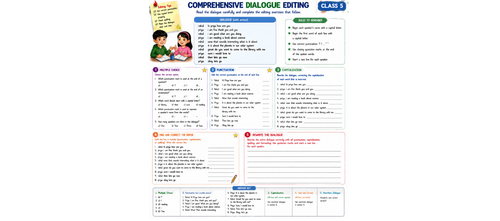

Title: Editing Dialogue: Punctuation, Capitalization, and Apostrophes – Grade 5 Grammar Worksheet
Have you ever written a conversation between characters and felt unsure about where to put the quotation marks, commas, or question marks? Punctuating dialogue correctly can be tricky, but it is an essential skill for any writer. In Grade 5, learning comprehensive dialogue editing helps you write conversations that are clear, correct, and easy to read. Dialogue should begin with a capital letter. A comma is used before the closing quotation mark when followed by a dialogue tag. Question marks and exclamation marks go inside the quotation marks. Each new speaker should start on a new line. This Grade 5 English grammar worksheet on comprehensive dialogue editing will teach you all the rules you need to punctuate dialogue perfectly.
Download these English grammar worksheets and practice regularly to strengthen your language skills and build a strong foundation. You can also book a free trial to get expert guidance and improve your reading, writing, and comprehension abilities. The worksheets are designed in a simple and structured way to help K–8 students learn grammar concepts easily and use them confidently in everyday communication.
Book a free trial!
What Is the Topic?
The topic of this worksheet is Editing: Comprehensive Dialogue Editing. Dialogue is when characters speak. When writing dialogue, you need to use quotation marks, commas, question marks, exclamation marks, and capital letters correctly. Dialogue should begin with a capital letter. Example: “Where are you going?” he asked. (The “W” in “Where” is capitalized.) A comma is used before the closing quotation mark when followed by a dialogue tag. Example: “I am coming,” she said. (The comma is inside the quotation marks before “she said.”) A full stop (period) is placed inside the quotation marks when the sentence ends. Question marks and exclamation marks go inside the quotation marks. Example: “Do you like cricket?” Ravi asked. “Let’s play!” they shouted. Dialogue tags like “he said” are usually not capitalized unless starting a sentence. Example: “I am ready,” she said. (“she” is not capitalized.) Each new speaker should start on a new line in dialogue writing. “Let’s” should include an apostrophe. Understanding all these rules helps you write dialogue that looks professional and is easy to read.
Book a free trial!
What’s in This Worksheet?
This worksheet contains five different exercises that help students master comprehensive dialogue editing. Here is what is included:
1. Exercise No. 1 – Multiple Choice Questions – Students read each sentence and choose the option with the correct punctuation and capitalization in dialogue. This exercise tests basic understanding of quotation marks, commas, question marks, and capitalization.
2. Exercise No. 2 – True and False – Students read ten statements about dialogue punctuation and decide whether each one is true or false. This helps correct common misunderstandings.
3. Exercise No. 3 – Fill in the Blanks – Students read sentences that are missing punctuation and capitalization and rewrite them correctly. This exercise practices applying dialogue rules.
4. Exercise No. 4 – Sentence Rewriting – Students read dialogue sentences and rewrite them with correct punctuation and capitalization. This exercise focuses on identifying and fixing errors.
5. Exercise No. 5 – Paragraph Writing – Students read a paragraph and correct all errors in dialogue punctuation, capitalization, and apostrophes. This combines reading comprehension with grammar application.
This worksheet supports exam preparation by covering all the key rules for punctuating dialogue correctly.
Book a free trial!
Definitions, Examples, Techniques, and Tips
Based only on the content of this worksheet, here are the exact definitions and examples students will learn:
Rules for Dialogue Punctuation:
- Rule 1: Dialogue should begin with a capital letter. Example: “Where are you going?” he asked.
- Rule 2: A comma is used before the closing quotation mark when followed by a dialogue tag. Example: “I am coming,” she said.
- Rule 3: Question marks go inside the quotation marks. Example: “Do you like cricket?” Ravi asked.
- Rule 4: Exclamation marks go inside the quotation marks. Example: “This is amazing!” she said.
- Rule 5: A full stop (period) is placed inside the quotation marks when the dialogue tag comes after the dialogue. Example: “It is raining,” he said.
- Rule 6: Dialogue tags like “he said” are usually not capitalized unless starting a sentence. Example: “I finished my homework,” Riya said.
- Rule 7: “Let’s” should include an apostrophe (contraction for “let us”).
- Rule 8: Each new speaker should start on a new line in dialogue writing.
Examples taken directly from the worksheet (Exercise No. 1 – multiple choice):
1. (a) “Where are you”, he asked. (b) “Where are you?” he asked.
Correct answer: b) “Where are you?” he asked.
2. (a) “I am coming,” she said. (b) “I am coming” she said.
Correct answer: a) “I am coming,” she said.
3. (a) “Do you like cricket”? Ravi asked. (b) “Do you like cricket?” Ravi asked.
Correct answer: b) “Do you like cricket?” Ravi asked.
4. (a) “It is raining”, he said. (b) “It is raining,” he said.
Correct answer: b) “It is raining,” he said.
5. (a) “Let’s play,” they said. (b) “Lets play,” they said.
Correct answer: a) “Let’s play,” they said.
6. (a) “Can you help me?” she asked. (b) “Can you help me?” she asked. (Both are correct)
Correct answer: a) “Can you help me?” she asked.
7. (a) “I finished my homework,” Riya said. (b) “I finished my homework” Riya said.
Correct answer: a) “I finished my homework,” Riya said.
8. (a) “What time is it?” he asked. (b) “What time is it?” he asked. (Both are correct)
Correct answer: a) “What time is it?” he asked.
9. (a) “We are ready,” they shouted. (b) “We are ready” they shouted.
Correct answer: a) “We are ready,” they shouted.
10. (a) This is fun!” she said. (b) “This is fun!” she said.
Correct answer: b) “This is fun!” she said.
Key facts from True and False section (Page 5):
- A question mark should never be placed inside quotation marks. (False – question marks go inside quotation marks)
- Dialogue should begin with a capital letter. (True)
- A comma is used before the closing quotation mark when followed by a dialogue tag. (True)
- Quotation marks are not needed in dialogue. (False – quotation marks are needed)
- “Let’s” should include an apostrophe in dialogue. (True)
- A full stop is always placed outside quotation marks. (False – full stops go inside quotation marks in dialogue when followed by a tag)
- Dialogue tags like “he said” are usually not capitalized unless starting a sentence. (True)
- Exclamation marks cannot be used inside quotation marks. (False – exclamation marks go inside quotation marks)
- Each new speaker should start on a new line in dialogue writing. (True)
- Commas are never used in dialogue. (False – commas are used in dialogue)
Examples from Exercise No. 3 – Fill in the blanks (Page 6 – rewrite with correct punctuation and capitalization):
1. She said, “I am ready.”
2. He asked, “Where are you going?”
3. Riya said, “I love reading books.”
4. They shouted, “We won the match!”
5. He said, “It is very hot today.”
6. She asked, “Can you help me?”
7. Rahul said, “I finished my work.”
8. The teacher said, “Sit quietly.”
9. She said, “This is amazing!”
10. He asked, “What time is the class?”
Examples from Exercise No. 4 – Sentence Rewriting (Pages 7 and 8 – correct punctuation and capitalization):
1. “Let’s go,” she said.
2. “Where are you going?” he asked.
3. “I am tired,” she said.
4. “We won the match!” they shouted.
5. “Can you help me?” he asked.
6. “This is fun!” she said.
7. “I will come soon,” Riya said.
8. “What is your name?” he asked.
9. “Stop running,” the teacher said.
10. “It is raining,” he said.
Example from Exercise No. 5 – Paragraph (Page 9) – correct all errors:
Original paragraph with errors:
“where are you going” Riya asked as she picked up her bag. “im going to the park” Ravi replied “do you want to come with me”. Riya smiled and said “yes i would love to come”. On the way, Ravi said “its a nice day today”, and Riya replied “yes the weather is perfect”. When they reached the park, Riya shouted “this is amazing”! Ravi laughed and said “be careful dont run too fast”. After playing for some time, Riya said “im getting tired now”. Ravi said “lets sit under that tree and rest for a while”. As they sat down, Riya asked “what should we do next”. Ravi thought for a moment and said “we can play again or just relax here”. Riya smiled and said “i think ill just relax”. Ravi replied “thats a good idea”. They both sat quietly and enjoyed the pleasant evening.
Corrected paragraph:
“Where are you going?” Riya asked as she picked up her bag. “I’m going to the park,” Ravi replied. “Do you want to come with me?” Riya smiled and said, “Yes, I would love to come.” On the way, Ravi said, “It’s a nice day today,” and Riya replied, “Yes, the weather is perfect.” When they reached the park, Riya shouted, “This is amazing!” Ravi laughed and said, “Be careful, don’t run too fast.” After playing for some time, Riya said, “I’m getting tired now.” Ravi said, “Let’s sit under that tree and rest for a while.” As they sat down, Riya asked, “What should we do next?” Ravi thought for a moment and said, “We can play again or just relax here.” Riya smiled and said, “I think I’ll just relax.” Ravi replied, “That’s a good idea.” They both sat quietly and enjoyed the pleasant evening.
Quick learning tip: Always put the punctuation inside the quotation marks. For statements, use a comma before the tag: “I am ready,” she said. For questions, use a question mark instead of a comma: “Are you ready?” she asked. For exclamations, use an exclamation mark: “I’m ready!” she shouted.
Book a free trial!
Why Is It Important to Learn This?
Learning comprehensive dialogue editing is important for several reasons. First, dialogue should begin with a capital letter. “where are you going” (incorrect) should be “Where are you going?” Second, a comma is used before the closing quotation mark when followed by a dialogue tag. “I am ready” she said (incorrect) should be “I am ready,” she said. Third, question marks and exclamation marks go inside the quotation marks. “Do you like cricket”? (incorrect) should be “Do you like cricket?” Fourth, each new speaker should start on a new line in dialogue writing. This helps readers follow the conversation. Fifth, “Let’s” should include an apostrophe. “Lets go” (incorrect) means “lets” as in “allows,” not “let us.” Sixth, this topic is tested in grammar exams where you may be asked to punctuate dialogue correctly. Finally, correctly punctuated dialogue makes your writing look professional and is easier to read.
Book a free trial!
Where Will This Knowledge Help You?
Knowledge of comprehensive dialogue editing will help you in many academic and real-life situations:
1. Grammar exams and language tests – Many questions ask you to punctuate dialogue correctly. This worksheet directly prepares you for those questions.
2. Writing stories and narratives – Whenever you write fiction, you will use dialogue. Correct punctuation makes your characters’ speech clear.
3. Quoting sources in essays – When you quote someone in an essay, the same dialogue punctuation rules apply: “He said, ‘The sky is blue.’”
4. Reading and understanding dialogue – Knowing the rules helps you understand what you read. You can tell when a character is speaking and when the narration continues.
5. Avoiding common errors – Many people forget the comma before the tag or put the question mark outside the quotes. Learning the rules helps you avoid these mistakes.
6. Building a strong grammar foundation – Dialogue punctuation is a key writing skill. Mastering it makes you a better writer overall.
Book a free trial!
How to Use This Worksheet?
Follow these steps to get the most out of this Grade 5 English grammar worksheet on comprehensive dialogue editing:
1. Attempt independently first – Without looking at any answers, complete all five exercises in order. Start with Exercise No. 1 (Multiple Choice Questions), then Exercise No. 2 (True and False), then Exercise No. 3 (Fill in the Blanks), then Exercise No. 4 (Sentence Rewriting), and finally Exercise No. 5 (Paragraph Writing – correct all errors).
2. Review answers carefully – After you finish all exercises, go to the Complete Answer Key section below. Compare your answers one by one. Pay special attention to Exercise No. 5 – make sure you corrected all the errors in punctuation, capitalization, and apostrophes.
3. Correct mistakes – For any answer that is different from the answer key, write the correct answer next to your attempt. Try to understand why you made the mistake. Did you forget to put the comma inside the quotation marks?
4. Practice regularly – Dialogue punctuation takes practice. Repeat the worksheet after a few days. For the paragraph correction task (Exercise No. 5), try to correct all the errors without looking at the answer key first.
The solutions follow the exact worksheet order. Students should compare their answers carefully.
Book a free trial!
Important Tips and Tricks
Here are important tips and tricks based directly on this worksheet to help you master comprehensive dialogue editing and score full marks:
1. Capitalize the first word of dialogue – Always start the dialogue with a capital letter, even if it is in the middle of a sentence. “She said, ‘Where are you going?’” – “Where” is capitalized.
2. Comma inside the quotes before the tag – For statements, put a comma inside the closing quotation mark, then the tag. “I am coming,” she said. NOT “I am coming” she said. NOT “I am coming”, she said.
3. Question mark inside the quotes – For questions, put the question mark inside the closing quotation mark. Do not add a comma. “Where are you going?” he asked. NOT “Where are you going?” he asked. (That is correct. The error would be “Where are you going?,” he asked – never add a comma after a question mark.)
4. Exclamation mark inside the quotes – For exclamations, put the exclamation mark inside the closing quotation mark. “This is amazing!” she said.
5. Period inside the quotes – When the dialogue tag comes after the dialogue, put the period inside the closing quotation mark. “It is raining,” he said. NOT “It is raining,” he said. (That is correct – the period goes after the tag. Wait – in the example “It is raining,” he said, the period is at the end of “said,” not inside the quotes. The dialogue itself ends with a comma, not a period. The period ends the whole sentence after the tag. So: “It is raining,” he said. (period after “said”). If the tag comes first: He said, “It is raining.” (period inside the quotes.)
6. Start a new line for each new speaker – In a paragraph of dialogue, when a different character speaks, start a new line. This helps readers follow who is talking.
7. “Let’s” needs an apostrophe – “Let’s” is a contraction for “let us.” “Lets” (without apostrophe) means “allows.” Always use the apostrophe in dialogue: “Let’s go.”
8. What examiners expect – Examiners expect you to capitalize the first word of dialogue, put commas and periods inside the quotation marks, put question marks and exclamation marks inside the quotation marks, and use apostrophes correctly in contractions like “let’s,” “I’m,” “it’s,” “don’t,” “can’t.”
9. How to score full marks – When answering multiple-choice questions, look for the capital letter at the start of the dialogue, the comma inside the quotation marks before the tag, and the question mark or exclamation mark inside the quotation marks. For true and false, remember that question marks and exclamation marks go inside the quotes, commas are used in dialogue, and each new speaker needs a new line.
10. For sentence rewriting (Exercise No. 3 and 4) – Read each sentence. Add quotation marks around the spoken words. Capitalize the first word of the dialogue. Add a comma inside the closing quotation mark before the tag (for statements). Add a question mark inside the closing quotation mark (for questions). Add an exclamation mark inside the closing quotation mark (for exclamations). Add apostrophes where needed (“let’s,” “I’m,” “it’s,” “don’t,” “can’t”).
11. For paragraph correction (Exercise No. 5) – Read the paragraph slowly. Look at every piece of dialogue. Check for capital letters at the start. Check for commas inside the quotation marks before tags. Check for question marks and exclamation marks inside the quotation marks. Check for apostrophes in contractions. Also check that dialogue tags are not capitalized unless they start a sentence. In the paragraph, correct “where are you going” to “Where are you going?” correct “im” to “I’m,” add missing commas and question marks, add apostrophes to “lets” → “let’s,” “thats” → “that’s,” “ill” → “I’ll,” “dont” → “don’t.”
Book a free trial!
Complete Answer Key
Below is the complete answer key for the Grade 5 English grammar worksheet on Editing: Comprehensive Dialogue Editing. The answers follow the exact order of the worksheet. Section names and question numbers are reproduced exactly as they appear in the worksheet.
Exercise No. 1
Choose the option with the correct punctuation and capitalization in dialogue.
1. (a) “Where are you”, he asked. (b) “Where are you?” he asked.
Answer: b) “Where are you?” he asked.
2. (a) “I am coming,” she said. (b) “I am coming” she said.
Answer: a) “I am coming,” she said.
3. (a) “Do you like cricket”? Ravi asked. (b) “Do you like cricket?” Ravi asked.
Answer: b) “Do you like cricket?” Ravi asked.
4. (a) “It is raining”, he said. (b) “It is raining,” he said.
Answer: b) “It is raining,” he said.
5. (a) “Let’s play,” they said. (b) “Lets play,” they said.
Answer: a) “Let’s play,” they said.
6. (a) “Can you help me?” she asked. (b) “Can you help me?” she asked.
Answer: a) “Can you help me?” she asked.
7. (a) “I finished my homework,” Riya said. (b) “I finished my homework” Riya said.
Answer: a) “I finished my homework,” Riya said.
8. (a) “What time is it?” he asked. (b) “What time is it?” he asked.
Answer: a) “What time is it?” he asked.
9. (a) “We are ready,” they shouted. (b) “We are ready” they shouted.
Answer: a) “We are ready,” they shouted.
10. (a) This is fun!” she said. (b) “This is fun!” she said.
Answer: b) “This is fun!” she said.
Exercise No. 2
True and False. Write True or False for each statement.
1. A question mark should never be placed inside quotation marks.
Answer: False
2. Dialogue should begin with a capital letter.
Answer: True
3. A comma is used before the closing quotation mark when followed by a dialogue tag.
Answer: True
4. Quotation marks are not needed in dialogue.
Answer: False
5. “Let’s” should include an apostrophe in dialogue.
Answer: True
6. A full stop is always placed outside quotation marks.
Answer: False
7. Dialogue tags like “he said” are usually not capitalized unless starting a sentence.
Answer: True
8. Exclamation marks cannot be used inside quotation marks.
Answer: False
9. Each new speaker should start on a new line in dialogue writing.
Answer: True
10. Commas are never used in dialogue.
Answer: False
Exercise No. 3
Rewrite each sentence with correct punctuation and capitalization.
1. She said, “I am ready.”
2. He asked, “Where are you going?”
3. Riya said, “I love reading books.”
4. They shouted, “We won the match!”
5. He said, “It is very hot today.”
6. She asked, “Can you help me?”
7. Rahul said, “I finished my work.”
8. The teacher said, “Sit quietly.”
9. She said, “This is amazing!”
10. He asked, “What time is the class?”
Exercise No. 4
Rewrite each sentence with correct punctuation and capitalization.
1. “Let’s go,” she said.
2. “Where are you going?” he asked.
3. “I am tired,” she said.
4. “We won the match!” they shouted.
5. “Can you help me?” he asked.
6. “This is fun!” she said.
7. “I will come soon,” Riya said.
8. “What is your name?” he asked.
9. “Stop running,” the teacher said.
10. “It is raining,” he said.
Exercise No. 5
Read the paragraph carefully and correct all errors in dialogue punctuation, capitalization, and apostrophes.
Corrected paragraph:
“Where are you going?” Riya asked as she picked up her bag. “I’m going to the park,” Ravi replied. “Do you want to come with me?” Riya smiled and said, “Yes, I would love to come.” On the way, Ravi said, “It’s a nice day today,” and Riya replied, “Yes, the weather is perfect.” When they reached the park, Riya shouted, “This is amazing!” Ravi laughed and said, “Be careful, don’t run too fast.” After playing for some time, Riya said, “I’m getting tired now.” Ravi said, “Let’s sit under that tree and rest for a while.” As they sat down, Riya asked, “What should we do next?” Ravi thought for a moment and said, “We can play again or just relax here.” Riya smiled and said, “I think I’ll just relax.” Ravi replied, “That’s a good idea.” They both sat quietly and enjoyed the pleasant evening.
Book a free trial!
You have now completed the entire worksheet on comprehensive dialogue editing. Dialogue should begin with a capital letter. A comma is used before the closing quotation mark when followed by a dialogue tag. Question marks and exclamation marks go inside the quotation marks. “Let’s” should include an apostrophe. Each new speaker should start on a new line. Remember: “Where are you going?” he asked. “I am coming,” she said. “This is amazing!” she shouted. “Let’s go,” they said. Keep practicing, and soon you will punctuate dialogue perfectly every time. You are building skills that will make your writing clear, professional, and easy to read in Grade 5 and beyond.
Book a free trial!