
Free PDF Verbs Practice Worksheet for Grade 2 Students
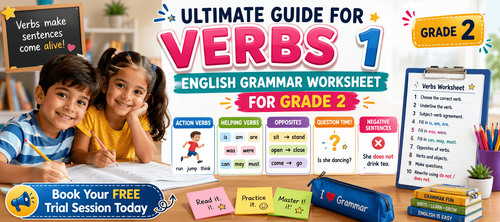

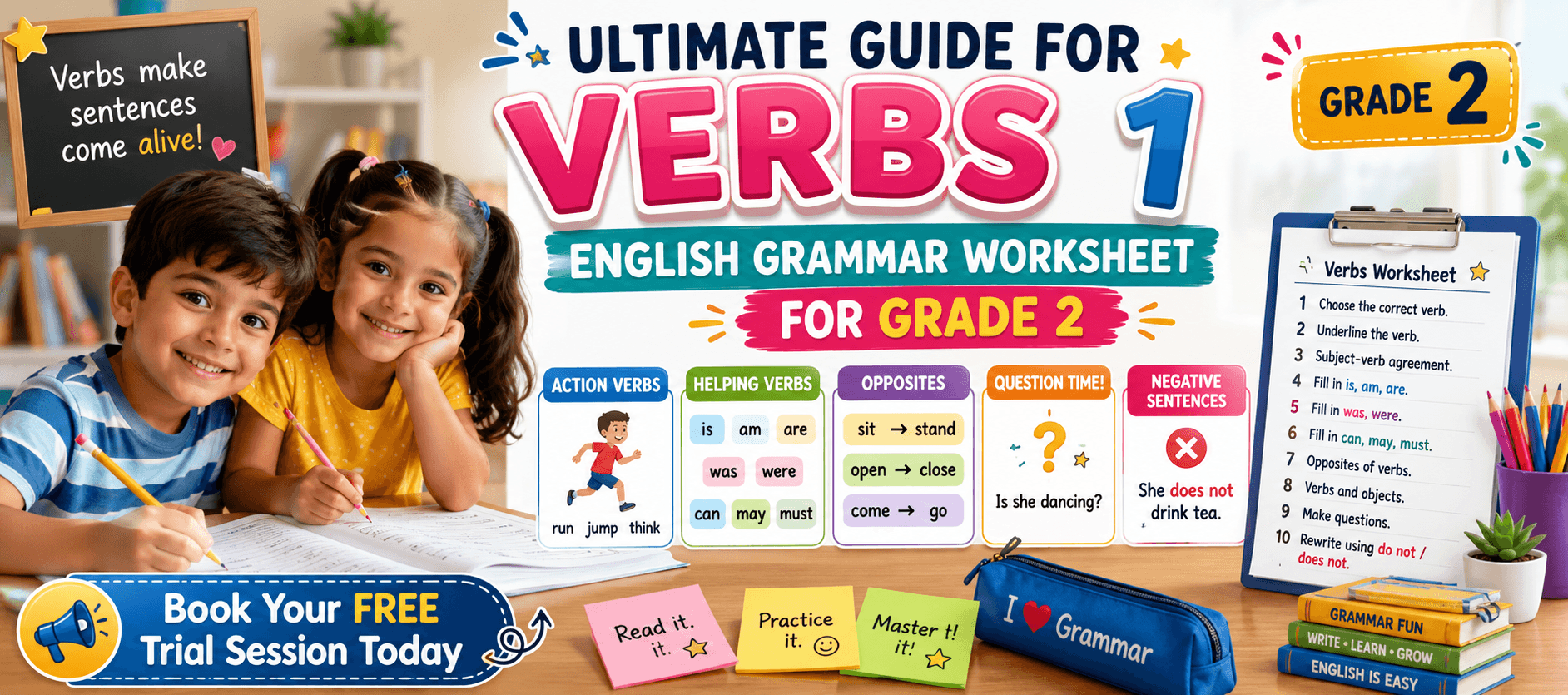
Ultimate Guide for Verbs 1 English Grammar Worksheet for Grade 2 With Answers
Learning verbs becomes exciting when students begin understanding how action words are used in everyday communication. This English grammar worksheet for Grade 2 on Verbs helps children identify action words, helping verbs, subject-verb agreement, opposites of verbs, verbs in questions, and negative sentences through engaging exercises and simple explanations. By practicing different types of verb activities, students improve sentence-building skills, grammar understanding, reading abilities, and communication confidence in a structured and enjoyable way.
In Grade 2, students begin learning how verbs make sentences meaningful and complete. This worksheet introduces learners to action verbs such as run, jump, and think while also teaching important grammar rules related to helping verbs and sentence formation. Through fill-in-the-blanks, matching activities, sentence corrections, and rearranging exercises, students strengthen their grammar foundation and become more confident in identifying and using verbs correctly in everyday English.
Download these English grammar worksheets and practice regularly to strengthen your language skills and build a strong foundation. You can also book a free trial to get expert guidance and improve your reading, writing, and comprehension abilities. The worksheets are designed in a simple and structured way to help K–8 students learn grammar concepts easily and use them confidently in everyday communication.
What Is the Topic?
A verb is a word that shows what someone or something is doing. It can also tell how someone feels or what is happening. Verbs are action words like run, jump, and think.
This Grade 2 English grammar worksheet teaches students different uses of verbs through simple explanations and exercises. Students learn:
• Action verbs
• Subject-verb agreement
• Helping verbs
• Opposites of verbs
• Verbs and objects
• Using verbs in questions
• Making negative sentences with verbs
The worksheet helps children understand how verbs are used correctly in sentences and how they help express actions clearly.
What’s in This Worksheet?
1. Action Verb Exercises
Students identify action verbs used for people, animals, and things.
2. Underlining Activities
Children underline verbs in simple sentences to improve recognition skills.
3. Subject-Verb Agreement Practice
Students choose correct verbs according to singular and plural subjects.
4. Helping Verb Exercises
The worksheet includes activities using is, am, are, was, were, can, may, and must.
5. Opposites of Verbs
Students learn opposite action words through multiple-choice questions.
6. Verbs and Objects Practice
Children identify verbs and objects in complete sentences.
7. Question Formation Activities
Students rearrange words to form correct questions using verbs.
8. Negative Sentence Exercises
Learners rewrite sentences using do not and does not.
9. Grammar Skill Development
The worksheet improves reading, writing, vocabulary, and sentence-building abilities.
10. Exam Preparation Support
These structured exercises help students practice important grammar concepts commonly used in classroom tests and school assignments.
Definitions, Examples, Techniques, and Tips
Definition of Verbs
A verb is a word that shows what someone or something is doing.
Examples From the Worksheet
• run
• smile
• sleep
• think
• jump
• clap
• cook
• draw
Subject-Verb Agreement Rule
If the subject is one person or thing, we add -s to the verb.
If the subject is more than one, we use the base form of the verb.
Examples
• She runs fast.
• They run every morning.
• Ria dances well.
• The dogs bark loudly.
Helping Verb Examples
• I am happy.
• He is playing.
• They are working.
• They were singing.
• She was late.
• You may go.
• We must listen.
• I can swim.
Opposite Verb Examples
• sit – stand
• open – close
• push – pull
• laugh – cry
• come – go
Quick Learning Tips
• Read sentences carefully before choosing verbs
• Match helping verbs with the correct subject
• Practice opposite verbs regularly
• Observe sentence patterns carefully
• Use verbs correctly while speaking and writing
Why Is It Important to Learn This?
Learning verbs is important because verbs are needed in every sentence. They help students express actions, feelings, and events clearly. Understanding verbs improves grammar accuracy and communication skills.
This topic helps children:
• Build meaningful sentences
• Improve speaking skills
• Strengthen writing abilities
• Develop grammar confidence
• Understand sentence structure properly
Learning helping verbs and subject-verb agreement also helps students avoid grammar mistakes in schoolwork and exams.
Where Will This Knowledge Help You?
Verb knowledge is useful in many daily and academic activities.
• Grammar tests
• Sentence writing
• Story writing
• Reading comprehension
• Classroom speaking activities
• Homework assignments
• Conversation practice
Understanding verbs correctly helps students communicate clearly in both written and spoken English.
How to Use This Worksheet?
1. Read Every Rule Carefully
Start by understanding each grammar explanation before attempting exercises.
2. Attempt Questions Independently
Try solving each activity on your own before checking answers.
3. Follow the Worksheet Order
The solutions follow the exact worksheet order, so students should compare answers carefully.
4. Correct Mistakes Properly
Review incorrect answers and understand why the correct verb is used.
5. Practice Regularly
Repeated practice improves grammar understanding and sentence-building confidence.
6. Revise Helping Verbs Often
Practice is, am, are, was, were, can, may, and must regularly for better understanding.
Important Tips and Tricks
1. Identify the Subject First
Always check whether the subject is singular or plural before choosing a verb.
2. Read the Whole Sentence Carefully
Understanding the sentence meaning helps in selecting the correct verb.
3. Learn Helping Verbs Through Practice
Practice helping verbs daily to improve grammar accuracy.
4. Watch for Question Patterns
Questions often begin with helping verbs such as is, are, and do.
5. Avoid Subject-Verb Agreement Mistakes
Singular subjects usually take verbs ending with -s.
6. Practice Opposite Verbs Regularly
Learning opposite action words improves vocabulary and comprehension.
7. Revise Negative Sentences
Understand where do not and does not are used correctly.
8. Improve Sentence Formation Skills
Practice rearranging words carefully to form proper questions.
Complete Answer Key
Exercise 1
Choose the correct action verb for the following.
1. The cat – meows
2. The teacher – teaches
3. The dog – barks
4. The girl – runs
5. The baby – cries
6. The player – plays
7. The chef – cooks
8. The bird – flies
Exercise 2
Underline the verb in each sentence.
1. ticks
2. jumps
3. drinks
4. moves
5. open
6. kicks
7. builds
8. combs
9. finish
10. follows
Exercise 3
Choose the correct verb for each subject.
1. writes
2. eat
3. dances
4. sing
5. walk
6. jumps
7. read
8. sleeps
9. work
10. flies
Exercise 4
Fill in the blanks with is, am, or are.
1. am
2. is
3. are
4. is
5. are
6. are
7. is
8. am
9. are
10. is
Exercise 5
Fill in the blanks with was or were.
1. was
2. were
3. was
4. were
5. were
6. was
7. were
8. was
9. was
10. were
Exercise 6
Fill in the blanks with can, may, or must.
1. can
2. can
3. must
4. May
5. can
6. can
7. must
8. may
9. May
10. must
Exercise 7
Choose the correct opposite of the verb.
1. laugh
2. sit
3. shut
4. go
5. take
6. catch
7. fall
8. wake
Exercise 8
Underline the verb and circle the object.
1. Verb – eats | Object – apple
2. Verb – throws | Object – ball
3. Verb – wash | Object – car
4. Verb – open | Object – door
5. Verb – catches | Object – mouse
6. Verb – read | Object – storybook
7. Verb – drink | Object – milk
8. Verb – drives | Object – car
9. Verb – draws | Object – flower
10. Verb – closes | Object – window
Exercise 9
Rearrange the words to make a question.
1. Is she dancing?
2. Are they sleeping?
3. Do you swim?
4. Does he eat apples?
5. Is it snowing?
6. Am I late?
7. Are we going?
8. Do you know this?
9. Is she reading?
10. Are the children playing?
Exercise 10
Rewrite the sentence using ‘do not’ or ‘does not’.
1. She does not drink tea.
2. I do not eat spinach.
3. They do not like sweets.
4. He does not play cricket.
5. We do not sing songs.
6. It does not bark loudly.
7. Ria does not wear shoes.
8. You do not make a mess.
9. The boy does not jump on the bed.
10. My friends do not visit the zoo.
Practicing this Grade 2 English grammar worksheet on Verbs helps students improve grammar understanding, sentence formation, vocabulary skills, and communication confidence. By learning action verbs, helping verbs, question formation, and negative sentences regularly, children become more comfortable using English correctly in reading, writing, and speaking activities. Continued grammar practice will help students perform better in classroom exercises, homework, and school assessments.