
Free Printable CVC Blending Exercises with Answers
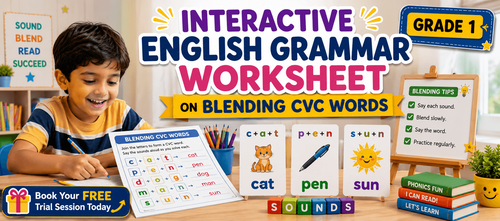

Interactive English Grammar Worksheet for Grade 1 on Blending CVC Words
Learning to blend sounds is an important step in early reading development. Young learners in Grade 1 begin to understand how individual letter sounds join together to form meaningful words. This English grammar worksheet on Blending CVC Words helps children practice combining consonant and vowel sounds to read simple three-letter words confidently. Through easy examples and engaging activities, students improve their phonics, pronunciation, and reading skills in a fun and structured way.
Download these English grammar worksheets and practice regularly to strengthen your language skills and build a strong foundation. You can also book a free trial to get expert guidance and improve your reading, writing, and comprehension abilities. The worksheets are designed in a simple and structured way to help K–8 students learn grammar concepts easily and use them confidently in everyday communication.
What Is Blending CVC Words?
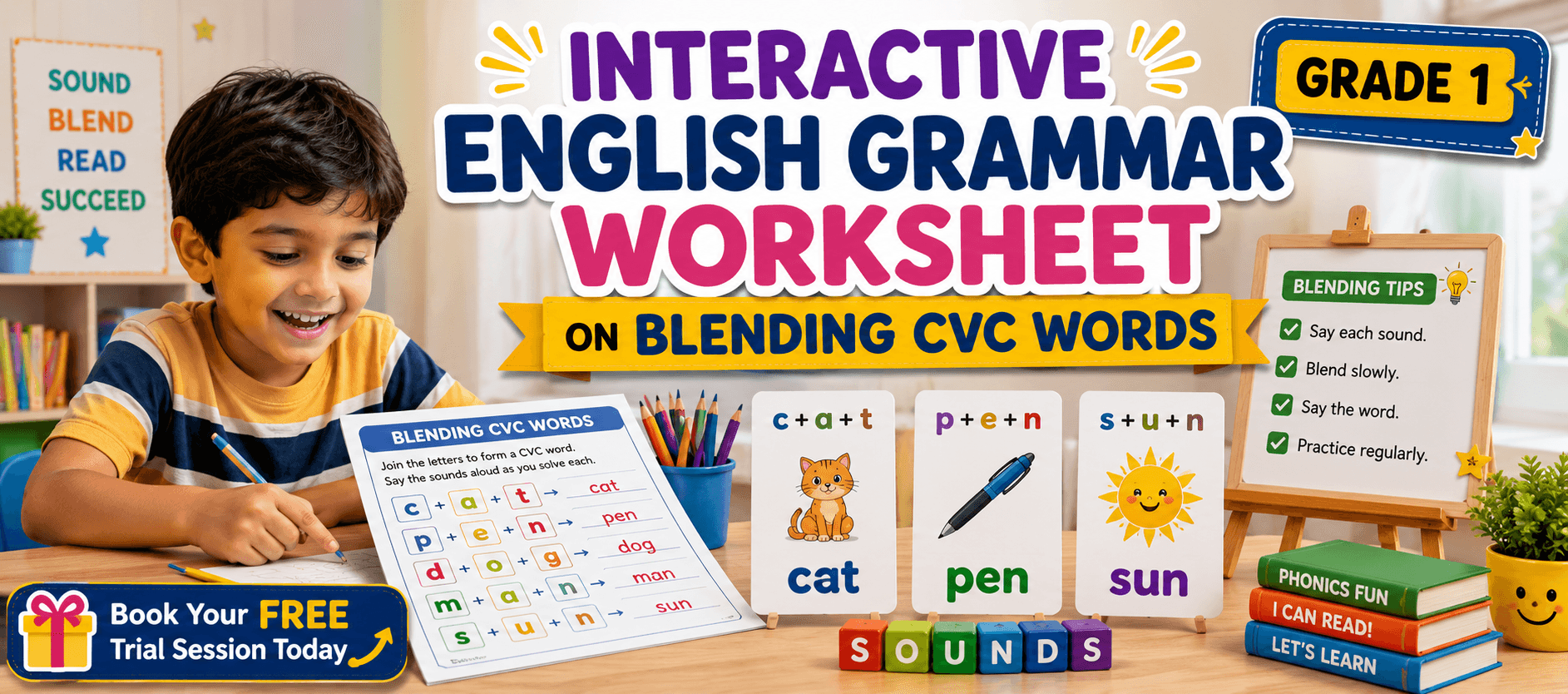
Blending means putting together the sounds of each letter to say the whole word. Children learn to blend individual sounds to read three-letter words (consonant-vowel-consonant).
Examples :
c + a + t = cat
p + e + n = pen
s + u + n = sun
In this Grade 1 English grammar worksheet, students practice joining sounds together to form simple CVC words. This activity helps children recognize sounds and improve reading fluency.
What’s in This Worksheet?
1. Introduction to blending
Students learn that blending means joining letter sounds to form words.
2. CVC word examples
The worksheet includes examples such as cat, pen, and sun.
3. Letter blending activities
Learners combine consonant and vowel sounds to create words.
4. Reading practice
Students say the sounds aloud while solving each word.
5. Phonics skill development
The worksheet strengthens sound recognition and decoding skills.
6. Simple word-building exercises
Children practice forming meaningful three-letter words.
7. Interactive learning activity
Students complete blending tasks by joining letters correctly.
Definitions, Examples, Techniques, and Tips
Definitions
Blending
Blending means putting together the sounds of each letter to say the whole word.
CVC Words
Children learn to blend individual sounds to read three-letter words (consonant-vowel-consonant).
Examples
c + a + t = cat
p + e + n = pen
s + u + n = sun
Techniques
1. Say each sound separately
Read every letter sound clearly before blending.
2. Blend slowly
Join the sounds together step by step to form the word.
3. Repeat the word aloud
Saying the word several times improves pronunciation.
4. Practice regularly
Repeated blending activities strengthen reading fluency.
Quick Learning Tips
1. Read one letter sound at a time.
2. Blend the sounds smoothly.
3. Practice simple three-letter words regularly.
4. Say the completed word aloud confidently.
5. Use phonics sounds carefully while reading.
Why Is It Important to Learn This?
Learning to blend CVC words is important because it helps students become confident readers. Blending teaches children how sounds work together to form words, which improves phonics and pronunciation skills. Students who understand blending can recognize and read simple words more quickly and accurately.
This Grade 1 English grammar worksheet also supports spelling development and listening skills. Practicing CVC word blending builds a strong reading foundation and helps children become more comfortable with everyday English words.
Where Will This Knowledge Help You?
1. Reading practice
Students can read simple words more fluently through blending practice.
2. Pronunciation improvement
Blending helps children pronounce words correctly.
3. Spelling development
Understanding sound patterns supports correct spelling.
4. Classroom participation
Students can confidently participate in reading and phonics activities.
5. Writing activities
Recognizing word patterns helps students write simple words correctly.
6. Exams and assessments
Blending skills are important in early English learning evaluations.
How to Use This Worksheet?
1. Read the instructions carefully
Understand how blending works before starting the activity.
2. Say each sound aloud
Pronounce every letter sound clearly and slowly.
3. Attempt independently first
Try to blend the sounds without help.
4. Compare answers carefully
The solutions follow the exact worksheet order, so students should compare answers carefully.
5. Correct mistakes
Review incorrect words and practice blending again.
6. Practice regularly
Daily blending practice improves reading and phonics skills.
7. Read completed words aloud
Saying the full word aloud improves fluency and confidence.
Important Tips and Tricks
1. Do not rush while blending
Blend sounds slowly and clearly.
2. Focus on every sound
Read each letter sound carefully before joining them.
3. Say the final word aloud
Hearing the completed word helps improve pronunciation.
4. Practice common CVC words
Repeated practice helps students recognize word patterns faster.
5. Use phonics sounds correctly
Pronounce consonants and vowels clearly.
6. Read instructions carefully
Follow the blending directions exactly as given.
7. Practice regularly
Frequent reading practice improves confidence and fluency.
Complete Answer Key
BLENDING CVC WORDS
Blending means putting together the sounds of each letter to say the whole word.
Children learn to blend individual sounds to read three-letter words (consonant-vowel-consonant).
Examples :
c + a + t = cat
p + e + n = pen
s + u + n = sun
Exercise
Join the letters to form a CVC word. Say the sounds aloud as you solve each.
1. c + a + t → cat
2. p + e + n → pen
3. d + o + g → dog
4. m + a + n → man
5. r + u + n → run
6. s + i + t → sit
7. h + o + p → hop
8. l + i + d → lid
9. j + e + t → jet
10. f + u + n → fun
Practicing blending CVC words regularly helps Grade 1 students improve their phonics, reading, pronunciation, and spelling skills. This English grammar worksheet on Blending CVC Words gives children simple and engaging activities to learn how sounds join together to form words. With regular practice, students become more confident readers and develop a strong foundation for future language learning.