
Free Subhas Chandra Bose Printable Worksheet – Grade 7
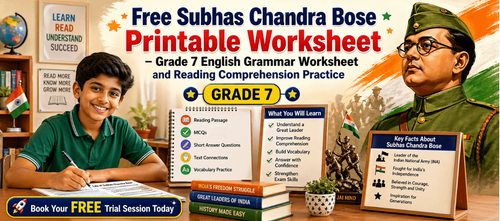

Free Subhas Chandra Bose Printable Worksheet – Grade 7 English Grammar Worksheet and Reading Comprehension Practice
Reading about national leaders helps students improve both knowledge and comprehension skills. This Grade 7 English grammar worksheet and reading comprehension activity on the Life of Subhas Chandra Bose helps students understand an important chapter of India’s history while strengthening their reading abilities. The worksheet includes a meaningful passage, multiple-choice questions, short-answer questions, and connection-based comprehension activities that encourage students to think carefully and answer correctly.
This worksheet is designed in a simple and structured format so that Grade 7 students can improve vocabulary, sentence understanding, and written responses. Students also learn how to identify important information from a passage and answer questions in the correct order. The activities encourage close reading and help students build confidence in reading comprehension tasks used in schools and exams.
Download these English grammar worksheets and practice regularly to strengthen your language skills and build a strong foundation. You can also book a free trial to get expert guidance and improve your reading, writing, and comprehension abilities. The worksheets are designed in a simple and structured way to help K–8 students learn grammar concepts easily and use them confidently in everyday communication.
What Is the Topic?
This Grade 7 worksheet focuses on reading comprehension through the topic “Life of Subhas Chandra Bose.” Students read a passage and answer questions based on the information given in the text.
The worksheet helps students:
• Understand factual information
• Answer objective questions
• Improve comprehension skills
• Learn vocabulary from context
• Make connections with the text
• Practice writing complete answers
Students also learn about:
• Subhas Chandra Bose’s role in India’s freedom struggle
• The Indian National Army (INA)
• Different approaches toward independence
• Leadership and bravery
What’s in This Worksheet?
1. A reading passage about the life and contributions of Subhas Chandra Bose.
2. Multiple-choice questions based on the passage.
3. Short-answer comprehension questions.
4. Text connection questions that require deeper understanding.
5. Vocabulary practice through synonym identification.
6. Structured exercises that improve reading and answering skills.
7. Activities that help students prepare for school comprehension tests and exams.
8. Questions arranged in a clear serial-number format for easy practice.
Definitions, Examples, Techniques, and Tips
Definition:
Reading comprehension means understanding a written passage and answering questions correctly based on the text.
Example:
The passage explains that Subhas Chandra Bose led the Indian National Army during India’s struggle for independence.
Another example:
The worksheet describes how Bose believed in using force to gain independence, unlike Gandhi’s non-violent approach.
Techniques students can use:
• Read the passage slowly and carefully.
• Identify important names and ideas.
• Read each question properly before answering.
• Match answers directly with the passage.
• Follow the correct serial-number order.
Quick learning tips:
• Focus on important details from the passage.
• Read all answer choices carefully.
• Revise the passage once after completing the worksheet.
• Use complete and meaningful sentences.
Why Is It Important to Learn This?
Reading comprehension improves understanding, concentration, and writing skills. It also helps students learn important historical topics and improve their ability to answer questions correctly.
This worksheet helps students:
• Improve reading accuracy
• Build vocabulary skills
• Understand historical passages
• Practice structured answer writing
• Develop deeper understanding through text-based questions
Regular comprehension practice also improves confidence and exam performance.
Where Will This Knowledge Help You?
• School exams
Students commonly answer comprehension passages in English exams.
• Classroom learning
Reading comprehension helps students participate actively in discussions.
• Writing practice
Students learn how to write complete and accurate answers.
• Vocabulary development
Passages introduce new words and meanings.
• General awareness
Students learn about important leaders and historical events.
How to Use This Worksheet?
1. Read the passage carefully before starting the exercises.
2. Underline important points and facts while reading.
3. Attempt the multiple-choice questions independently.
4. Answer all questions according to the serial-number order.
5. Compare your answers carefully with the complete answer key.
6. Correct mistakes and revise difficult questions.
7. Practice regularly to improve reading and comprehension skills.
8. Follow the exact worksheet order while checking answers.
Important Tips and Tricks
1. Read the passage at least two times before answering.
2. Do not skip any line while reading.
3. Pay attention to keywords in the questions.
4. Use information directly from the passage while answering.
5. Answer subjective questions in complete sentences.
6. Vocabulary questions should be answered using words from the passage.
7. Think carefully before answering text connection questions.
8. Examiners expect neat, accurate, and properly ordered answers.
9. Revise your completed worksheet before submission.
10. Practice reading passages regularly to improve speed and understanding.
Complete Answer Key
Reading Passage:
Life of Subhas Chandra Bose
Subhas Chandra Bose was a prominent leader in India's fight for independence. He is best known for his leadership of the Indian National Army (INA), which fought alongside the Japanese against British forces during World War II. Bose believed in the use of force to gain independence, in contrast to Mahatma Gandhi's non-violent approach. He formed the INA to mobilize Indian soldiers, and with their help, he hoped to drive the British out of India. Although the INA did not succeed in liberating India, Bose’s efforts remain an important chapter in India’s history. His bravery, determination, and vision for an independent India continue to inspire many.
Exercise No. 1
Choose the most appropriate option in relevance to this passage.
1. What was Subhas Chandra Bose best known for?
☑ b) Leading the Indian National Army
2. What was Bose’s approach to India’s independence?
☑ b) He used force to achieve independence
3. Who did Bose’s Indian National Army ally with during World War II?
☑ c) The Japanese
Exercise No. 2
Answer the following questions from the passage.
1. What was Subhas Chandra Bose’s vision for India’s independence?
Answer:
Subhas Chandra Bose’s vision for India’s independence was to drive the British out of India with the help of the Indian National Army and achieve freedom through force and military support.
2. What is the Indian National Army (INA)?
Answer:
The Indian National Army (INA) was an army formed by Subhas Chandra Bose to mobilize Indian soldiers and fight for Indian independence.
3. Why is Subhas Chandra Bose remembered in India’s history?
Answer:
Subhas Chandra Bose is remembered in India’s history for his leadership, bravery, determination, and his efforts to form the Indian National Army during India’s freedom struggle.
Exercise No. 3
Read the questions carefully and answer the following by making connections with the text.
1. How did Bose’s approach to independence differ from Gandhi’s?
Answer:
Bose believed in the use of force and military support to gain independence, while Gandhi focused on a non-violent approach.
2. What was Bose's impact on the freedom struggle?
Answer:
Bose inspired many people through his bravery, determination, and strong efforts to fight for India’s independence.
3. What challenges did Bose face while leading the INA?
Answer:
Bose faced challenges such as limited resources, opposition, and failure to gain widespread support.
4. Find a synonym of “mobilize” from the passage.
Answer:
Organize
This Grade 7 English grammar worksheet and reading comprehension practice on the Life of Subhas Chandra Bose helps students improve reading skills, vocabulary, understanding, and answer-writing abilities. Regular practice with comprehension passages can improve confidence, accuracy, and performance in exams and classroom activities. Careful reading and answering questions in the correct order are important skills that become stronger through consistent practice.