
Fun Adverbs of Place English Exercises for Grade 3 Learners
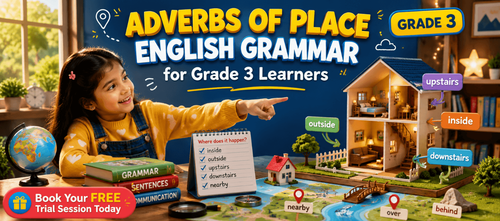

Adverbs of Place English Grammar Worksheet for Grade 3 Learners
Learning adverbs of place can make sentences more interesting and meaningful for young learners. In Grade 3, students begin to understand how words can describe where an action happens. This worksheet on adverbs of place helps children practice identifying, using, and writing place words in a fun and engaging way. Through coloring activities, fill in the blanks, sentence rewriting, and sentence formation, students can build confidence in English grammar while improving their writing and speaking skills. The activities are simple, interactive, and designed to help Grade 3 learners understand how adverbs of place work in everyday communication.
Download these English grammar worksheets and practice regularly to strengthen your language skills and build a strong foundation. You can also book a free trial to get expert guidance and improve your reading, writing, and comprehension abilities. The worksheets are designed in a simple and structured way to help K–8 students learn grammar concepts easily and use them confidently in everyday communication.
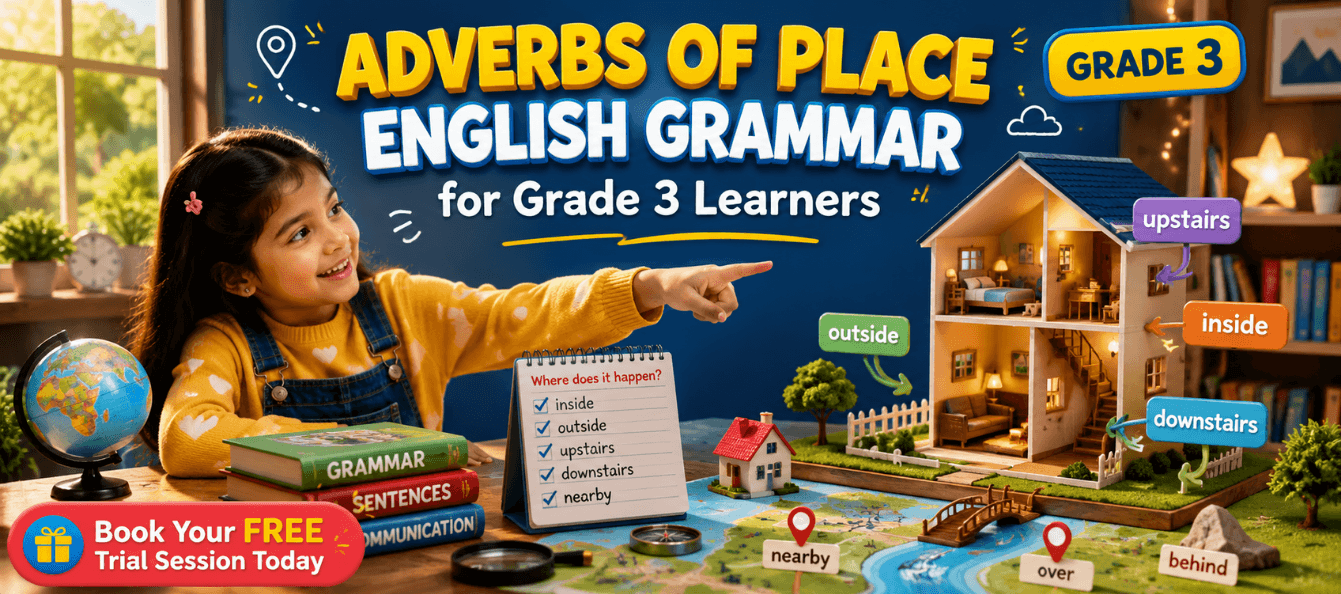
What Is Adverbs of Place?
Adverbs of place describe where the action happens. They answer the question “Where?” and usually come after the verb.
Some common adverbs of place included in this worksheet are:
here, there, upstairs, downstairs, outside, inside, nearby, away
Examples:
The children are playing outside.
The balloon went up.
In this Grade 3 English grammar worksheet, students learn how to identify words that tell where something happens. They also practice using these words correctly in sentences.
What’s in This Worksheet?
1. Color the words that tell where something happens.
2. Underline the adverbs of place in sentences.
3. Fill in the blanks using words that tell where something happens.
4. Rewrite sentences by adding suitable adverbs of place.
5. Write new sentences using adverbs of place from a given list.
6. Practice sentence formation using different place words.
7. Improve grammar understanding through simple and engaging exercises.
8. Build confidence in identifying and using adverbs of place in daily communication.
9. Strengthen reading and writing skills through grammar-based activities.
10. Prepare for school grammar exercises and classroom participation.
Definitions, Examples, Techniques, and Tips
Definition:
Adverbs of place describe where the action happens.
They answer the question “Where?” and usually come after the verb.
Examples from the worksheet:
The children are playing outside.
The balloon went up.
Common adverbs of place:
here
there
upstairs
downstairs
outside
inside
nearby
away
Techniques to Learn Adverbs of Place:
1. Read the sentence carefully and ask “Where did the action happen?”
2. Look for words that show position or direction.
3. Practice identifying place words in simple sentences.
4. Use adverbs of place while speaking and writing daily sentences.
Quick Learning Tips:
1. Words like inside, outside, below, and upstairs often tell place.
2. Place words help readers understand location clearly.
3. Practice sentence writing regularly to remember the correct usage.
4. Read each sentence slowly before selecting the adverb of place.
Why Is It Important to Learn This?
Learning adverbs of place is important because they help students explain where actions happen clearly. They make sentences more meaningful and interesting. Grade 3 students can improve their grammar, speaking, and writing skills by learning how to use place words correctly.
Understanding adverbs of place also helps students write better stories, answer grammar questions correctly, and communicate ideas clearly in school and everyday life.
Where Will This Knowledge Help You?
1. In English grammar exams and class tests.
2. During sentence writing activities in school.
3. While speaking and describing actions clearly.
4. In reading comprehension activities.
5. During classroom discussions and participation.
6. In daily communication and storytelling.
7. While improving vocabulary and grammar confidence.
How to Use This Worksheet?
1. Read each question carefully before answering.
2. Attempt all exercises independently first.
3. Follow the exact order of questions while answering.
4. Compare your answers carefully with the solutions.
5. Underline or identify the correct adverbs properly.
6. Rewrite the sentences neatly using suitable place words.
7. Practice sentence formation regularly to improve grammar skills.
8. The solutions follow the exact worksheet order, so students should compare answers carefully.
9. Revise difficult words and practice them again.
10. Continue practicing similar grammar exercises regularly.
Important Tips and Tricks
1. Always look for words that answer the question “Where?”
2. Read the complete sentence before choosing the adverb of place.
3. Words like inside, outside, below, nearby, and upstairs usually show place.
4. Avoid confusing adverbs of place with action words.
5. Write complete sentences neatly during sentence formation exercises.
6. Underline the correct place word carefully when instructed.
7. Practice using adverbs of place in daily conversations.
8. Examiners expect correct grammar usage and proper sentence structure.
9. Read instructions carefully before solving each exercise.
10. Double-check spellings of place words before finishing the worksheet.
Complete Answer Key
Exercise 1
Color the words that tell us where something happens.
1. nearby
2. behind
3. downstairs
4. around
5. above
6. inside
7. back
8. below
9. there
10. away
11. somewhere
12. outside
13. everywhere
14. there
15. upstairs
Exercise 2
Underline the word that tells where something happens in each sentence.
1. The children played __INDOORS__ during recess.
2. We saw butterflies __outdoors__ in the garden.
3. The shop is __near__ my house.
4. The bird flew __far__ across the sky.
5. She stayed __inside__ her house on Sunday.
6. You can sit __anywhere__ you like.
7. He climbed __up__ the ladder.
8. The ball rolled __down__ the hill.
9. We walked __along__ the river.
10. The pencil rolled __below__ the table.
Exercise 3
Fill in the blanks with words that tell where something happens.
1. She looked EVERYWHERE for her pencil.
2. They played hide and seek outside.
3. The kite flew above the trees.
4. Your shoes are lying under the bed.
5. My house is near the bakery.
6. The children ran around the yard.
7. We found the cat hiding behind the curtain.
8. He threw the ball over the fence.
9. A butterfly flew around the flowers.
10. The kids ran inside when it rained.
Exercise 4
Rewrite each sentence by adding a word that tells where something happens. Underline the word you added.
1. He parked his bicycle __outside__.
2. The children played __inside__.
3. The cat slept __upstairs__.
4. She put the keys __there__.
5. They built a sandcastle __nearby__.
6. We found a frog __outside__.
7. He stood and waited __there__.
8. She placed the bowl __below__.
9. The balloon floated __up__.
10. I kept the book __inside__.
Exercise 5
Write 5 sentences using any 5 words from the list that tell where something happens.
1. Please sit here beside me.
2. The children are playing outside.
3. The cat hid under the table.
4. My friend lives nearby.
5. The bird flew over the tree.
Practicing adverbs of place regularly can help Grade 3 students become more confident in grammar and sentence writing. These exercises make learning enjoyable and help students understand how to describe where actions happen clearly. Keep practicing English grammar worksheets to improve your reading, writing, and communication skills every day.