
Fun and Easy Nouns Grammar Guide for Grade 2 Learners
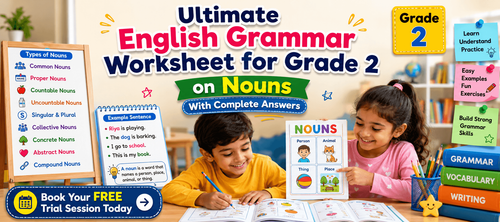

Ultimate English Grammar Worksheet for Grade 2 on Nouns With Complete Answers
Learning nouns is one of the first and most important steps in understanding English grammar. This English grammar worksheet for Grade 2 on Nouns helps children identify different kinds of nouns through engaging explanations, examples, and practice exercises. Students learn about common nouns, proper nouns, countable nouns, uncountable nouns, singular nouns, plural nouns, collective nouns, concrete nouns, abstract nouns, and compound nouns in a simple and structured way.
In Grade 2, children begin building stronger reading and writing skills. Understanding nouns helps students describe people, places, animals, things, feelings, and groups correctly in sentences. This worksheet includes easy explanations and enjoyable activities that make grammar learning more interesting and effective for young learners.
Download these English grammar worksheets and practice regularly to strengthen your language skills and build a strong foundation. You can also book a free trial to get expert guidance and improve your reading, writing, and comprehension abilities. The worksheets are designed in a simple and structured way to help K–8 students learn grammar concepts easily and use them confidently in everyday communication.
What Is the Topic?
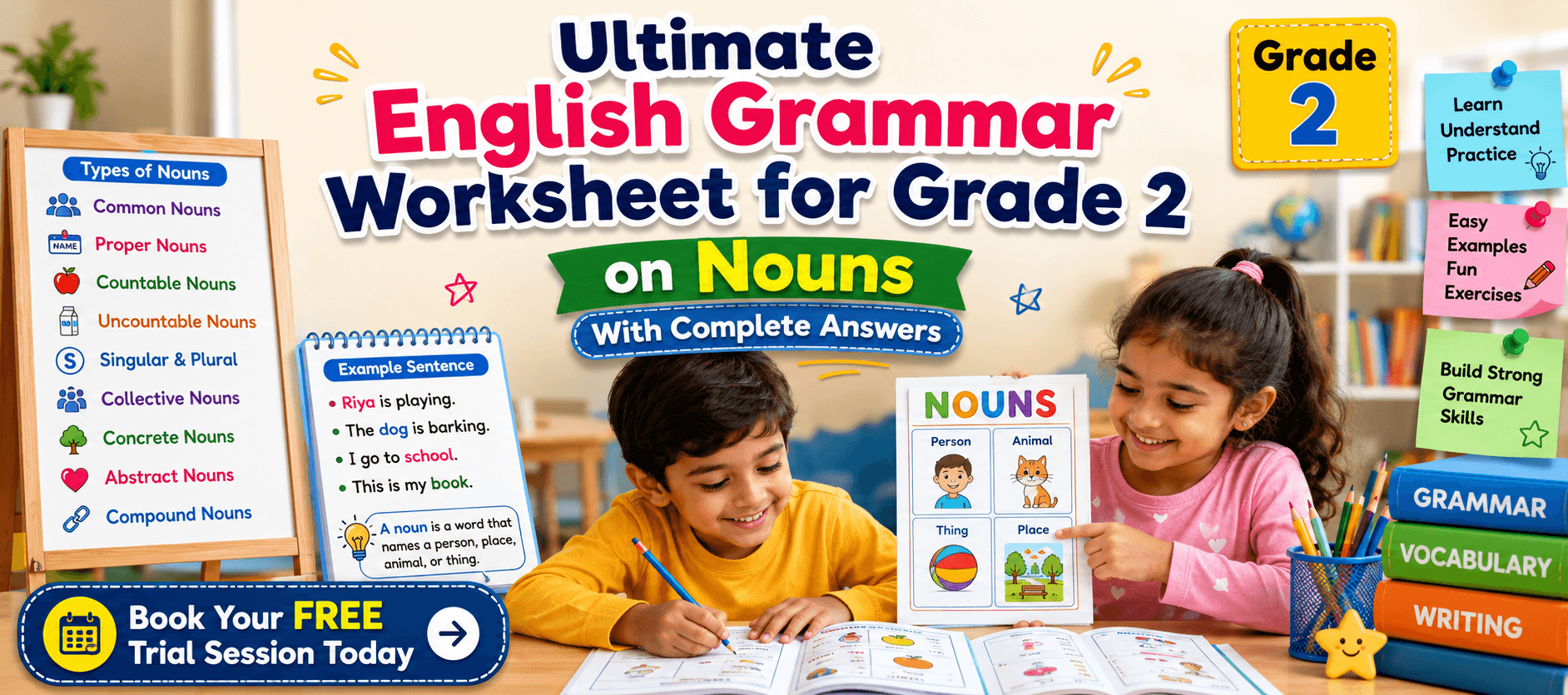
A noun is a word that names a person, place, animal, or thing.
Examples from the worksheet include:
Person – Dad, Teacher
Animal – Cat, Elephant
Thing – Ball, Book
Place – Park, Zoo
The worksheet also explains nouns through sentences such as:
• Riya is playing.
• The dog is barking.
• I go to school.
• This is my book.
This English grammar worksheet for Grade 2 on Nouns teaches students different types of nouns and how they are used in sentences. Students learn how to identify naming words, understand their types, and use them correctly while reading and writing.
The worksheet covers:
• Common nouns and proper nouns
• Countable and uncountable nouns
• Singular and plural nouns
• Collective nouns
• Concrete and abstract nouns
• Compound nouns
What’s in This Worksheet?
1. Noun Identification Activities
Students learn to identify nouns in different sentences and examples.
2. Common and Proper Noun Practice
The worksheet includes exercises where students identify common nouns and proper nouns correctly.
3. Countable and Uncountable Noun Exercises
Students practice sorting nouns into countable and uncountable categories.
4. Singular and Plural Noun Questions
Children complete sentences using the correct singular or plural form of nouns.
5. Collective Noun Activities
Students learn group naming words such as flock, herd, team, and bunch.
6. Concrete and Abstract Noun Sorting
The worksheet helps students understand the difference between things they can sense and feelings or ideas.
7. Compound Noun Practice
Students break compound nouns into smaller words and also join words together to form new nouns.
8. Practice Worksheets
Additional exercises help students revise all noun concepts together and improve grammar confidence.
Definitions, Examples, Techniques, and Tips
Definition of Nouns
A noun is a word that names a person, place, animal, or thing.
Examples
• Dad
• Teacher
• Cat
• Elephant
• Ball
• Book
• Park
• Zoo
Common Nouns and Proper Nouns
A Common Noun is a general name for a person, place, animal, or thing.
Examples:
• boy
• city
• school
• cat
• car
A Proper Noun is the special name of a person, place, animal, or thing.
Examples:
• Max
• India
• Taj Mahal
• Ram
• Mumbai
Countable and Uncountable Nouns
Countable nouns are things we can count.
Examples:
• apple
• pencil
• dog
Uncountable nouns are things we cannot count one by one.
Examples:
• milk
• rice
• sugar
Singular and Plural Nouns
A Singular Noun means one person, place, animal, or thing.
Examples:
• one apple
• one book
• one dog
A Plural Noun means more than one person, place, animal, or thing.
Examples:
• two apples
• many books
• three dogs
Collective Nouns
A Collective Noun is a word that means a group of people, animals, or things.
Examples:
• flock of birds
• herd of cows
• team of players
• bunch of flowers
Concrete and Abstract Nouns
A Concrete Noun is something you can see, touch, hear, taste, or smell.
Examples:
• toy
• apple
• dog
• chair
An Abstract Noun is something you cannot see or touch.
Examples:
• love
• joy
• fear
• kindness
Compound Nouns
A Compound Noun is made by joining two words together to make one new word.
Examples:
• toothbrush
• sunflower
• football
• schoolbag
• playground
Why Is It Important to Learn This?
Learning nouns is important because nouns are used in almost every sentence. They help students name people, places, animals, objects, groups, feelings, and ideas correctly.
This English grammar worksheet for Grade 2 on Nouns strengthens grammar understanding and helps students write clearer sentences. When students learn different types of nouns, they improve reading comprehension, vocabulary, and communication skills.
Understanding nouns also helps children:
• Build stronger sentences
• Improve writing skills
• Speak confidently
• Understand grammar rules better
• Perform well in school exams
Grammar learning becomes easier when students practice nouns regularly through activities and exercises.
Where Will This Knowledge Help You?
1. School Grammar Exams
Nouns are one of the most important grammar topics in Grade 2 English exams and worksheets.
2. Writing Sentences and Paragraphs
Students use nouns while writing stories, descriptions, and classroom assignments.
3. Reading Activities
Understanding nouns helps students read and understand sentences correctly.
4. Classroom Communication
Students use nouns while answering questions, speaking in class, and participating in activities.
5. Daily Conversations
Children use nouns every day while talking about people, places, objects, and feelings.
How to Use This Worksheet?
1. Read Every Explanation Carefully
Students should first understand each noun type before solving the exercises.
2. Solve the Exercises Independently
Attempt each question carefully without rushing.
3. Compare Answers in the Correct Order
The solutions follow the exact worksheet order, so students should compare answers carefully.
4. Correct Mistakes Properly
Students should reread incorrect answers and understand the correct noun usage.
5. Practice Difficult Questions Again
Repeated practice helps students remember noun rules more easily.
6. Revise All Types of Nouns Regularly
Regular grammar revision improves understanding and exam performance.
Important Tips and Tricks
1. Remember That Every Naming Word Is a Noun
People, places, animals, things, groups, and feelings can all be nouns.
2. Use Capital Letters for Proper Nouns
Names such as Delhi, Mumbai, Priya, and Taj Mahal always begin with capital letters.
3. Check Singular and Plural Forms Carefully
Read the sentence properly before choosing singular or plural nouns.
4. Learn Common Collective Nouns
Words such as flock, herd, team, and bunch are commonly used in exams.
5. Read Compound Nouns Slowly
Break compound nouns into smaller words to understand them easily.
6. Practice Grammar Daily
Daily grammar practice improves writing accuracy and confidence.
Complete Answer Key
Exercise 1
Circle the Proper Nouns and underline the Common Nouns in each sentence.
1. Aarav played with his new bat in the park.
Proper Noun: Aarav
Common Nouns: bat, park
2. Grandma gave Priya a red balloon.
Proper Noun: Priya
Common Nouns: Grandma, balloon
3. We visited the Red Fort during our trip.
Proper Noun: Red Fort
Common Nouns: trip
4. The cow is eating grass in the field.
Common Nouns: cow, grass, field
5. Mr. Verma teaches Mathematics in our school.
Proper Nouns: Mr. Verma, Mathematics
Common Noun: school
6. Aisha and her sister went to the zoo.
Proper Noun: Aisha
Common Nouns: sister, zoo
7. The monkey jumped on the tree near my house.
Common Nouns: monkey, tree, house
8. The cat is sitting on Shreya’s sofa.
Proper Noun: Shreya
Common Nouns: cat, sofa
9. Rahul packed his bag before going to Delhi.
Proper Nouns: Rahul, Delhi
Common Noun: bag
10. My uncle lives in Kolkata near the river.
Proper Noun: Kolkata
Common Nouns: uncle, river
Exercise 2
Write C for Countable Nouns and U for Uncountable Nouns for the words given below.
orange → C
butter → U
spoon → C
soap → U
chair → C
juice → U
book → C
cotton → U
egg → C
sand → U
biscuit → C
tea → U
star → C
air → U
cup → C
salt → U
balloon → C
honey → U
toy → C
flour → U
Exercise 3
Fill in the blanks with the correct singular or plural noun.
1. My uncle has three cars in the garden.
2. We saw one monkey sitting on the branch.
3. There is a red cushion on the chair.
4. The frogs are jumping in the muddy puddles.
5. I put one eraser in my pencil box.
6. Two policemen are standing near the gate.
7. That dog is barking loudly on the stranger.
8. The stars are shining brightly at night.
Exercise 4
Fill in the blanks with the correct collective noun from the word box below.
1. A flock of birds flew across the blue sky.
2. My teacher asked the class to sit quietly.
3. A huge crowd of people cheered for the parade.
4. The herd of cows was eating grass.
5. A group of children is playing in the garden.
6. The football team was wearing red shirts.
7. There is a pile of toys on the bed.
8. I live with my family in the city.
9. Mom bought a bunch of bananas from the market.
10. A pack of wolves was howling at night.
Exercise 5
Look at the words in the word box. Sort them into Concrete Nouns and Abstract Nouns.
Concrete Nouns
pencil
bicycle
pillow
apple
table
rainbow
sweater
drum
schoolbag
Abstract Nouns
love
honesty
happiness
noise
anger
fun
idea
beauty
fear
kindness
pride
Exercise 6
Break each compound noun into the two smaller words that form it.
1. Birdhouse → bird + house
2. Mailman → mail + man
3. Rainbow → rain + bow
4. Notebook → note + book
5. Pancake → pan + cake
6. Airport → air + port
7. Jellyfish → jelly + fish
8. Cupcake → cup + cake
9. Playground → play + ground
10. Firefly → fire + fly
Practice Worksheet
Exercise 1
Choose the word from the bracket that best fits the sentence.
1. He felt anger when his toy broke.
2. We should always speak with honesty.
3. She was full of fear before going on stage.
4. Grandma shares stories full of wisdom.
5. Everyone clapped for their bravery.
Exercise 2
Rewrite each sentence by fixing the proper noun with a capital letter.
1. I met Priya at the park.
2. We are going to Delhi tomorrow.
3. The Taj Mahal is very beautiful.
4. My cousin lives in Mumbai.
5. We celebrate Diwali every year.
Exercise 3
Match the words with the correct collective noun.
1. Lions → pride
2. Books → pile
3. Chairs → sets
4. Singers → choir
5. Bees → swarm
Exercise 4
Circle the countable nouns from the box below.
APPLE
CHAIR
PEN
CAKE
BANANA
EGG
BOOK
ORANGE
TOY
FLOWER
MAN
SHOES
SPOON
CAT
TREE
Exercise 5
Join the two words to make a compound noun.
1. Rain + coat → raincoat
2. Cup + cake → cupcake
3. Play + ground → playground
4. Note + book → notebook
5. Black + board → blackboard
Exercise 6
Write the correct common noun under each picture.
1. Answers based on the pictures provided in the worksheet.
Practicing nouns regularly helps children build a strong grammar foundation and improve communication skills. This English grammar worksheet for Grade 2 on Nouns gives students structured practice with different noun types through simple explanations and engaging activities. By practicing these exercises carefully, children can become more confident in reading, writing, speaking, and understanding English grammar in everyday life and school learning.