
Fun Compound Nouns Exercises for Class 2 Learners
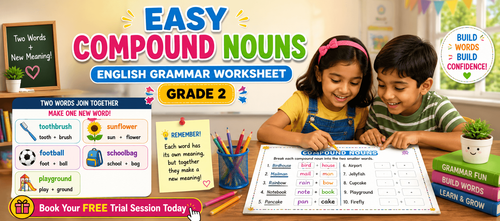

Easy Compound Nouns English Grammar Worksheet for Grade 2 Learners
Learning grammar becomes more exciting when students discover how two small words can join together to create a completely new word with a different meaning. This English grammar worksheet for Grade 2 on Compound Nouns helps children understand how compound nouns are formed and how they are used in daily language. Through simple examples and word-breaking activities, students improve vocabulary, spelling, and grammar skills in an enjoyable and structured way.
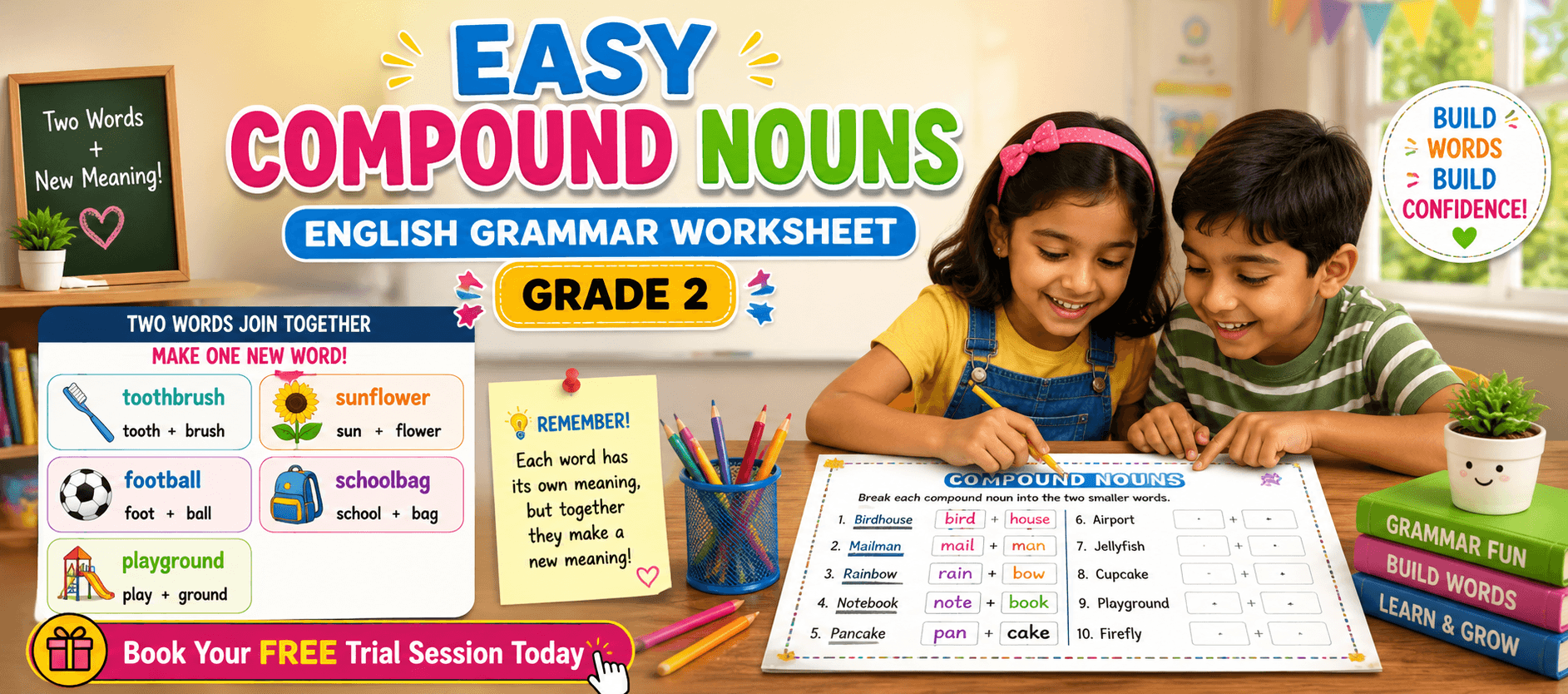
In Grade 2, students begin learning how words work together in meaningful ways. Compound nouns help children understand word formation and sentence construction more clearly. This worksheet introduces easy compound nouns such as toothbrush, sunflower, football, and schoolbag. Students also practice breaking compound nouns into smaller words, helping them recognize how new meanings are created when words combine.
Download these English grammar worksheets and practice regularly to strengthen your language skills and build a strong foundation. You can also book a free trial to get expert guidance and improve your reading, writing, and comprehension abilities. The worksheets are designed in a simple and structured way to help K–8 students learn grammar concepts easily and use them confidently in everyday communication.
What Is Compound Nouns?
A Compound Noun is made by joining two words together to make one new word.
Each word has its own meaning, but when we put them together, they make a new meaning.
This worksheet teaches students how compound nouns are formed and how two smaller words can combine to describe a new object, place, or thing. Students learn to identify both the full compound noun and the smaller words used to create it.
The worksheet uses familiar examples to make the concept easy and relatable for Grade 2 students.
What’s in This Worksheet?
1. A simple explanation of compound nouns
2. Examples showing how two words combine to form a new word
3. Meanings of common compound nouns
4. Word-building examples such as toothbrush and sunflower
5. Practice breaking compound nouns into smaller words
6. Vocabulary-building grammar exercises
7. Word recognition and spelling practice
8. Sentence-friendly examples suitable for Grade 2 students
9. Structured activities that improve reading and grammar understanding
10. Practice exercises useful for classroom learning and exam preparation
Definitions, Examples, Techniques, and Tips
A Compound Noun is made by joining two words together to make one new word.
Each word has its own meaning, but when we put them together, they make a new meaning.
Examples from the worksheet:
toothbrush
tooth + brush
a brush for cleaning teeth
sunflower
sun + flower
a flower that looks like the sun
football
foot + ball
a ball used for playing football
schoolbag
school + bag
a bag used for school
playground
play + ground
a place where children play
Students can improve understanding by reading both smaller words carefully before identifying the compound noun. Breaking words into smaller parts helps children understand spelling patterns and meanings more clearly.
The worksheet also encourages students to observe how new meanings are formed when two words are joined together.
Why Is It Important to Learn This?
Learning compound nouns helps students improve vocabulary and understand word formation better. Students become familiar with how words combine to create new meanings that are commonly used in daily communication.
Compound nouns also improve reading and spelling skills because students learn to recognize smaller words inside bigger words. This understanding supports sentence-building and improves confidence during grammar activities.
This grammar topic is important for Grade 2 learners because it strengthens vocabulary development and helps students identify meaningful word patterns in reading and writing tasks.
Where Will This Knowledge Help You?
Compound nouns are useful in reading, writing, spelling, and grammar activities.
This knowledge helps students during:
1. English grammar exams
2. Vocabulary-building activities
3. Sentence writing practice
4. Reading comprehension exercises
5. Spelling practice
6. Classroom discussions
7. Word recognition tasks
8. Story reading activities
9. Understanding meanings of new words
10. Improving communication and grammar confidence
Students who understand compound nouns can identify words more quickly and use them correctly in speaking and writing.
How to Use This Worksheet?
1. Read the explanation of compound nouns carefully before starting the exercise.
2. Study the examples given in the worksheet to understand how two words combine to form one new word.
3. Read each compound noun carefully during the activity.
4. Break the word into two smaller words independently first.
5. Check whether both smaller words create the correct compound noun meaning.
6. Compare your answers carefully with the complete answer key provided below.
7. Correct mistakes and revise difficult compound nouns regularly.
8. Follow the exact worksheet order while checking answers.
9. Practice identifying compound nouns in books and daily reading activities.
10. Revise worksheet examples regularly to improve vocabulary and grammar understanding.
Important Tips and Tricks
1. Read the whole compound noun carefully before breaking it into smaller words.
2. Look for smaller familiar words inside the compound noun.
3. Remember that both smaller words together create a new meaning.
4. Practice spelling compound nouns regularly.
5. Use worksheet examples to understand word formation patterns.
6. Avoid breaking words incorrectly while answering.
7. Read both smaller words aloud to check if they form the correct compound noun.
8. During exams, observe spelling carefully before writing answers.
9. Practice compound nouns from daily reading materials.
10. Regular grammar practice improves vocabulary and word recognition skills.
Complete Answer Key
A Compound Noun is made by joining two words together to make one new word.
Each word has its own meaning, but when we put them together, they make a new meaning.
Compound Noun — Word 1 — Word 2 — Meaning
toothbrush — tooth — brush — a brush for cleaning teeth
sunflower — sun — flower — a flower that looks like the sun
football — foot — ball — a ball used for playing football
schoolbag — school — bag — a bag used for school
playground — play — ground — a place where children play
Break each compound noun into the two smaller words that form it.
1. Birdhouse
bird + house
2. Mailman
mail + man
3. Rainbow
rain + bow
4. Notebook
note + book
5. Pancake
pan + cake
6. Airport
air + port
7. Jellyfish
jelly + fish
8. Cupcake
cup + cake
9. Playground
play + ground
10. Firefly
fire + fly
Practicing compound nouns regularly helps Grade 2 students improve vocabulary, spelling, grammar understanding, and reading confidence. This English grammar worksheet on Compound Nouns introduces easy explanations, familiar examples, and engaging word-building activities that make learning enjoyable for young learners. With regular practice, students can confidently recognize compound nouns and understand how words combine to create new meanings in everyday English.