
Fun Conjunctions Practice Worksheet for Grade 3 Students

Conjunctions Easily with This English Grammar Worksheet for Grade 3 Students
Learning conjunctions can be exciting and enjoyable when students practice through fun and structured exercises. This English grammar worksheet for Grade 3 helps children understand how joining words connect ideas, sentences, and thoughts in a meaningful way. Through sentence formation, fill in the blanks, matching exercises, and choosing the correct conjunctions, students get plenty of opportunities to improve their grammar skills step by step.
The worksheet topic, Conjunctions (Joining Words), is designed to help Grade 3 students build stronger sentences and improve both writing and speaking skills. Students learn how words like and, but, because, so, or, and if are used in everyday communication. By practicing regularly, children become more confident in forming meaningful and grammatically correct sentences.
Download these English grammar worksheets and practice regularly to strengthen your language skills and build a strong foundation. You can also book a free trial to get expert guidance and improve your reading, writing, and comprehension abilities. The worksheets are designed in a simple and structured way to help K–8 students learn grammar concepts easily and use them confidently in everyday communication.
What Is the Topic?
Conjunctions are joining words that connect two words, ideas, or sentences together. This Grade 3 English grammar worksheet explains that conjunctions help make sentences smoother and more meaningful. Students learn how different conjunctions are used in different situations.
The worksheet includes examples such as:
• I have a pen and a pencil.
• I am small but strong.
• It was raining, so we stayed inside.
• I am happy because it is my birthday.
• If you are hungry, eat a banana.
• Do you want juice or milk?
By practicing conjunctions, students learn how to connect thoughts correctly and improve sentence formation skills.
What’s in This Worksheet?
1. Fill in the blanks using suitable conjunctions such as and, but, or, so, yet, because, if, when, either...or, neither...nor, and although.
2. Sentence joining activities where students combine two simple sentences using suitable conjunctions.
3. Match the following exercises that help students connect sentence beginnings and endings correctly.
4. Choose the correct conjunction activities to improve understanding of sentence meaning.
5. Sentence formation practice to help students write complete and meaningful sentences.
6. Exercises arranged in a simple and structured format for easy learning.
7. Practice questions that strengthen grammar concepts useful for school assignments and exams.
Definitions, Examples, Techniques, and Tips
Definition
Conjunctions are used to join two words, ideas, or sentences together. They are also called joining words.
Examples
• I have a pen and a pencil.
• I am small but strong.
• It was raining, so we stayed inside.
• I am happy because it is my birthday.
• If you are hungry, eat a banana.
• Do you want juice or milk?
Techniques
• Read the full sentence carefully before choosing the conjunction.
• Understand the relationship between both parts of the sentence.
• Use conjunctions that correctly connect ideas.
• Practice sentence joining regularly.
Quick Learning Tips
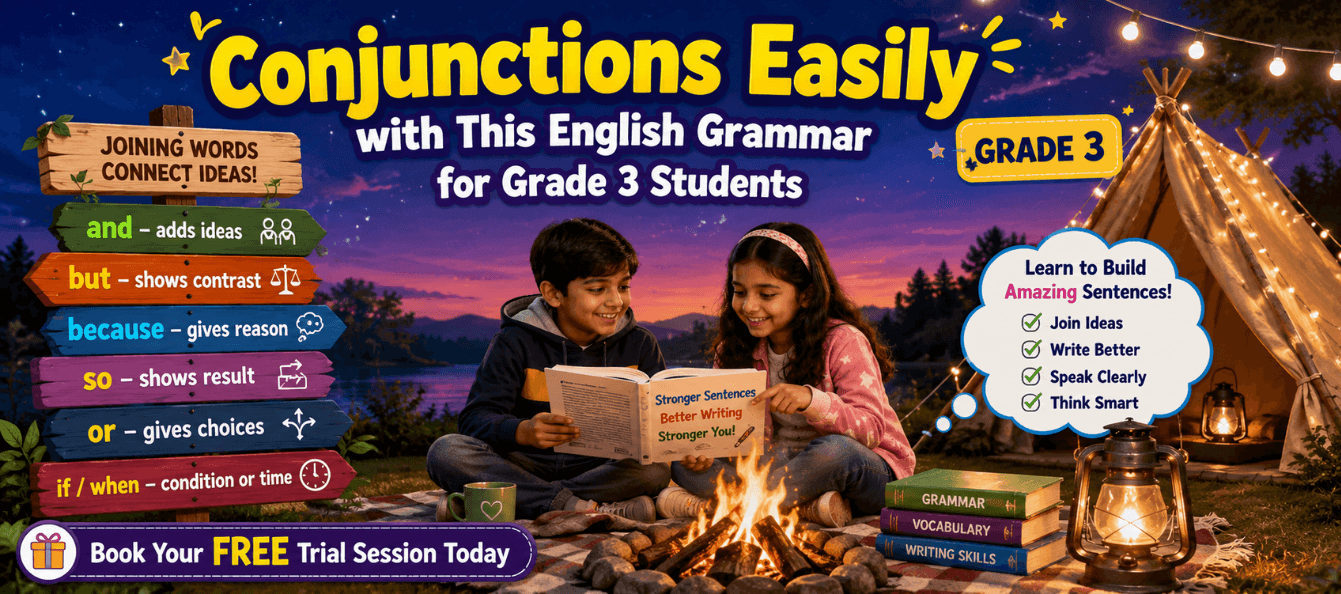
• Use and to add ideas.
• Use but to show contrast.
• Use because to give a reason.
• Use so to show result.
• Use or to show choices.
• Use if and when for conditions or time.
Why Is It Important to Learn This?
Learning conjunctions is important because they help students connect ideas clearly. Without conjunctions, sentences may sound incomplete or disconnected. This English grammar worksheet for Grade 3 helps students improve communication skills by teaching how sentences are linked together properly.
Conjunctions also make writing more interesting and meaningful. Students can express ideas smoothly while speaking and writing. Understanding conjunctions improves reading comprehension and helps children write longer and better sentences.
Regular practice also helps students perform better in grammar tests, classroom activities, and daily communication.
Where Will This Knowledge Help You?
Students can use conjunctions in many real-life situations and academic tasks.
• Writing complete sentences in school assignments.
• Speaking clearly during classroom discussions.
• Improving grammar test performance.
• Building better sentence formation skills.
• Understanding reading passages more easily.
• Participating confidently in English activities.
• Writing stories, essays, and answers correctly.
How to Use This Worksheet?
1. Read each question carefully before answering.
2. Attempt all exercises independently to understand conjunction usage properly.
3. Check how conjunctions join ideas and sentences together.
4. Compare your answers carefully with the complete answer key.
5. Practice sentence formation regularly for better understanding.
6. Follow the exact worksheet order while solving questions.
7. Revise mistakes and practice similar sentence patterns again.
8. Read all conjunction examples carefully to improve grammar skills.
Important Tips and Tricks
1. Read both parts of the sentence before choosing the conjunction.
2. Use but when two ideas are opposite.
3. Use because to explain reasons clearly.
4. Use so to show what happened as a result.
5. Use and to connect similar ideas.
6. Use or when giving choices.
7. Check sentence meaning carefully before answering.
8. Practice matching and sentence joining exercises regularly.
9. Write complete sentences with correct punctuation.
10. Focus on understanding sentence relationships instead of guessing answers.
Complete Answer Key
Exercise 1
1. I was tired but happy.
2. She wanted to come, but she was too busy.
3. We can go to the zoo or the museum.
4. He stayed home because it was raining.
5. I worked hard, yet I didn’t win.
6. You will be late if you don’t hurry.
7. I’ll call you when I get home.
8. Although she was sick, she still came to school.
9. You can choose either pizza or pasta.
10. Neither my mom nor my dad was at home.
Exercise 2
1. I like apples and bananas.
2. She was late because she missed the bus.
3. He is tall but he cannot play basketball.
4. I was hungry so I ate a sandwich.
5. I have to go because I have to do homework.
6. The sun was hot so we stayed inside.
7. I like swimming but I don’t like running.
8. She smiled although she was crying inside.
9. We must hurry or we’ll miss the bus.
10. It was raining yet we went out anyway.
Exercise 3
1. I was hungry so I ate a sandwich.
2. It was cold but I forgot my coat.
3. She smiled although she was nervous.
4. He worked hard yet didn’t finish on time.
5. I will call you when I reach home.
6. Either Mom or Dad will pick us up.
7. Neither Jack nor Jim came to class.
8. If it was raining so we got our umbrella.
Exercise 4
1. Do you want juice or water?
2. He passed the test because he studied hard.
3. I will go out when it stops raining.
4. Although I’m tired, I will still help you.
5. I called you, but you didn’t answer.
6. You must finish your homework and go to bed.
7. I will eat lunch when I come back.
8. I want to play, but it’s getting dark.
9. She sings and dances on the stage.
10. You can either stay here or come with me.
This English grammar worksheet for Grade 3 on conjunctions gives students an excellent opportunity to improve sentence-building skills in a simple and engaging way. By practicing joining words regularly, children can become more confident in speaking and writing English correctly. Continuous grammar practice helps students understand sentence structure better and use conjunctions naturally in everyday communication.