
Fun Hard Soft G English Practice Worksheet for Class 1


Interactive English Grammar Worksheet for Grade 1 on Hard and Soft Sounds of G
Learning phonics becomes more enjoyable when students discover that one letter can make different sounds in different words. In Grade 1, children begin to understand how the letter g changes its sound depending on the letters that follow it. This English grammar worksheet on Hard and Soft Sounds of G helps students recognize these important sound patterns through simple examples and engaging sorting activities. By practicing these sounds regularly, learners improve pronunciation, reading fluency, spelling, and vocabulary skills in a fun and structured way.
This Grade 1 English grammar worksheet introduces the two sounds of the letter g using familiar and easy-to-read words. Students learn that the letter g usually makes a hard sound before a, o, and u, while it often makes a soft sound before e, i, and y. Through word classification and sound recognition activities, children strengthen their phonics understanding and become more confident readers and writers.
Download these English grammar worksheets and practice regularly to strengthen your language skills and build a strong foundation. You can also book a free trial to get expert guidance and improve your reading, writing, and comprehension abilities. The worksheets are designed in a simple and structured way to help K–8 students learn grammar concepts easily and use them confidently in everyday communication.
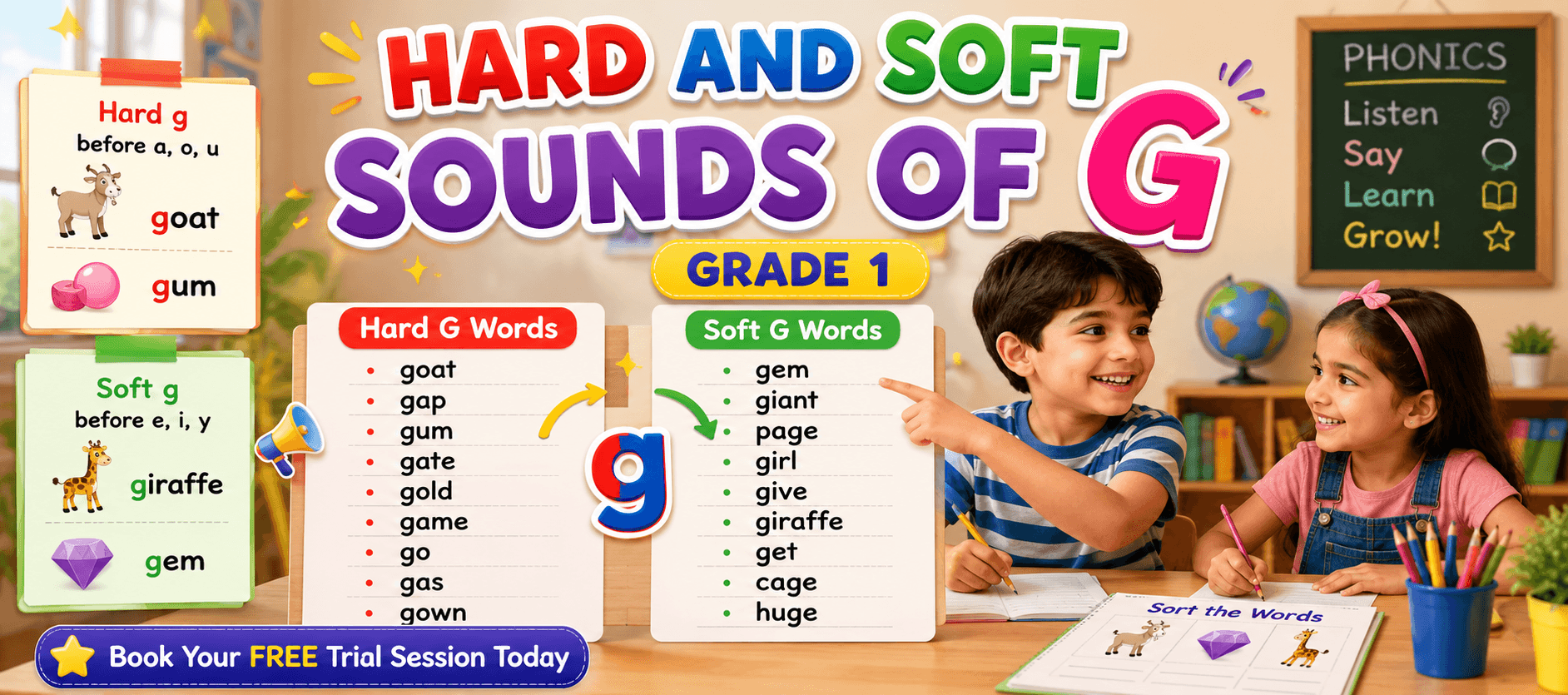
What Is the Topic?
The Hard and Soft Sounds of G topic teaches students that the letter g can produce two different sounds in English words.
The worksheet explains:
Hard sound before a, o, u
Soft sound before e, i, y
Students also learn through examples such as:
Hard g: goat, gum
Soft g: giraffe, gem
The hard sound of g is heard clearly in words like goat and gum, while the soft sound is heard in words like giraffe and gem. Understanding these sound rules helps children improve phonics skills and pronunciation.
What’s in This Worksheet?
1. Explanation of hard and soft sounds of g
2. Simple examples showing both sounds
3. Word-sorting activity for practice
4. Reading and pronunciation exercises
5. Phonics-based learning activities
6. Vocabulary practice using familiar words
7. Easy worksheet structure suitable for Grade 1 students
8. Practice that supports classroom grammar learning
Definitions, Examples, Techniques, and Tips
Definition
Letter ‘g’ make two kinds of sounds:
Hard sound before a, o, u
Soft sound before e, i, y
Examples
Hard g: goat, gum
Soft g: giraffe, gem
Techniques
1. Read each word carefully before sorting it.
2. Look at the letter that comes after g.
3. If g comes before a, o, or u, it usually makes a hard sound.
4. If g comes before e, i, or y, it usually makes a soft sound.
5. Say the word aloud to hear the sound clearly.
Quick Learning Tips
1. Practice reading hard g and soft g words every day.
2. Listen carefully to the sound made by the letter g.
3. Use the worksheet examples to remember the sound patterns.
4. Group similar sounding words together for easier learning.
5. Repeat the words aloud to improve pronunciation.
Why Is It Important to Learn This?
Learning the hard and soft sounds of g helps students become stronger readers and better spellers. Understanding these sound patterns helps children pronounce words correctly and recognize common phonics rules while reading.
This grammar concept is important because many English words use the letter g in different ways. By learning when g makes a hard sound and when it makes a soft sound, students improve reading fluency and word recognition.
Practicing these sounds also supports vocabulary development, classroom participation, and confidence in reading activities. Students become more comfortable while reading aloud and completing grammar exercises.
Where Will This Knowledge Help You?
Students can use this knowledge in many areas of learning and communication.
1. Reading English words correctly
2. Improving pronunciation during reading practice
3. Writing words with correct spelling patterns
4. Completing grammar and phonics worksheets
5. Understanding sound rules while reading stories
6. Participating confidently in classroom activities
7. Preparing for school tests and phonics exercises
How to Use This Worksheet?
1. Read the examples carefully before beginning the exercise.
2. Look at each word one by one.
3. Identify the sound made by the letter g.
4. Check the letter that comes after g.
5. Sort the words into Hard G Words and Soft G Words correctly.
6. Compare your completed answers carefully with the answer key.
7. The solutions follow the exact worksheet order for easy checking.
8. Correct any mistakes neatly after reviewing your work.
9. Practice reading the words aloud for better understanding.
Important Tips and Tricks
1. Always check the letter after g before deciding the sound.
2. Read each word slowly and carefully.
3. Hard g usually has a strong sound.
4. Soft g usually sounds smoother.
5. Remember:
Hard sound before a, o, u
Soft sound before e, i, y
6. Practice similar words regularly to improve phonics skills.
7. Keep handwriting neat while sorting words into columns.
8. Double-check spellings before completing the worksheet.
9. Examiners usually expect correct sound recognition and proper word grouping.
Complete Answer Key
HARD AND SOFT
SOUNDS OF G
Examples:
Hard g: goat, gum
Soft g: giraffe, gem
Letter ‘g’ make two kinds of sounds:
Hard sound before a, o, u
Soft sound before e, i, y
Exercise
Write the words in the correct columns.
Hard G Words
goat
gap
gum
gate
gold
game
go
gas
gown
Soft G Words
gem
giant
page
girl
give
giraffe
get
cage
huge
Practicing hard and soft sounds of g regularly helps Grade 1 students improve reading, pronunciation, spelling, and phonics skills. This English grammar worksheet on Hard and Soft Sounds of G gives children a simple and enjoyable way to understand important sound rules through examples and sorting activities. With regular practice, students can build stronger language skills and become more confident readers and writers step by step.