
Fun Homophones Activities for Kids in Grade 2 with Answers

Homophones Activities for Kids in Grade 2 with Answers | English Grammar Worksheet
Homophones are words that sound the same but have different meanings and spellings. Learning homophones helps young learners improve their vocabulary, reading, spelling, and sentence-building skills. This Grade 2 English grammar worksheet on Homophones introduces children to common homophone pairs through engaging matching activities, multiple-choice questions, correction exercises, and sentence-writing practice. By completing these activities, students can become more confident in identifying and using the correct word in different situations while strengthening their grammar foundation.
Download these English grammar worksheets and practice regularly to strengthen your language skills and build a strong foundation. You can also book a free trial to get expert guidance and improve your reading, writing, and comprehension abilities. The worksheets are designed in a simple and structured way to help K–8 students learn grammar concepts easily and use them confidently in everyday communication.
What Is the Topic?
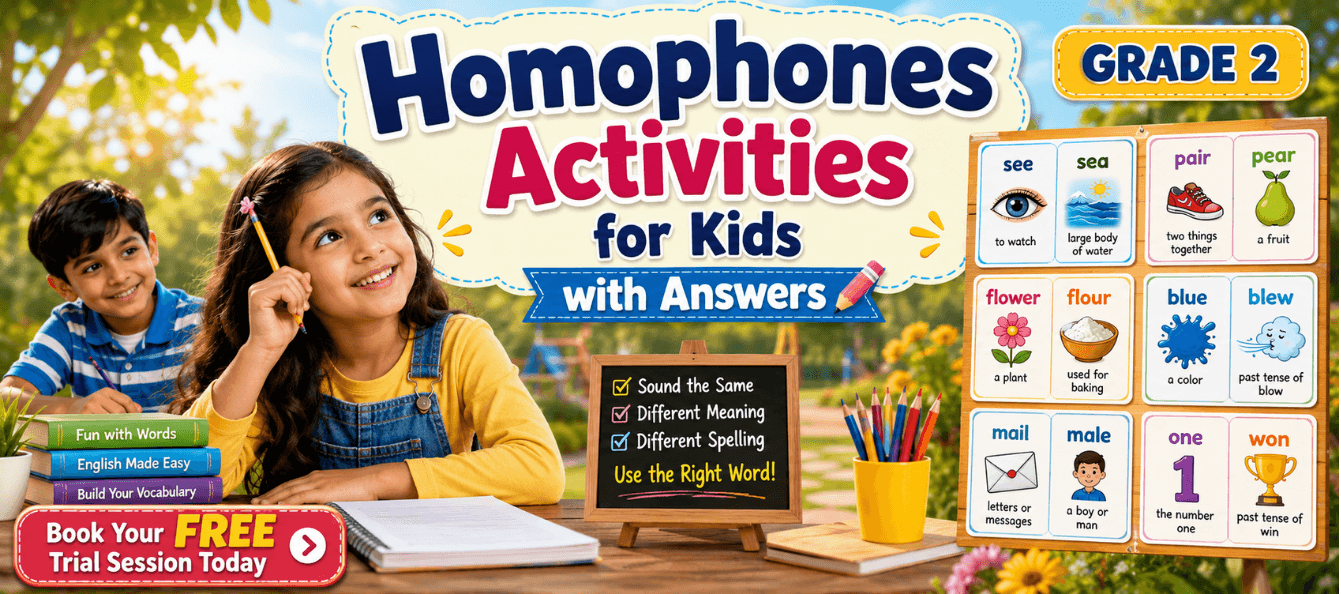
This English grammar worksheet focuses on homophones. Homophones are words that sound alike when spoken but have different spellings and meanings. In this Grade 2 worksheet, students learn to identify matching homophone pairs, choose correct homophones in sentences, correct wrongly used homophones, and create their own sentences using homophone pairs. Through repeated practice, children become familiar with commonly used homophones such as see/sea, pair/pear, flower/flour, blue/blew, and many others.
What’s in This Worksheet?
1. Match the following activity where students connect words with their correct homophones.
2. Multiple-choice questions that help students identify the correct homophone from given options.
3. A sorting exercise where students find and write correct homophone pairs from a word box.
4. Rewrite-the-sentence practice that requires students to correct incorrectly used homophones.
5. Sentence-writing activities where students use homophone pairs correctly in meaningful sentences.
6. Practice with commonly used Grade 2 homophones such as pair/pear, blue/blew, sun/son, flower/flour, mail/male, knight/night, one/won, and more.
7. Exercises that strengthen vocabulary, spelling awareness, sentence construction, and grammar accuracy.
8. Structured activities that support classroom learning and exam preparation by helping students recognize commonly confused words.
Definitions, Examples, Techniques, and Tips
Definition
Homophones are words that sound the same but have different meanings and spellings.
Examples from the worksheet
• see – sea
• flower – flour
• blew – blue
• mail – male
• one – won
• knight – night
• hear – hair
• pair – pear
• whole – hole
• their – there
Techniques
• Read the complete sentence before choosing a homophone.
• Think about the meaning of the sentence.
• Compare both words in the homophone pair carefully.
• Check spelling while writing answers.
• Practice using homophones in sentences regularly.
Quick learning tips
• Say both words aloud to hear that they sound the same.
• Remember that spelling changes meaning.
• Look for clues in the sentence.
• Revise common homophone pairs frequently.
• Use homophones in daily speaking and writing practice.
Why Is It Important to Learn This?
Learning homophones is important because it improves spelling and vocabulary. Students become better at understanding the meaning of words in different contexts. Correct usage of homophones makes writing clearer and more accurate. It also helps children avoid common grammar mistakes and improves reading comprehension. Regular practice with homophones strengthens communication skills and builds confidence in using English correctly.
Where Will This Knowledge Help You?
• During grammar tests and examinations.
• While reading storybooks and passages.
• During classroom discussions and oral activities.
• When writing sentences, paragraphs, and short compositions.
• While completing school assignments and worksheets.
• In everyday communication and conversations.
• While understanding the correct meaning of words in different contexts.
How to Use This Worksheet?
1. Read each question carefully before answering.
2. Attempt every activity independently without looking at solutions.
3. Match homophone pairs by identifying words that sound alike.
4. Select the correct option in multiple-choice questions based on meaning and pronunciation.
5. Rewrite sentences carefully and replace incorrect homophones with correct ones.
6. Complete sentence-writing tasks using both words in the homophone pair correctly.
7. Compare your work with the answer key provided below.
8. Review mistakes and understand why the correct homophone fits the sentence.
9. Practice similar homophone pairs regularly for better retention.
10. The solutions follow the exact worksheet order, so compare each answer carefully with the corresponding question.
Important Tips and Tricks
1. Read the whole sentence before choosing a homophone.
2. Do not select a word only because it sounds correct; make sure its meaning fits the sentence.
3. Pay close attention to spelling differences.
4. Learn common homophone pairs such as pair/pear, blue/blew, and flower/flour.
5. While correcting sentences, identify the meaning first and then choose the correct homophone.
6. In sentence-writing tasks, use each word according to its correct meaning.
7. Avoid rushing through multiple-choice questions.
8. Recheck spellings before submitting your work.
9. Practice speaking and reading homophones aloud.
10. Regular revision helps improve accuracy and confidence.
Complete Answer Key
Exercise:1
Match each word in Column A with its correct homophone in Column B.
1. see – sea
2. flower – flour
3. blew – blue
4. mail – male
5. one – won
6. knight – night
7. hear – hair
8. pair – pear
9. whole – hole
10. their – there
Exercise: 2
Choose the correct homophone for the highlighted word in each sentence.
1. I want to buy a new “pair” of shoes.
Answer: a. pear
2. Which word sounds the same as "blue"?
Answer: c. blew
3. Which is the homophone for "sea"?
Answer: a. see
4. Choose the homophone for "knight".
Answer: b. night
5. Which word sounds the same as "flower"?
Answer: c. flour
6. Which word is the homophone for "one"?
Answer: b. won
7. Choose the homophone for "right".
Answer: b. write
8. What sounds the same as "male"?
Answer: a. mail
Exercise: 3
Find and write the correct pair of homophones from the box given below.
1. sun – son
2. pair – pear
3. blue – blew
4. bear – bare
5. hair – hare
6. one – won
7. night – knight
8. plane – plain
9. hole – whole
Exercise:4
Rewrite the sentence by correcting the wrong homophone.
1. I know the answer to that question.
2. They’re going to the zoo tomorrow.
3. I saw a hare in the forest.
4. The knight was very brave.
5. I ate the whole cake.
6. The sea is very blue today.
7. She read the story book.
8. I need to buy a new pair of shoes.
9. He won prize at the fair.
10. The flower smells lovely.
Exercise:5
Write a sentence using each homophone pair correctly.
1. pair - pear
I bought a pair of shoes and ate a pear after lunch.
2. blue - blew
The sky is blue and the wind blew strongly.
3. sun - son
The sun is shining and her son is playing outside.
4. flower - flour
She picked a flower and used flour to bake a cake.
5. mail - male
I received the mail from a male friend.
This Grade 2 English grammar worksheet on Homophones provides excellent practice through matching activities, multiple-choice questions, correction exercises, and sentence-writing tasks. By completing these exercises regularly, students can improve their understanding of homophones, strengthen spelling skills, and become more confident in using the correct words while speaking and writing. Consistent practice will help learners master common homophone pairs and build a strong grammar foundation for future learning.