
Fun Is, Am, Are Practice Worksheet for Grade 2 Students
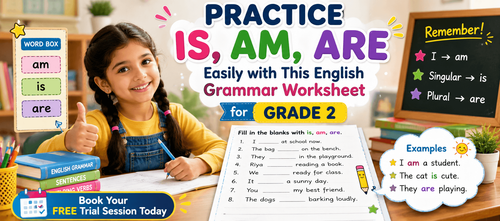

Practice Is, Am, Are Easily with This English Grammar Worksheet for Grade 2
Learning how to use is, am, and are correctly is an important part of building strong English grammar skills. This English grammar worksheet for Grade 2 on Is, Am, Are helps students understand how helping verbs are used in sentences. Through simple fill in the blanks activities and everyday examples, students improve grammar understanding, sentence-building abilities, and communication skills in a fun and structured way.
In Grade 2, children begin writing longer and more meaningful sentences. Using the correct helping verb makes sentences grammatically correct and easier to understand. This worksheet provides guided practice with simple sentence patterns that help learners understand where to use is, am, and are correctly in daily communication.
Download these English grammar worksheets and practice regularly to strengthen your language skills and build a strong foundation. You can also book a free trial to get expert guidance and improve your reading, writing, and comprehension abilities. The worksheets are designed in a simple and structured way to help K–8 students learn grammar concepts easily and use them confidently in everyday communication.
What Is the Topic?
Is, am, and are are helping verbs used in sentences. They help complete sentences and describe actions, conditions, or situations correctly. In this English grammar worksheet for Grade 2, students practice choosing the correct helping verb according to the subject of the sentence.
The worksheet focuses on simple sentence structures using singular and plural subjects. Students learn how is, am, and are change depending on the person, animal, place, or thing being discussed in the sentence.
By practicing these exercises, Grade 2 learners improve grammar accuracy and sentence formation skills. The worksheet also helps students become more confident in both spoken and written English.
What’s in This Worksheet?
1. Fill in the blanks questions using is, am, and are.
2. Simple sentence-based grammar practice for Grade 2 learners.
3. Everyday examples that help students understand helping verbs easily.
4. Guided grammar exercises with a word box for support.
5. Practice with singular and plural subjects.
6. Sentence completion activities that improve writing and reading skills.
7. Grammar exercises useful for classroom learning and school exams.
8. Structured practice that strengthens sentence-building confidence.
Definitions, Examples, Techniques, and Tips
Is, am, and are are helping verbs used with different subjects in sentences.
The worksheet includes examples such as:
I am at school now.
The bag is on the bench.
They are in the playground.
These examples help students understand how helping verbs change depending on the subject of the sentence.
Students can use simple techniques while solving is, am, are exercises:
1. Read the complete sentence carefully before choosing the helping verb.
2. Identify the subject of the sentence first.
3. Check whether the subject is singular or plural.
4. Match the subject with the correct helping verb.
5. Read the completed sentence aloud to check if it sounds correct.
Quick learning tips from this worksheet:
1. Use am with I.
2. Use is with singular subjects.
3. Use are with plural subjects.
4. Read carefully before selecting the helping verb.
5. Practice sentence-building regularly for better grammar accuracy.
Why Is It Important to Learn This?
Learning is, am, and are is important because these helping verbs are used in everyday English communication. They help students make complete and grammatically correct sentences.
Understanding helping verbs improves both speaking and writing skills. Students can describe people, places, actions, and situations more clearly and confidently.
For Grade 2 learners, learning is, am, and are builds a strong grammar foundation that supports future English learning. It also improves reading comprehension because students understand sentence structure better.
Regular grammar practice with helping verbs helps children become more confident during classroom activities, conversations, and exams.
Where Will This Knowledge Help You?
Is, am, and are are useful in many school and daily-life situations.
1. During English grammar exams and worksheets.
2. While writing complete sentences.
3. During classroom speaking activities.
4. While answering questions in class.
5. In reading comprehension exercises.
6. During spoken English conversations.
7. In paragraph writing and sentence formation tasks.
8. While improving communication and grammar confidence.
Understanding helping verbs helps students communicate clearly and write grammatically correct sentences in everyday situations.
How to Use This Worksheet?
1. Read each sentence carefully before choosing the helping verb.
2. Identify the subject of the sentence first.
3. Attempt all questions independently before checking answers.
4. Choose the helping verb that matches the subject correctly.
5. Review your completed answers carefully.
6. Compare your answers with the complete answer key in the exact worksheet order.
7. Correct mistakes and practice difficult sentences again.
8. Read the completed sentences aloud for better understanding.
9. Practice similar grammar exercises regularly to improve accuracy.
10. Use the worksheet again before school exams and grammar tests for revision.
Important Tips and Tricks
1. Always identify the subject before selecting is, am, or are.
2. Use am only with I.
3. Use is for one person, animal, place, or thing.
4. Use are for more than one person, animal, place, or thing.
5. Read the sentence completely before filling in the blank.
6. Recheck completed sentences to make sure they sound natural.
7. Practice simple helping verb sentences daily for better grammar skills.
8. Avoid rushing while solving grammar worksheets.
9. Write neatly and carefully while completing exercises.
10. Regular practice improves confidence and exam performance.
Complete Answer Key
Fill in the blanks with the correct word from the box.
1. I am at school now.
2. The bag is on the bench.
3. They are in the playground.
4. Riya is reading a book.
5. We are ready for class.
6. It is a sunny day.
7. You are my best friend.
8. The dogs are barking loudly.
Learning is, am, and are helps students build correct and meaningful sentences in English. This English grammar worksheet for Grade 2 on Is, Am, Are gives children simple grammar practice using everyday examples and easy sentence patterns. With regular practice, students can improve sentence formation, speaking confidence, and grammar understanding step by step. Consistent grammar learning makes English easier, more enjoyable, and more effective for Grade 2 learners.