
Fun Speech Writing Practice Worksheet for Grade 3 Kids
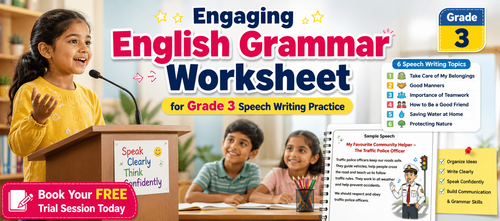

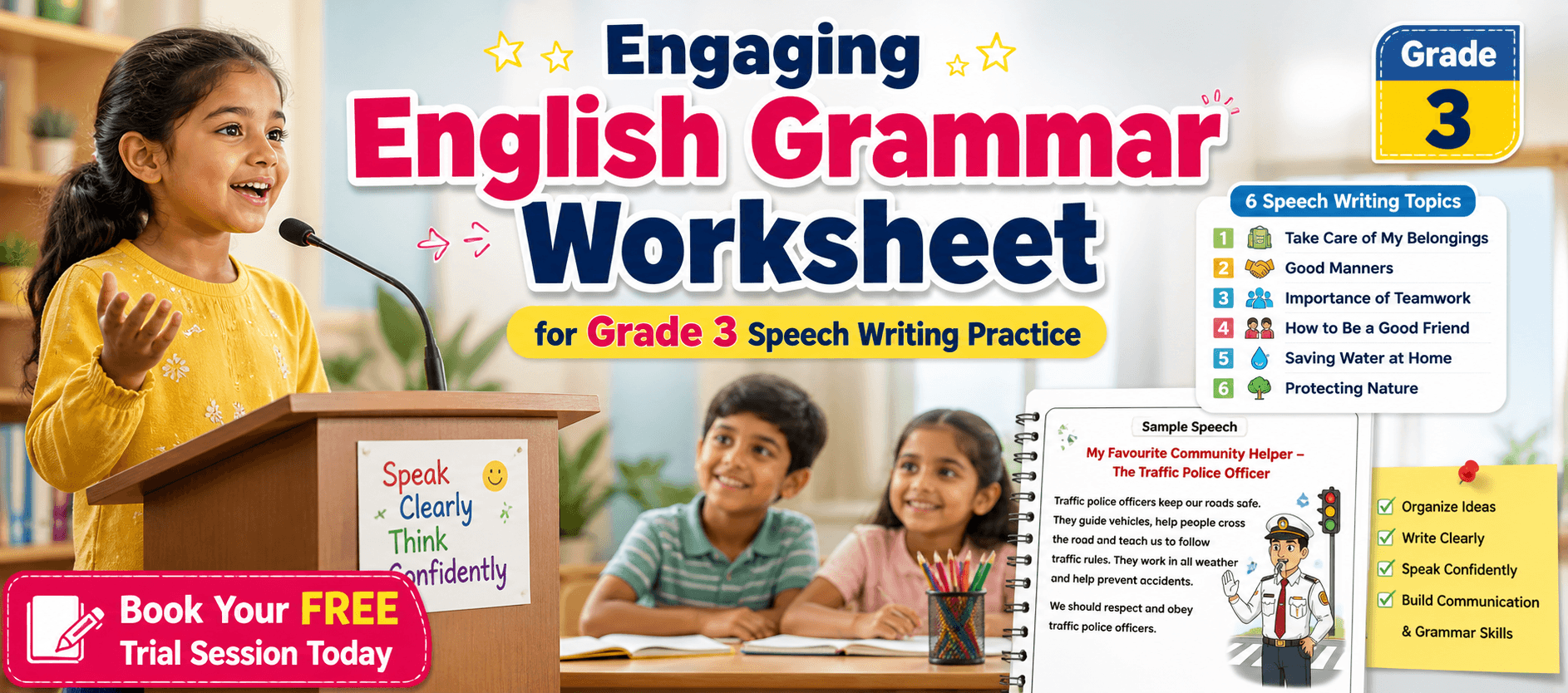
Engaging English Grammar Worksheet for Grade 3 Speech Writing Practice
Speaking clearly and confidently is an important skill that helps children express their ideas and communicate better with others. This English grammar worksheet for Grade 3 on Speech Writing gives students an excellent opportunity to practice speaking and writing through meaningful and relatable topics. By working on different speech-writing activities, students learn how to organize thoughts, present ideas properly, and speak politely in front of others.
The worksheet includes topics connected to daily life, such as teamwork, good manners, friendship, saving water, protecting nature, and taking care of personal belongings. These familiar topics make learning easier and more enjoyable for children. Students also improve sentence-building skills, vocabulary, and confidence while practicing speeches.
Download these English grammar worksheets and practice regularly to strengthen your language skills and build a strong foundation. You can also book a free trial to get expert guidance and improve your reading, writing, and comprehension abilities. The worksheets are designed in a simple and structured way to help K–8 students learn grammar concepts easily and use them confidently in everyday communication.
What Is the Topic?
Speech Writing is the process of writing thoughts and ideas in a way that can be spoken clearly before an audience. In this Grade 3 English grammar worksheet, students learn how to prepare speeches on different everyday topics using simple and organized sentences.
The worksheet teaches students how to:
1. Begin a speech politely
2. Introduce a topic clearly
3. Explain ideas in a proper order
4. Use meaningful and connected sentences
5. End the speech confidently
The sample speech in the worksheet helps students understand how speeches should be written and presented. By practicing different topics, students improve their grammar, creativity, and public speaking confidence.
What’s in This Worksheet?
1. A sample speech titled “My Favourite Community Helper – The Traffic Police Officer.”
2. Six speech-writing exercises based on useful and meaningful topics.
3. Activities that improve speaking and writing confidence.
4. Practice tasks that encourage students to organize ideas clearly.
5. Exercises related to teamwork, friendship, manners, and nature.
6. Opportunities to improve grammar, sentence formation, and communication skills.
7. Structured speech-writing practice suitable for Grade 3 students.
8. Activities that help students prepare for classroom speaking tasks and writing assessments.
Definitions, Examples, Techniques, and Tips
Definition of Speech Writing
Speech Writing means writing ideas in a form that can be spoken aloud clearly and confidently. A speech usually includes a greeting, introduction, explanation of ideas, and a concluding statement.
Example from the Worksheet
The sample speech “My Favourite Community Helper – The Traffic Police Officer” explains the important role of traffic police officers in keeping roads safe and organized. The speech includes:
1. A polite opening
2. Introduction to the topic
3. Explanation of responsibilities
4. Importance of traffic rules
5. Respect and appreciation for community helpers
Techniques Used in the Worksheet
1. Simple and clear language
The worksheet uses easy words and sentences suitable for Grade 3 students.
2. Real-life topics
The speech topics are connected to daily life experiences.
3. Organized flow of ideas
Each speech follows a proper sequence from introduction to conclusion.
4. Positive and meaningful communication
The worksheet encourages responsible behavior and good habits.
Quick Learning Tips
1. Begin speeches politely with greetings.
2. Stay focused on one topic.
3. Use simple and meaningful sentences.
4. Explain ideas in a clear order.
5. End speeches with a positive conclusion.
Why Is It Important to Learn This?
Learning Speech Writing helps students become confident speakers and better communicators. It teaches children how to express their thoughts clearly and respectfully. Students also improve their grammar and writing skills while practicing speeches regularly.
Speech Writing encourages organized thinking and creativity. It also helps children participate confidently in classroom discussions, assemblies, and presentations. Students learn how to share ideas in a meaningful way and speak politely in front of others.
For Grade 3 students, speech-writing practice helps develop:
1. Communication skills
2. Public speaking confidence
3. Better sentence formation
4. Creative thinking
5. Organized writing habits
Where Will This Knowledge Help You?
1. Classroom Activities
Students can participate confidently in speeches and presentations.
2. School Competitions
Speech-writing practice helps children prepare for speaking competitions and assemblies.
3. Writing Skills
Students improve grammar, sentence structure, and paragraph writing.
4. Daily Communication
Children learn how to express thoughts politely and clearly.
5. Exams and Assessments
Speech-writing activities support writing preparation for school exams.
6. Team Activities
Students learn how to communicate better while working with others.
How to Use This Worksheet?
1. Read the sample speech carefully.
Notice how the speech begins, explains ideas, and ends properly.
2. Attempt each exercise independently.
Think carefully about the topic before writing the speech.
3. Follow the worksheet order exactly.
The solutions and exercises should always remain in the same sequence as given in the worksheet.
4. Check grammar and spelling carefully.
Review every sentence after writing.
5. Correct mistakes neatly.
Rewrite incorrect sentences properly for better learning.
6. Practice speeches regularly.
Regular practice improves speaking and writing confidence.
7. Compare answers carefully.
Students should carefully compare answers with the worksheet instructions and maintain proper structure.
Important Tips and Tricks
1. Always begin with a greeting.
Start speeches politely with phrases like “Good morning everyone.”
2. Stay connected to the topic.
Do not include unrelated ideas.
3. Use proper sentence structure.
Write complete and meaningful sentences.
4. Keep the language simple.
Use easy words suitable for Grade 3 students.
5. Organize ideas properly.
Present thoughts in a clear and logical order.
6. Practice reading aloud.
Reading speeches aloud improves pronunciation and confidence.
7. Avoid grammar mistakes.
Check punctuation, spelling, and sentence formation carefully.
8. Write neatly and clearly.
Good presentation improves readability.
9. Use positive language.
The worksheet topics encourage kindness, teamwork, and responsibility.
10. Practice speaking confidently.
Confidence improves with regular speech-writing practice.
Complete Answer Key
Sample Speech
My Favourite Community Helper – The Traffic Police Officer
Good morning everyone, today I want to speak about my favourite community helper, the traffic police officer, who plays an important role in keeping our roads safe and organised. Every day, traffic police officers stand at busy crossings to guide vehicles, help people cross the road, and prevent accidents. They work very hard in all kinds of weather, whether it is hot, rainy, or dusty. Even when the traffic is heavy and noisy, they remain calm and focused on their duty. Traffic police officers teach us to follow important road safety rules, such as wearing seatbelts, using zebra crossings, stopping at red lights, and waiting for the green signal before moving. They also help school children cross the road safely during busy hours. Without traffic police officers, our roads would be confusing and unsafe. Their work requires patience, discipline, and courage. We should always respect traffic police officers and follow their instructions carefully. By obeying traffic rules, we can help them do their job better and keep everyone safe. I truly admire traffic police officers for their dedication and service to our community.
Exercise No. 1
Good morning everyone, today I want to talk about how I take care of my books, school bag, and other belongings. I always keep my books neatly arranged on my study table and cover them properly to protect them from damage. I make sure my school bag is clean and organized every day. I also sharpen my pencils carefully and keep all my stationery items safely in my pencil box. Taking care of our things teaches us responsibility and discipline. When we look after our belongings properly, they last longer and stay in good condition. It also helps us stay organized and prepared for school. I believe everyone should take good care of their books and belongings.
Exercise No. 2
Good morning everyone, today I want to speak about good manners. Good manners help us behave politely and respectfully with others. We should always say “please,” “thank you,” and “sorry” whenever needed. Respecting elders, listening carefully, and helping others are also examples of good manners. Children with good manners are liked and appreciated by everyone. Good manners make our school, home, and community peaceful and happy. They also show that we are kind and responsible people. I believe good manners are important for becoming a good human being.
Exercise No. 3
Good morning everyone, today I want to talk about the importance of teamwork. Teamwork means working together to achieve a common goal. When people work as a team, tasks become easier and faster. Teamwork teaches us cooperation, sharing, and respect for others’ ideas. In school, students often work together during games, projects, and activities. A good team supports each other and solves problems together. Teamwork also helps us build friendships and improve communication skills. By working together, we can achieve better results and learn many important lessons. Teamwork is very important in both school and daily life.
Exercise No. 4
Good morning everyone, today I want to talk about how to be a good friend. A good friend is kind, caring, and helpful. Friends should always support and respect each other. We should share our things, listen carefully, and help friends when they need us. A good friend never lies or behaves rudely. Spending time with friends makes us happy and confident. True friendship is built on honesty, trust, and kindness. I feel lucky to have good friends who care about me. We should always try to be good friends to others.
Exercise No. 5
Good morning everyone, today I want to speak about saving water at home. Water is very important for all living things, so we should use it carefully. We should turn off taps properly after use and avoid wasting water while brushing or washing hands. Taking shorter baths and using only the required amount of water also helps save water. We can reuse water for watering plants and cleaning purposes. Saving water is important because clean water is limited. If we waste water today, there may not be enough for future generations. Every small effort can make a big difference. We should all save water and protect this valuable resource.
Exercise No. 6
Good morning everyone, today I want to talk about how students can help protect nature. Nature gives us clean air, water, food, and beautiful surroundings. Students can help protect nature by planting trees, saving water, and keeping places clean. We should avoid wasting paper and always throw garbage in dustbins. Using less plastic and recycling materials can also help reduce pollution. Students should spread awareness about protecting the environment among friends and family. Small actions can help make the Earth cleaner and healthier. Protecting nature is everyone’s responsibility, and we should all do our part to care for our planet.
This English grammar worksheet for Grade 3 on Speech Writing helps students become more confident speakers and thoughtful writers through meaningful practice activities. By learning how to organize ideas and express thoughts clearly, students improve both communication and grammar skills. Regular speech-writing practice encourages creativity, confidence, and responsible communication, helping children perform better in school activities and daily conversations.