
Grade 1 Joining Words Activities for Early Grammar Success
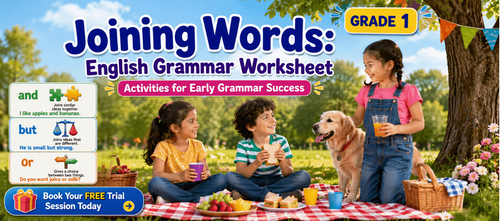

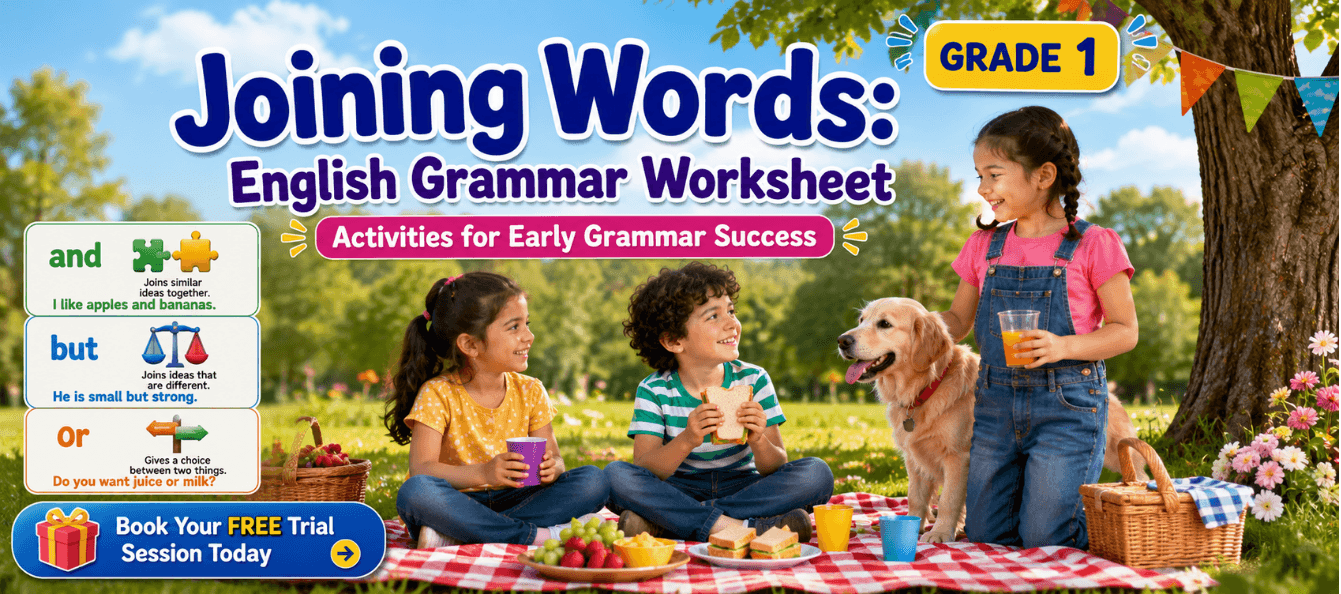
Joining Words: English Grammar Worksheet Grade 1 Activities for Early Grammar Success
Learning how to join words and ideas is an important step in building strong sentences. This Grade 1 Joining Words worksheet helps young learners understand how simple joining words connect ideas and make sentences more meaningful. Through matching activities, multiple-choice questions, sentence rearranging, sentence rewriting, and picture description tasks, students get plenty of practice using joining words correctly. These engaging exercises help children improve reading, writing, and communication skills while making grammar learning enjoyable and interactive.
Download these English grammar worksheets and practice regularly to strengthen your language skills and build a strong foundation. You can also book a free trial to get expert guidance and improve your reading, writing, and comprehension abilities. The worksheets are designed in a simple and structured way to help K–8 students learn grammar concepts easily and use them confidently in everyday communication.
What Is the Topic?
This Grade 1 English grammar worksheet focuses on joining words. Joining words help connect words, phrases, or ideas in a sentence. In this worksheet, students practice using the joining words and, but, and or. The activities help learners understand when to join similar ideas, when to show a contrast, and when to present choices. By completing the exercises, students learn how to create complete and meaningful sentences using appropriate joining words.
What’s in This Worksheet?
1. Match the following activity where students select the joining word that best completes each sentence.
2. Multiple-choice questions that require choosing the correct joining word from given options.
3. Sentence rearranging exercises where students arrange words correctly to form meaningful sentences using joining words.
4. Sentence rewriting activities that require correcting sentences by replacing incorrect joining words with suitable ones.
5. Picture description activity where students write a short paragraph describing a scene using joining words.
6. Practice with the joining words and, but, and or in different sentence structures.
7. Exercises that help strengthen grammar understanding and sentence-building skills.
8. Activities that support classroom learning and grammar revision.
Definitions, Examples, Techniques, and Tips
Definitions
• and joins similar ideas together.
• but joins ideas that are different or contrasting.
• or gives a choice between two things.
Examples from the worksheet
• I like apples and bananas.
• He is small but strong.
• Do you want juice or milk?
• It is raining but we are still playing.
• She wants pizza or pasta.
Techniques
• Read both parts of the sentence carefully.
• Look for ideas that belong together.
• Look for opposite ideas when using but.
• Use or when choosing between two options.
• Rearrange words carefully before writing the final sentence.
Quick Learning Tips
• Check whether the sentence shows addition, contrast, or choice.
• Read the completed sentence aloud to see if it sounds correct.
• Practice writing simple sentences using joining words every day.
• Review mistakes and correct them carefully.
Why Is It Important to Learn This?
Learning joining words helps students create longer and clearer sentences. It improves communication by connecting ideas smoothly. Understanding joining words helps children express choices, combine information, and show differences between ideas. These skills support better reading comprehension and writing development. Regular practice also helps students become more confident when speaking and writing complete sentences.
Where Will This Knowledge Help You?
• In grammar exams and classroom tests.
• During sentence-writing activities.
• While completing worksheets and assignments.
• During reading and comprehension exercises.
• When speaking and sharing ideas in class.
• When writing stories, descriptions, and simple paragraphs.
• In everyday conversations where ideas need to be connected clearly.
How to Use This Worksheet?
1. Read each question carefully before selecting a joining word.
2. Attempt all activities independently before checking answers.
3. Compare your work with the answer key in the exact worksheet order.
4. Review every correction and understand why the joining word fits.
5. Rearrange sentence activities carefully by reading all words before writing the final sentence.
6. Rewrite incorrect sentences using the appropriate joining word.
7. Complete the picture description activity using meaningful sentences.
8. Practice similar sentence patterns regularly to strengthen understanding.
Important Tips and Tricks
1. Use and when two ideas belong together.
2. Use but when the ideas are different or unexpected.
3. Use or when making a choice between options.
4. Read the entire sentence before choosing a joining word.
5. Check that the completed sentence makes sense.
6. Pay attention to opposite ideas because they often need but.
7. When choices are given, or is usually the correct joining word.
8. In sentence rearranging activities, place words in a logical order before writing the final sentence.
9. For picture description tasks, connect ideas clearly using joining words.
10. Write neatly and review your answers before submitting the worksheet.
Complete Answer Key
Exercise:1
Match the joining word that best completes each sentence.
1. I like apples and bananas.
2. She is small but strong.
3. Do you want juice or milk?
4. I like cake but I don’t like ice cream.
5. We can go to the park or the zoo.
6. He is tall but he can’t reach the shelf.
7. You can have tea or coffee.
8. I like red and blue.
9. I will come now and he will come later.
10. It is raining but we are still playing.
Exercise: 2
Choose the correct joining word to complete each sentence.
1. I like milk and honey.
2. We can read a book or play outside.
3. He is small but strong.
4. We can go to the park but it is raining.
5. The cat is black and white.
6. She wants pizza or pasta.
7. We can take the bus or walk.
8. He was tired but happy.
Exercise: 3
Rearrange the words to make a correct sentence using a joining word.
1. Rita likes milk and cookies.
2. We went to the park but it was crowded.
3. We can take the bus or taxi.
4. The morning felt sunny and breezy.
5. Please choose pizza or pasta.
6. The rabbit is fast but the turtle is slow.
7. Bring your book and pencil.
8. We bought mangoes and oranges.
9. They were tired but still smiling.
10. Do you want a drink or a snack?
Exercise:4
Rewrite the sentence using the correct joining word (and, but, or).
1. I like apples and bananas.
2. We can go to the park or the beach.
3. She is tall but she is short.
4. I want tea or coffee but not both.
5. The sun is bright but the sky is cloudy.
6. He runs fast and jumps high.
7. You can eat cake or ice cream.
8. I was tired but I kept working.
9. We saw lions and tigers in the zoo.
10. She likes painting and drawing.
Exercise:5
Write a short paragraph describing the scene by joining the ideas using the correct joining word (and, but, or).
The children are having a picnic in the park and they are sitting under a tree. A dog is standing near the children and everyone looks happy. The children have food and drinks on the picnic mat. One child is standing and another child is sitting. The weather is nice and the park looks beautiful.
Practicing joining words regularly helps young learners build stronger sentences and communicate ideas more clearly. This Grade 1 Joining Words worksheet provides engaging activities that develop grammar confidence through matching, sentence building, rewriting, and picture description exercises. Keep practicing these joining word activities to improve sentence formation skills and become a more confident reader, writer, and speaker.