
Grade 2 Opposite Words Worksheet with Fun Vocabulary Activities
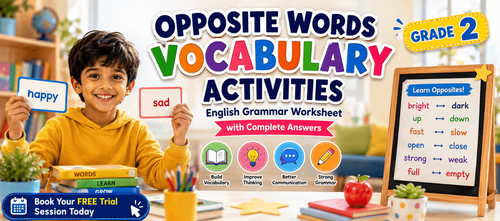

Opposite Words Vocabulary Activities – Grade 2 English Grammar Worksheet with Complete Answers
Learning opposite words is an exciting way for children to improve their vocabulary and communication skills. Opposite words, also called antonyms, help students understand how words can have completely different meanings. In this Grade 2 English grammar worksheet, students practice identifying, matching, choosing, correcting, and using opposite words through a variety of engaging activities. These exercises help children strengthen their vocabulary, improve sentence formation, and become more confident readers and writers.
Download these English grammar worksheets and practice regularly to strengthen your language skills and build a strong foundation. You can also book a free trial to get expert guidance and improve your reading, writing, and comprehension abilities. The worksheets are designed in a simple and structured way to help K–8 students learn grammar concepts easily and use them confidently in everyday communication.
What Is Opposite Words (Antonyms)?
Opposite words, also known as antonyms, are words that have completely different meanings from each other. They help students describe people, places, objects, and actions more clearly. Learning antonyms improves vocabulary and helps children understand language better.
In this Grade 2 opposite words English grammar worksheet, students learn to:
• Match words with their opposites
• Identify correct opposite words
• Recognize opposite word pairs
• Correct sentences using suitable opposite words
• Use opposite words in meaningful sentences
What’s in This Worksheet?
1. Match the following activity where students connect words with their opposites.
2. Multiple-choice questions that help students identify the correct opposite word.
3. Opposite pair identification exercise using a word bank.
4. Sentence correction activity where incorrect opposite words are replaced with suitable words.
5. Sentence writing activity using pairs of opposite words.
6. Vocabulary-building practice that strengthens understanding of antonyms.
7. Exercises that improve reading comprehension and sentence construction skills.
8. Structured practice suitable for classroom learning, homework, and revision.
Definitions, Examples, Techniques, and Tips
Definition
Opposite words are pairs of words that have different meanings.
Examples from the worksheet
• bright – dark
• early – late
• push – pull
• open – close
• happy – sad
• fast – slow
• strong – weak
• rich – poor
• up – down
• night – day
Techniques
• Read the word carefully before choosing its opposite.
• Think about the meaning of the word.
• Compare all answer choices before selecting one.
• Use opposite word pairs regularly in speaking and writing.
Quick Learning Tips
• Learn opposite words in pairs.
• Practice using opposites in simple sentences.
• Read storybooks and identify opposite words.
• Revise common antonyms frequently for better memory.
Why Is It Important to Learn This?
Learning opposite words helps students express ideas more clearly. Antonyms improve vocabulary and make communication more effective. They help children understand comparisons and descriptions while reading and writing.
This topic also develops language skills that support classroom learning, comprehension activities, creative writing, and everyday conversations. A strong understanding of opposite words makes it easier for students to understand instructions, answer questions, and communicate confidently.
Where Will This Knowledge Help You?
• School examinations and assessments
• Vocabulary-based questions
• Reading comprehension exercises
• Creative writing activities
• Story writing and sentence formation
• Classroom discussions
• Everyday communication
• Building strong language skills for future learning
How to Use This Worksheet?
1. Read every question carefully before answering.
2. Attempt each activity independently and try to identify the opposite words on your own.
3. Compare your responses with the complete answer key provided below.
4. Correct any mistakes and understand why the opposite word is more suitable.
5. Follow the solutions in the exact worksheet order for easier checking.
6. Practice similar opposite word pairs regularly to improve vocabulary.
7. Review difficult word pairs multiple times for better understanding.
8. Use newly learned antonyms while speaking and writing sentences.
Important Tips and Tricks
1. Always understand the meaning of the given word before choosing its opposite.
2. Read all options carefully in multiple-choice questions.
3. Remember common opposite word pairs such as happy–sad and fast–slow.
4. In sentence correction exercises, replace the incorrect word with a suitable opposite that makes sense.
5. Check whether the completed sentence sounds logical and meaningful.
6. Practice writing your own sentences using opposite words.
7. Avoid selecting words that are related but not exact opposites.
8. Revise vocabulary regularly to improve accuracy and confidence.
Complete Answer Key
Exercise:1
Match each word in Column A with its opposite in Column B.
1. bright → dark
2. early → late
3. push → pull
4. open → close
5. happy → sad
6. win → lose
7. empty → full
8. fast → slow
9. strong → weak
10. rich → poor
Exercise: 2
1. Which word is the opposite of "dirty"?
Answer: clean
2. Which word is the opposite of "open"?
Answer: close
3. Which word is the opposite of "happy"?
Answer: sad
4. Which word is the opposite of "strong"?
Answer: weak
5. Which word is the opposite of "up"?
Answer: down
6. Which word is the opposite of "full"?
Answer: empty
7. Which word is the opposite of "start"?
Answer: end
8. Which word is the opposite of "short"?
Answer: long
Exercise: 3
Find and write the correct pair of opposite words from the box given below.
1. tall – short
2. sit – stand
3. small – big
4. cold – warm
5. fast – slow
6. light – heavy
7. dry – wet
8. up – down
9. night – day
Exercise:4
Rewrite the sentence by correcting the opposite word.
1. The turtle is slower than the rabbit.
2. My bag is empty but I need it to be fuller.
3. I think the night is darker than the day.
4. That drink is cold and refreshing.
5. The sun is up and shiny.
6. The boy is polite and respectful.
7. The mountain is steep than the road.
8. This place is quiet, we want it to be more loud.
9. He is fat, but I want to be thinner.
10. My toy is smoother than hers.
Exercise:5
Write a sentence or two using each pair of opposite words given below.
1. big - small
The elephant is big. The mouse is small.
2. happy - sad
I am happy when I play with my friends. I feel sad when they leave.
3. full - empty
The bottle is full of water. The other bottle is empty.
4. cold - hot
The ice cream is cold. The soup is hot.
5. early - late
I arrived early for school. My friend came late.
Practicing opposite words regularly helps children build a stronger vocabulary and improve communication skills. This Grade 2 opposite words English grammar worksheet provides enjoyable practice through matching, multiple-choice questions, sentence correction, and sentence writing activities. Keep revising these antonym pairs and use them in everyday conversations to become a more confident speaker and writer.