
Grade 2 Possessive Nouns Practice with Everyday Examples
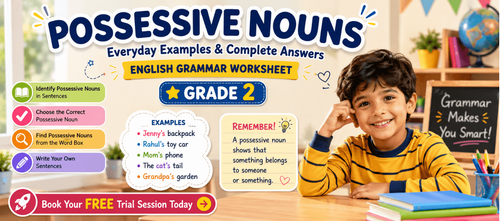

Possessive Nouns: Grade 2 English Grammar Worksheet with Everyday Examples and Complete Answers
Learning possessive nouns is an important step in helping young learners understand how to show ownership in sentences. In this Grade 2 English grammar worksheet, students practice identifying possessive nouns, choosing the correct possessive forms, finding possessive nouns from a word box, and writing their own sentences using possessive nouns. Through simple everyday examples, children learn how apostrophes can show that something belongs to someone or something. This worksheet offers engaging activities that help students build confidence in grammar while improving their reading and writing skills.
Download these English grammar worksheets and practice regularly to strengthen your language skills and build a strong foundation. You can also book a free trial to get expert guidance and improve your reading, writing, and comprehension abilities. The worksheets are designed in a simple and structured way to help K–8 students learn grammar concepts easily and use them confidently in everyday communication.
What Is the Topic?
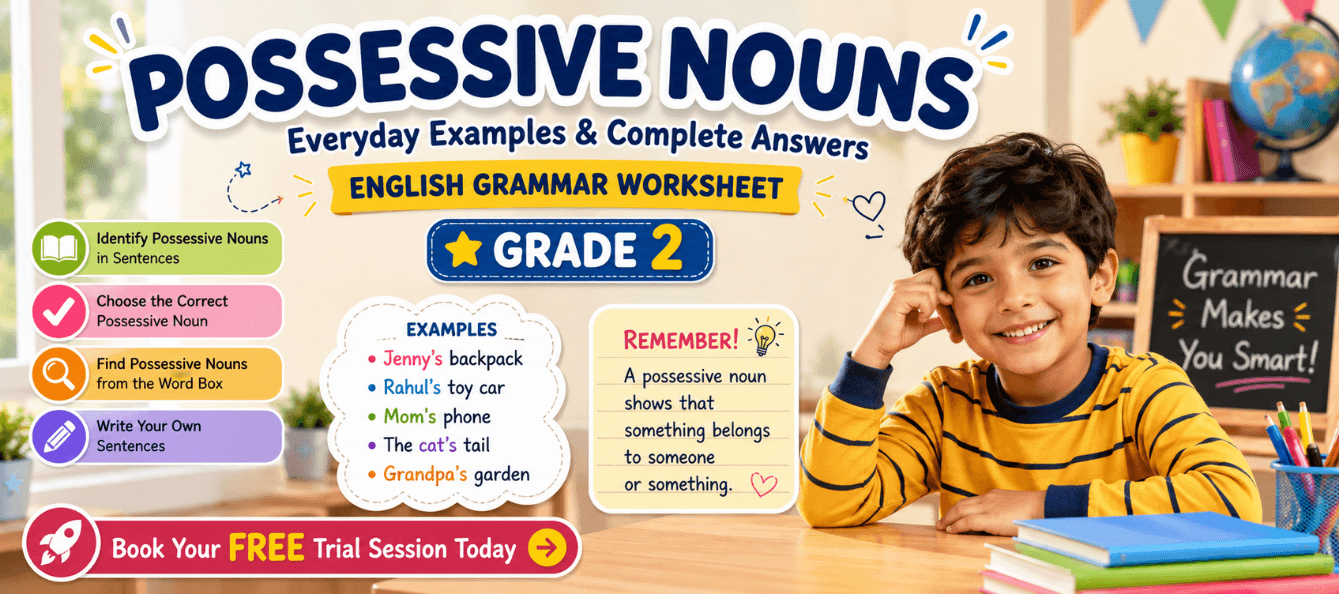
This worksheet focuses on possessive nouns. Possessive nouns show ownership or belonging. Throughout the worksheet, students learn to identify possessive nouns in sentences, choose the correct possessive noun from multiple options, recognize possessive nouns from a list of words, and use possessive nouns in their own sentences. The activities help Grade 2 students understand how possessive nouns are used in everyday language.
What’s in This Worksheet?
1. Underline the possessive nouns in complete sentences.
2. Multiple-choice questions to select the correct possessive noun.
3. A sorting and identification activity using a word box.
4. Sentence-writing practice using given possessive nouns.
5. Practice with everyday examples that make grammar easy to understand.
6. Activities that strengthen reading, grammar recognition, and sentence-building skills.
7. Structured exercises that help students prepare for school assignments and grammar assessments.
Definitions, Examples, Techniques, and Tips
Definition
A possessive noun shows that something belongs to a person, animal, or thing.
Examples from the worksheet
• Jenny’s backpack is blue.
• Rahul’s toy car.
• Mom’s phone.
• Grandpa’s garden.
• The cat’s tail.
• Tina’s book.
• The baby’s bottle.
Techniques
• Look for nouns that include an apostrophe and show ownership.
• Read the sentence carefully to identify who owns the object.
• Choose the option that correctly shows possession.
• Practice writing sentences using possessive nouns in meaningful contexts.
Quick Learning Tips
• Pay attention to apostrophes.
• Check whether the noun is showing ownership.
• Read every option before selecting an answer.
• Use possessive nouns naturally when writing sentences.
Why Is It Important to Learn This?
Possessive nouns help students express ownership clearly in speaking and writing. Understanding possessive nouns improves sentence construction and reading comprehension. Learning this grammar concept also helps children communicate ideas more accurately. Regular practice with possessive nouns strengthens grammar skills that are useful in classroom activities, assignments, and everyday communication.
Where Will This Knowledge Help You?
• Grammar tests and classroom assessments.
• Reading and understanding sentences correctly.
• Writing complete and meaningful sentences.
• Describing ownership in everyday conversations.
• School assignments and workbook activities.
• Participating confidently in classroom discussions.
How to Use This Worksheet?
1. Read each question carefully before answering.
2. Attempt every activity independently.
3. Identify possessive nouns by looking for ownership words.
4. Review all multiple-choice options before selecting an answer.
5. Compare your work with the complete answer key provided below.
6. Follow the solutions in the exact worksheet order.
7. Correct any mistakes after checking your answers.
8. Practice similar sentences regularly to improve accuracy.
Important Tips and Tricks
1. Look carefully for apostrophes that show ownership.
2. Do not confuse a regular noun with a possessive noun.
3. Read the entire sentence before choosing an answer.
4. Check who owns the object mentioned in the sentence.
5. In multiple-choice questions, select the option that correctly shows possession.
6. When writing sentences, make sure the possessive noun fits naturally into the sentence.
7. Write neatly and read your answers again before submitting.
8. Consistent practice can help you score full marks in grammar exercises.
Complete Answer Key
Exercise:1
Underline the possessive nouns in each sentence.
1. Jenny’s backpack is blue.
Answer: Jenny’s
2. This is Rahul’s toy car.
Answer: Rahul’s
3. The teacher’s desk is neat.
Answer: teacher’s
4. Mom’s phone is ringing.
Answer: Mom’s
5. Grandpa’s garden has roses.
Answer: Grandpa’s
6. My sister’s doll is broken.
Answer: sister’s
7. Dad’s shoes are in the hallway.
Answer: Dad’s
8. The cat’s tail is fluffy.
Answer: cat’s
9. Tina’s book is on the shelf.
Answer: Tina’s
10. The baby’s bottle is on the table.
Answer: baby’s
Exercise: 2
Choose the correct possessive noun in each sentence.
1. That is ___ pencil.
Answer: Jim’s
2. The ___ hat is red.
Answer: boy’s
3. We went to ___ house.
Answer: grandma’s
4. The ___ tail is long.
Answer: dog’s
5. The ___ book is torn.
Answer: teacher’s
6. The ___ shoes are blue.
Answer: girl’s
7. The ___ car is fast.
Answer: Dad’s
8. That is my ___ toy.
Answer: cousin’s
Exercise: 3
Find and write the correct possessive nouns from the box given below.
1. Maya’s
2. Boy’s
3. Dog’s
4. Teacher’s
5. Grandpa’s
6. Ben’s
7. Father’s
Exercise:4
Write a sentence using each possessive noun.
1. mom’s
Answer: Mom’s bag is on the chair.
2. Riya’s
Answer: Riya’s pencil is sharp.
3. dog’s
Answer: The dog’s tail is wagging.
4. teacher’s
Answer: The teacher’s book is on the desk.
5. Grandpa’s
Answer: Grandpa’s garden is beautiful.
Practicing possessive nouns regularly helps Grade 2 students become more confident readers and writers. This Grade 2 English grammar worksheet provides simple and engaging activities that strengthen understanding of ownership in sentences. By completing these exercises and reviewing the answers carefully, students can improve their grammar skills and use possessive nouns correctly in everyday communication. Keep practicing and enjoy learning new grammar concepts step by step.