
Grade 3 Demonstrative Adjectives Grammar Practice Worksheet PDF
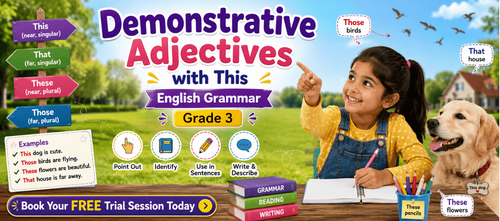

Demonstrative Adjectives with This Grade 3 English Grammar Worksheet
Learning demonstrative adjectives can be fun and exciting when students practice with simple and engaging exercises. This Grade 3 English grammar worksheet on demonstrative adjectives helps children understand how to point out specific people, animals, places, and things clearly in sentences. Through activities like underlining words, filling in the blanks, rewriting sentences, and picture description tasks, students get plenty of practice using words such as this, that, these, and those correctly.
This worksheet is specially designed for Grade 3 students to improve grammar skills step by step. It encourages children to read carefully, identify pointing words, and use demonstrative adjectives confidently in daily communication. The exercises are easy to follow and help students become better at sentence formation, writing, and speaking.
Download these English grammar worksheets and practice regularly to strengthen your language skills and build a strong foundation. You can also book a free trial to get expert guidance and improve your reading, writing, and comprehension abilities. The worksheets are designed in a simple and structured way to help K–8 students learn grammar concepts easily and use them confidently in everyday communication.
What Is the Topic?
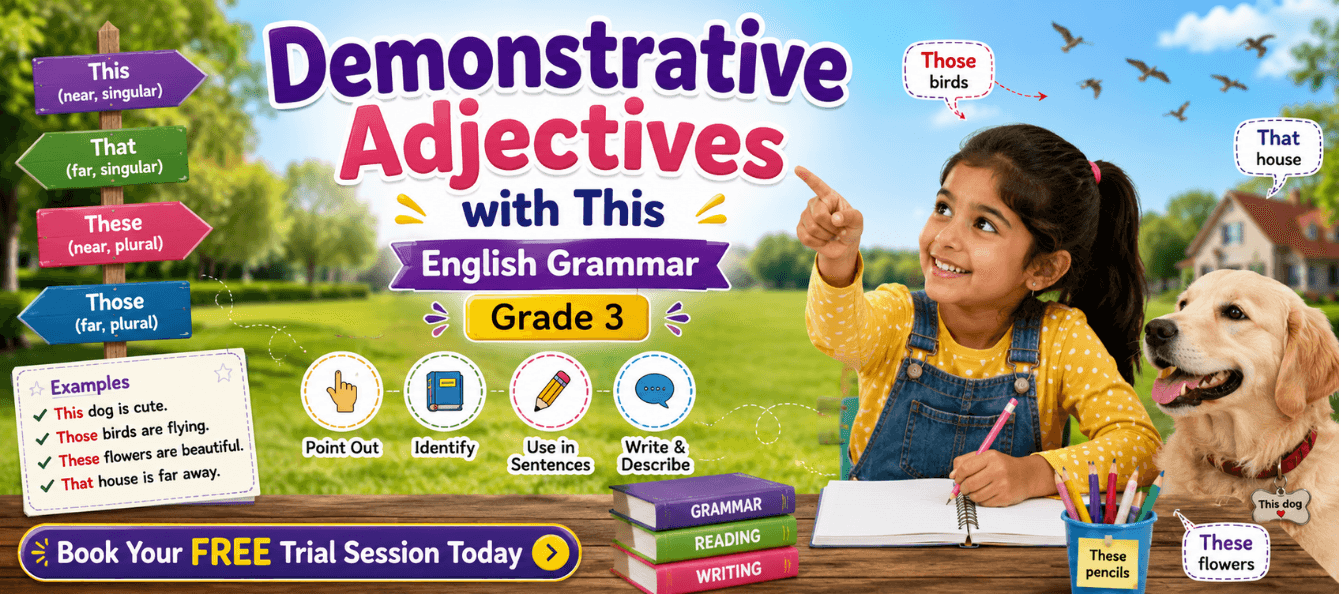
Demonstrative adjectives are words that point to a specific person, animal, place, or thing. They help us understand which one we are talking about in a sentence. These words make sentences clearer and easier to understand.
Some commonly used demonstrative adjectives are:
• this
• that
• these
• those
For example:
• This book is very interesting.
• Those shoes are too big for me.
In this Grade 3 English grammar worksheet, students learn how to identify demonstrative adjectives, use them in sentences, and rewrite sentences using suitable pointing words. The worksheet also helps students understand singular and plural nouns while choosing the correct demonstrative adjective.
What’s in This Worksheet?
1. Underlining demonstrative adjectives in sentences to identify the correct pointing words.
2. Filling in the blanks using suitable demonstrative adjectives such as this, that, these, and those.
3. Rewriting sentences by adding appropriate demonstrative adjectives.
4. Picture description activities where students write their own sentences using demonstrative adjectives.
5. Practice exercises that improve grammar understanding and sentence-building skills.
6. Exercises that help students prepare for grammar tests and school assignments.
7. Activities that improve reading, observation, and writing abilities in a simple and engaging way.
Definitions, Examples, Techniques, and Tips
Definition:
A demonstrative adjective is a word that points to a specific person, animal, place, or thing.
Examples from the worksheet:
• This pencil belongs to Meera.
• Those dogs are barking loudly.
• These cookies taste delicious!
• That mango is ripe and juicy.
Techniques:
• Use “this” for one thing nearby.
• Use “that” for one thing far away.
• Use “these” for many things nearby.
• Use “those” for many things far away.
Quick Learning Tips:
• Read the noun carefully before choosing the demonstrative adjective.
• Check whether the noun is singular or plural.
• Observe whether the object is near or far.
• Practice writing complete sentences regularly.
• Underline the demonstrative adjective to identify it easily.
Why Is It Important to Learn This?
Learning demonstrative adjectives is important because they help students speak and write clearly. These words make it easier to point out specific people, animals, places, or things in sentences.
Demonstrative adjectives also improve sentence structure and help students avoid confusion while communicating. When students learn how to use this, that, these, and those correctly, they become more confident in grammar and writing activities.
This topic is also useful for school exams, classwork, comprehension passages, and daily conversations. Strong grammar skills help students become better readers, writers, and speakers.
Where Will This Knowledge Help You?
Students can use demonstrative adjectives in many real-life situations and academic activities.
• In school grammar tests and worksheets.
• During classroom speaking activities.
• While writing sentences and paragraphs.
• In comprehension and creative writing tasks.
• During conversations with teachers and friends.
• While describing pictures, objects, animals, or places.
• In daily communication to speak more clearly.
How to Use This Worksheet?
1. Read each question carefully before answering.
2. Attempt all exercises independently first.
3. Identify whether the noun is singular or plural before choosing the demonstrative adjective.
4. Underline, fill in, rewrite, or complete the sentences exactly as instructed.
5. Compare your answers carefully with the complete answer key.
6. Review mistakes and correct them neatly.
7. Practice the worksheet regularly to improve grammar skills and sentence formation.
8. Follow the exact worksheet order while checking answers.
Important Tips and Tricks
1. Remember that “this” and “that” are used for singular nouns.
2. Remember that “these” and “those” are used for plural nouns.
3. Read the sentence fully before choosing the correct word.
4. Underline only the demonstrative adjective when asked.
5. Rewrite complete sentences neatly and correctly.
6. In picture description exercises, make sure every sentence includes a demonstrative adjective.
7. Use correct punctuation and capitalization in every sentence.
8. Check whether the object is near or far before selecting the demonstrative adjective.
9. Practice identifying pointing words in everyday conversations.
10. Write answers in the same order as the questions for better understanding and accuracy.
Complete Answer Key
Exercise 1
Underline the words that point to a particular person, place, animal, or thing.
1. _THIS_ pencil belongs to Meera.
2. I don’t like _those_ noisy buses.
3. _That_ mango is ripe and juicy.
4. _These_ shoes are too big for me.
5. _Those_ dogs are barking loudly.
6. _This_ story is very interesting.
7. Can you carry _that_ heavy bag?
8. _These_ cookies taste delicious!
9. I will take _this_ umbrella with me.
10. _Those_ books are for the library.
Exercise 2
Fill in the blanks with words that point to a person, place, animal, or thing.
1. THAT kite is flying high in the sky.
2. I don’t like those shoes. They are too tight.
3. These flowers smell very sweet.
4. That elephant is spraying water with its trunk.
5. These toys are for the children in the nursery.
6. Is this your water bottle on the table?
7. We are going to read this book today.
8. These pencils are new and colourful.
9. That car makes a loud noise.
10. She painted those pictures herself.
Exercise 3
Rewrite each sentence by adding a word that shows which person, animal, place, or thing you are talking about. Underline the word you added.
1. _That_ book is on the table.
2. _Those_ apples are in the basket.
3. _That_ toy is broken.
4. _These_ pencils are new.
5. _That_ girl is singing a song.
6. _Those_ bags are heavy.
7. _This_ cup is full of milk.
8. _Those_ birds are flying in the sky.
9. _That_ cat is sleeping.
10. _Those_ mangoes are ripe.
Exercise 4
Write 5 sentences that point to a specific person, animal, or thing in the picture. Underline the demonstrative adjective in each sentence.
1. _This_ dog is sitting near the children.
2. _Those_ birds are flying in the sky.
3. _That_ bench is under the tree.
4. _These_ children are playing in the park.
5. _This_ ball is on the grass.
This Grade 3 English grammar worksheet on demonstrative adjectives is a wonderful way to build strong grammar skills through simple and enjoyable activities. By practicing regularly, students can learn how to use pointing words correctly in speaking and writing. The exercises in this worksheet help children become more confident while forming sentences and understanding grammar concepts clearly. Keep practicing demonstrative adjectives to improve communication skills and become a better English learner every day.