
Grade 3 Grammar Practice with Was and Were Helping Verbs
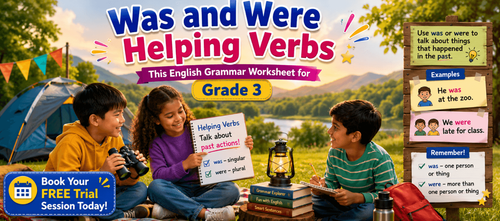

Was and Were Helping Verbs with This English Grammar Worksheet for Grade 3
Learning helping verbs becomes easy and fun when students practice with clear examples and engaging activities. This English grammar worksheet for Grade 3 on helping verbs was and were helps children understand how to talk about things that already happened in the past. Students learn to identify helping verbs, fill in blanks, choose the correct answers, rewrite sentences, and form their own sentences using was and were.
This worksheet is designed in a simple and interactive way so that Grade 3 students can build confidence in grammar while improving sentence formation and communication skills. By practicing these exercises carefully, students can become more comfortable using helping verbs correctly in both speaking and writing activities.
Download these English grammar worksheets and practice regularly to strengthen your language skills and build a strong foundation. You can also book a free trial to get expert guidance and improve your reading, writing, and comprehension abilities. The worksheets are designed in a simple and structured way to help K–8 students learn grammar concepts easily and use them confidently in everyday communication.
What Is the Topic?
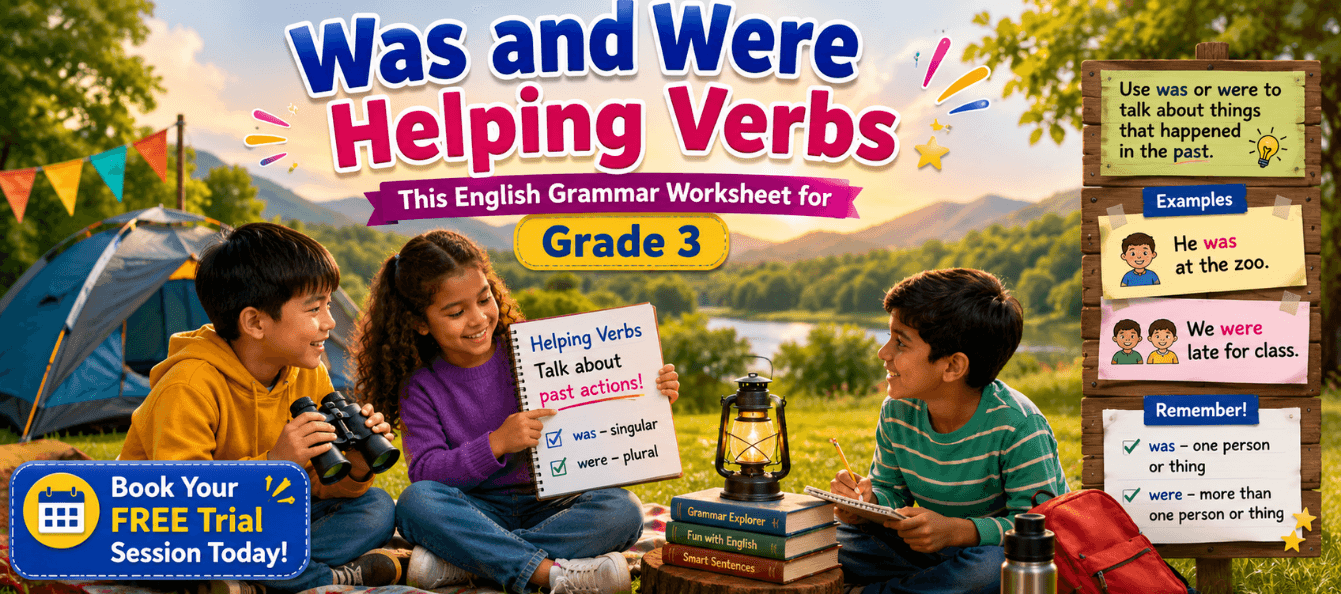
This worksheet focuses on helping verbs “was” and “were.” These helping verbs are used to talk about actions or situations that happened in the past.
The worksheet explains that these verbs help us talk about something that already happened. They are commonly used while telling stories or speaking about yesterday, last week, or earlier events.
Examples from the worksheet:
• He was at the zoo.
• We were late for class.
Students are expected to learn:
• How to identify helping verbs in sentences
• When to use “was”
• When to use “were”
• How to rewrite incorrect sentences
• How to create meaningful sentences using helping verbs
What’s in This Worksheet?
1. Underline the helping verbs in sentences.
2. Fill in the blanks using “was” or “were.”
3. Choose the correct helping verb from multiple-choice options.
4. Rewrite incorrect sentences using the correct helping verb.
5. Write sentences using helping verbs based on a picture.
6. Practice past tense sentence formation skills.
7. Improve grammar understanding through fun and engaging exercises.
8. Strengthen reading and writing confidence for school grammar activities and exams.
Definitions, Examples, Techniques, and Tips
Definitions
Helping verbs “was” and “were” are used to describe actions or situations that already happened in the past.
Examples
• He was at the zoo.
• We were late for class.
• She was reading a book.
• The students were in the classroom.
Techniques
• Use “was” with singular subjects like he, she, it, and I.
• Use “were” with plural subjects like we, they, and the students.
• Read the sentence carefully before choosing the helping verb.
• Check whether the subject is singular or plural.
Quick Learning Tips
• “Was” is usually used for one person or thing.
• “Were” is usually used for more than one person or thing.
• Practice reading sentences aloud to hear what sounds correct.
• Underline the helping verb to identify it easily.
Why Is It Important to Learn This?
Learning helping verbs like “was” and “were” is important because they help students speak and write clearly about past events. These helping verbs are commonly used in daily conversations, classroom discussions, stories, and writing activities.
Understanding helping verbs improves sentence formation and helps students avoid grammar mistakes. It also makes communication more meaningful and correct.
Strong grammar skills help students:
• Write better sentences
• Speak confidently
• Understand stories easily
• Perform better in grammar exercises and school tests
Where Will This Knowledge Help You?
Students will use helping verbs in many situations such as:
• School grammar worksheets
• Class tests and exams
• Story writing activities
• Daily conversations
• Reading comprehension
• Speaking about past events
• Classroom participation
• Sentence correction activities
Correct use of “was” and “were” also helps students become more confident while writing paragraphs and answering grammar questions.
How to Use This Worksheet?
1. Read each sentence carefully before answering.
2. Identify whether the subject is singular or plural.
3. Attempt every exercise independently first.
4. Underline the helping verbs wherever instructed.
5. Fill in the blanks using the correct helping verb.
6. Rewrite the incorrect sentences carefully.
7. Compare your work with the complete answer key.
8. Follow the exact worksheet order while checking answers.
9. Practice the worksheet regularly to improve grammar skills.
10. Review mistakes carefully and correct them step by step.
Important Tips and Tricks
1. Use “was” with singular subjects such as:
• I
• He
• She
• It
2. Use “were” with plural subjects such as:
• We
• They
• You
• The children
3. Read the complete sentence before choosing the helping verb.
4. Underline helping verbs carefully in identification exercises.
5. In rewriting activities, correct only the helping verb while keeping the sentence structure proper.
6. For sentence-writing activities, write meaningful sentences connected to the picture.
7. Avoid mixing singular subjects with “were.”
8. Avoid mixing plural subjects with “was.”
9. Check spelling carefully while writing helping verbs.
10. Practice sentence formation daily to improve grammar accuracy.
Complete Answer Key
Exercise 1
Underline the helping verbs in each sentence.
1. They WERE happy with their gifts.
2. I WAS late for the school bus.
3. She WAS reading a book.
4. We WERE playing in the field.
5. He WAS watching a cartoon.
6. You WERE dancing at the party.
7. It WAS cold last night.
8. The students WERE in the classroom.
9. I WAS helping my mom yesterday.
10. The dogs WERE barking loudly.
Exercise 2
Fill in the blanks with the correct helping verb: was or were.
1. I WAS in the library yesterday.
2. They WERE running around the field.
3. She WAS painting a picture.
4. The children WERE singing loudly.
5. He WAS watching TV at night.
6. You WERE playing hide and seek.
7. It WAS very cold in the morning.
8. The dogs WERE barking at strangers.
9. We WERE waiting for our teacher.
10. My friends WERE very happy.
Exercise 3
Choose the correct helping verb from the options given below and fill in the blanks.
1. He WAS running late for school.
a) Was b) Were
2. They WERE sitting under the tree.
a) Was b) Were
3. I WAS reading a comic book.
a) Was b) Were
4. You WERE dancing on the stage.
a) Was b) Were
5. It WAS a very windy day.
a) Was b) Were
6. She WAS writing a poem.
a) Was b) Were
7. We WERE eating ice cream.
a) Was b) Were
8. The dogs WERE sleeping peacefully.
a) Was b) Were
Exercise 4
Rewrite each sentence using the correct helping verb: was or were. Underline the helping verb.
1. They WERE watching a movie.
2. I WAS late to school.
3. She WAS drawing a flower.
4. The children WERE dancing.
5. He WAS reading a comic.
6. We WERE laughing at the joke.
7. The cats WERE drinking milk.
8. It WAS cold last night.
9. You WERE running very fast.
10. My friends WERE playing cricket.
Exercise 5
Write 5 sentences using helping verbs was, were on the picture given below.
1. The children WERE sitting on the mat.
2. The dog WAS eating food.
3. The boy WAS smiling happily.
4. The girls WERE enjoying the picnic.
5. They WERE having fun in the park.
Practicing helping verbs regularly helps Grade 3 students become more confident in grammar and sentence writing. This English grammar worksheet on was and were gives students a great opportunity to improve their understanding of past tense helping verbs through simple and engaging exercises. Keep practicing these grammar activities regularly to strengthen your writing and speaking skills step by step.