
Grade 3 Stopping by Woods Poem Worksheet With Answers
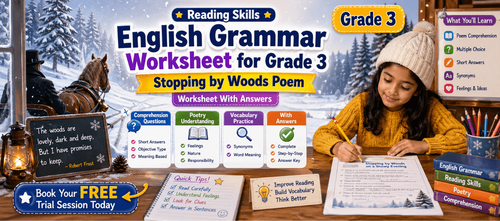

Reading Skills English Grammar Worksheet for Grade 3 – Stopping by Woods Poem Worksheet With Answers
Poems help children imagine beautiful scenes, understand emotions, and improve reading skills in a fun way. In Grade 3, students begin learning how to read poems carefully and answer comprehension questions based on them. The poem “Stopping by Woods on a Snowy Evening” helps students explore nature, feelings, and responsibility through simple but meaningful lines. This English grammar worksheet for Grade 3 includes reading comprehension questions, multiple-choice exercises, and thoughtful answers that help students understand the poem better.
Students can improve their vocabulary, observation skills, and comprehension abilities while practicing this worksheet. Parents and teachers can also use this worksheet to guide children in understanding poetry in an easy and enjoyable way.
Download these English grammar worksheets and practice regularly to strengthen your language skills and build a strong foundation. You can also book a free trial to get expert guidance and improve your reading, writing, and comprehension abilities. The worksheets are designed in a simple and structured way to help K–8 students learn grammar concepts easily and use them confidently in everyday communication.
What Is the Topic?
This worksheet is based on the poem “Stopping by Woods on a Snowy Evening.” The poem describes a person stopping near snowy woods and quietly observing the peaceful surroundings. The poem also shows how the speaker remembers his responsibilities even while enjoying the beauty of nature.
In this English grammar worksheet for Grade 3, students learn:
• How to understand a poem carefully
• How to answer objective and subjective questions
• How to identify meanings from poetic lines
• How to connect feelings and ideas with the poem
• How to improve reading comprehension skills
The worksheet encourages students to think deeply about what they read and answer questions in the correct order.
What’s in This Worksheet?
1. A complete poem titled “Stopping by Woods on a Snowy Evening”
2. Multiple-choice questions based on facts from the poem
3. Short-answer comprehension questions
4. Questions that help students connect feelings and ideas with the poem
5. Vocabulary practice through synonym identification
6. Reading comprehension practice for Grade 3 students
7. Objective-type and subjective-type questions
8. Practice in understanding the poet’s thoughts and emotions
9. Questions arranged in a simple and structured format
10. Answer keys for all exercises
Definitions, Examples, Techniques, and Tips
Definition:
Reading comprehension means understanding what we read and answering questions correctly based on the text.
Example from the worksheet:
“The woods are lovely, dark and deep,”
This line shows how peaceful and beautiful the woods seem to the poet.
Another example:
“But I have promises to keep,”
This line shows that the poet remembers his duties and responsibilities.
Techniques:
• Read the poem slowly and carefully.
• Observe important details in every stanza.
• Understand the feelings of the poet.
• Look for clues in the lines before answering questions.
• Match the question with the correct part of the poem.
Quick learning tips:
• Underline important words while reading.
• Read difficult lines more than once.
• Focus on who, what, where, and why in comprehension questions.
• Practice answering in complete sentences.
• Learn meanings of new words from the poem.
Why Is It Important to Learn This?
Reading poems helps students improve imagination, vocabulary, and understanding skills. This topic is important because it teaches children how to understand emotions, nature, and meanings hidden inside poetic lines.
This worksheet also helps students:
• Improve reading fluency
• Build comprehension skills
• Learn to answer different question types
• Develop thinking and observation abilities
• Understand the importance of responsibility
Poetry reading also makes language learning more enjoyable and creative for Grade 3 students.
Where Will This Knowledge Help You?
Students can use these skills in many areas of learning and daily school activities.
• School exams and class tests
• Reading comprehension activities
• English grammar worksheets
• Classroom discussions
• Poetry recitation and understanding
• Writing answers in complete sentences
• Vocabulary improvement
• Reading storybooks and poems confidently
These comprehension skills also help students become better readers and writers over time.
How to Use This Worksheet?
1. Read the poem carefully from beginning to end before answering.
2. Understand the meaning of each stanza and identify important lines.
3. Attempt all questions independently first.
4. Solve the multiple-choice questions carefully by choosing the correct option.
5. Answer the comprehension questions in complete sentences.
6. Compare your answers carefully with the solutions.
7. The solutions follow the exact worksheet order, so check every answer step by step.
8. Correct mistakes after reviewing the answers.
9. Practice reading the poem again to improve fluency and understanding.
10. Revise difficult words and meanings regularly.
Important Tips and Tricks
1. Read every question carefully before answering.
2. Look back at the poem whenever needed.
3. Do not rush while choosing multiple-choice answers.
4. Focus on important words like woods, snow, horse, wind, and promises.
5. Understand the poet’s feelings while reading.
6. Write answers neatly and in proper order.
7. Learn difficult vocabulary from the poem.
8. For comprehension questions, answer exactly according to the poem.
9. For synonym questions, identify the word with a similar meaning carefully.
10. Examiners expect students to understand both facts and feelings from the poem.
Complete Answer Key
Stopping by Woods on a Snowy Evening (Frost)
Whose woods these are I think I know.
His house is in the village though;
He will not see me stopping here
To watch his woods fill up with snow.
My little horse must think it queer
To stop without a farmhouse near
Between the woods and frozen lake
The darkest evening of the year.
He gives his harness bells a shake
To ask if there is some mistake.
The only other sound’s the sweep
Of easy wind and downy flake.
The woods are lovely, dark and deep,
But I have promises to keep,
And miles to go before I sleep,
And miles to go before I sleep.
Exercise No. 1
Choose the most appropriate option in relevance to this poem.
1. Where is the speaker standing?
☑ a) Between the woods and frozen lake
b) Inside a warm house
c) Near a city park
d) On a mountain top
2. What does the horse do to get attention?
a) Stamps its feet
☑ b) Shakes its harness bells
c) Whinnies loudly
d) Runs away
3. What does the poet have to do before sleeping?
a) Count stars
b) Visit the owner of the woods
c) Feed his horse
☑ d) Keep his promises
Exercise No. 2
Answer the following questions from the poem.
1. Why does the poet stop by the woods?
The poet stops to watch the woods fill with snow.
2. What makes the horse think the stop is strange?
The horse finds it strange as there is no farmhouse near.
3. What are the only other sounds the poet hears?
The poet hears the wind and the fall of snow.
Exercise No. 3
Read the questions carefully and answer the following by making connections with the poem.
1. What feeling do the woods give to the poet?
The woods feel peaceful and beautiful to him.
2. What might “promises to keep” mean in the poet’s life?
“Promises to keep” means his responsibilities before rest.
3. How do the poet’s words show his sense of duty?
He remembers his duties even though the woods attract him.
4. Find the synonym of “dim” from the poem.
“dark”
This English grammar worksheet for Grade 3 on “Stopping by Woods on a Snowy Evening” is a wonderful way for students to improve reading comprehension and poetry understanding skills. By practicing these questions regularly, students can become more confident in reading poems, understanding meanings, and answering comprehension questions correctly. Careful reading and regular practice will help children perform better in school activities and English exams.