
Grade 4 Dialogue Writing Exercises for Kids | Free PDF
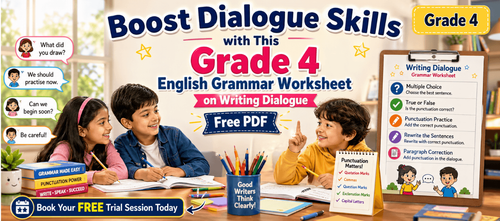

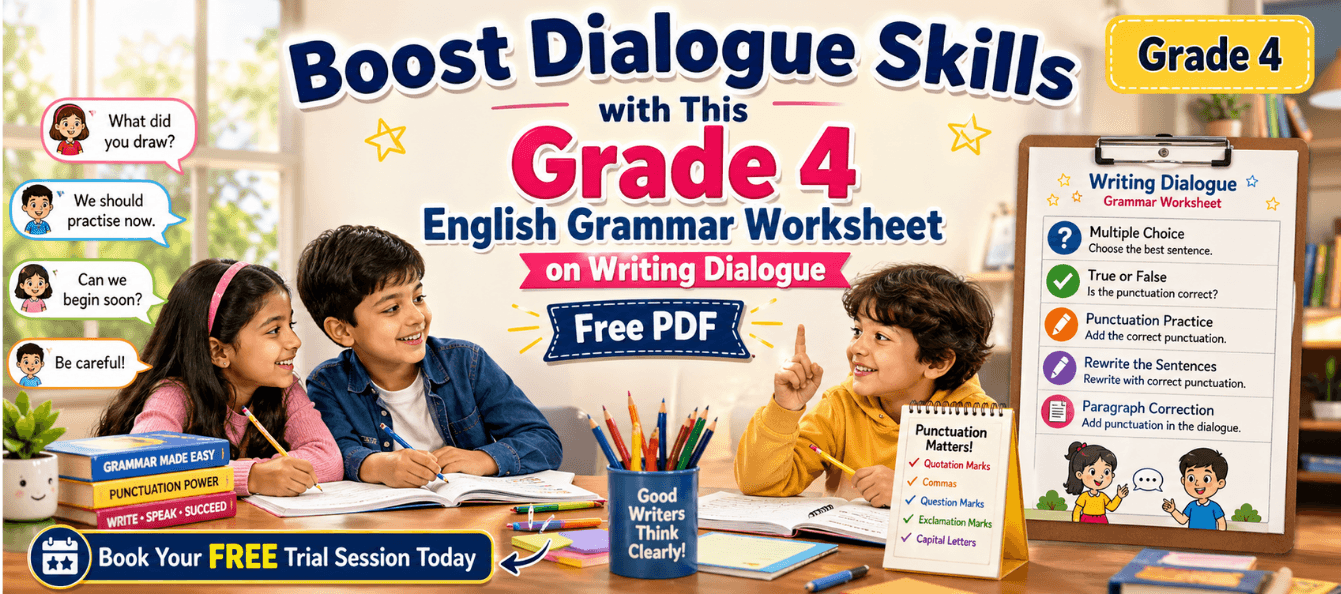
Boost Dialogue Skills with This Grade 4 English Grammar Worksheet on Writing Dialogue | Free PDF
Writing dialogue is an exciting way for students to make conversations clear, meaningful, and fun. In Grade 4, students begin learning how punctuation helps readers understand who is speaking and what is being said. This Grade 4 English grammar worksheet on Writing Dialogue helps children practise quotation marks, commas, question marks, exclamation marks, and sentence rewriting through engaging activities.
The worksheet includes multiple-choice questions, true or false statements, punctuation practice, sentence rewriting, and paragraph correction tasks. These activities help students understand how dialogue is written correctly in everyday conversations. By practising these exercises, students can improve both their grammar and writing confidence.
Download these English grammar worksheets and practice regularly to strengthen your language skills and build a strong foundation. You can also book a free trial to get expert guidance and improve your reading, writing, and comprehension abilities. The worksheets are designed in a simple and structured way to help K–8 students learn grammar concepts easily and use them confidently in everyday communication.
What Is Writing Dialogue?
Writing dialogue means writing the exact words spoken by a person in a conversation. In this Grade 4 English grammar worksheet, students learn how to use punctuation correctly while writing spoken sentences.
Students learn:
• How to use quotation marks correctly
• Where to place commas and periods
• How to punctuate questions and exclamation marks
• How to rewrite sentences properly
• How to identify correctly punctuated dialogue
The worksheet also helps students understand how punctuation changes the meaning and clarity of a sentence.
What’s in This Worksheet?
1. Multiple-choice questions to choose correctly written dialogue sentences
2. True and false questions to identify correct punctuation usage
3. Dialogue punctuation practice exercises
4. Sentence rewriting activities with correct punctuation
5. A paragraph-writing activity with dialogue correction
6. Practice with quotation marks, commas, periods, question marks, and exclamation marks
7. Exercises that improve grammar accuracy and sentence structure
8. Activities that support school exams and classroom writing practice
Definitions, Examples, Techniques, and Tips
Definition:
Dialogue is the conversation between two or more people written using punctuation marks and quotation marks.
Examples from the worksheet:
• “What did you draw?” Ria asked.
• “We should practise now,” Harsh said.
• “Can we begin soon?” Inaaya asked.
• “Where should we stand?” Kiaan asked.
• “Be careful!” shouted Leo.
Techniques:
• Use quotation marks around spoken words.
• Use commas before or after dialogue tags when needed.
• Use question marks for questions.
• Use exclamation marks for strong feelings or excitement.
• Begin spoken sentences with capital letters.
Quick Learning Tips:
• Read the dialogue aloud to check punctuation.
• Check whether the sentence is a question or statement.
• Make sure quotation marks open and close correctly.
• Rewrite sentences carefully without missing punctuation marks.
Why Is It Important to Learn This?
Learning dialogue writing is important because it helps students write conversations clearly and correctly. Proper punctuation makes sentences easier to understand and improves writing quality.
This topic helps students:
• Write better stories and conversations
• Improve grammar and punctuation skills
• Understand spoken and written communication
• Perform well in grammar tests and school assignments
• Build confidence in creative writing
Where Will This Knowledge Help You?
Students can use dialogue writing skills in many places, including:
• English grammar exams
• Story writing activities
• Classroom discussions
• Paragraph writing tasks
• Reading comprehension exercises
• Creative writing competitions
• Everyday communication and conversations
How to Use This Worksheet?
1. Read each sentence carefully before answering.
2. Attempt the multiple-choice questions independently first.
3. Check punctuation marks such as commas, quotation marks, periods, question marks, and exclamation marks carefully.
4. Compare your answers with the complete answer key provided below.
5. Follow the exact worksheet order while checking answers.
6. Correct mistakes carefully and rewrite incorrect sentences properly.
7. Practise the exercises regularly to improve punctuation accuracy.
Important Tips and Tricks
1. Always place quotation marks around spoken words.
2. Use question marks for questions inside dialogue.
3. Use exclamation marks for excitement or warnings.
4. Begin dialogue with capital letters.
5. Do not forget commas before dialogue tags such as “said” or “asked”.
6. Read the sentence fully before choosing the correct answer.
7. While rewriting, keep the sentence meaning the same and only correct punctuation.
8. In paragraph activities, check every spoken sentence carefully.
Complete Answer Key
Exercise No. 1
Choose the best sentence showing correctly written dialogue.
1. ✔ c) “What did you draw?” Ria asked.
2. ✔ a) “We should practise now,” Harsh said.
3. ✔ a) “How do we solve this?” Leen asked.
4. ✔ a) “Bring your science notebook,” Saif said.
5. ✔ a) “Can we begin soon?” Inaaya asked.
6. ✔ b) “Wait for the signal,” Arush said.
7. ✔ a) “Why is it so noisy?” Mahek asked.
8. ✔ a) “Write your answer clearly,” Devika said.
9. ✔ a) “Where should we stand?” Kiaan asked.
10. ✔ a) “Open the window, please,” Samira said.
Exercise No. 2
Tick True or False if punctuation used correctly.
1. “Are you coming to the picnic?” asked Meera. — ✔ True
2. “Please sit down, said the teacher. — ✔ False
3. “Watch the birds flying!” shouted Rohan. — ✔ True
4. Neha asked, “Can I borrow your book?” — ✔ True
5. “That was fantastic!” exclaimed Tara. — ✔ True
6. He said, “I will meet you after school.” — ✔ True
7. “Where did you put my bag?” asked Kiran. — ✔ True
8. “Let’s start the project,” suggested Ananya. — ✔ True
9. “Be careful!” shouted Leo. — ✔ True
10. Riya asked, “Have you finished your homework” — ✔ False
Exercise No. 3
Add correct punctuation to the dialogue below.
1. “Why is the work pending?” Ayra asked.
2. “Please find it quickly,” said Neela.
3. Hiba said, “Can you open it?”
4. Viraaj asked, “Where is the food?”
5. “Can you carry this bag?” said Anya.
6. Rivan said, “Please bring the pen here.”
7. “Where is my bill kept?” asked Tanish.
8. Abeer said, “I cannot find my ring.”
9. “Will you finish the puzzle now?” asked Ayra.
10. Abeer asked, “Is this your dress?”
Exercise No. 4
Re-write the following sentences using correct punctuations.
1. “Hello Ben,” said Ben. “Are you coming with us?”
2. “I am almost ready,” Latha replied.
3. “Wait for me!” shouted Omar.
4. “Why are you smiling?” asked Ria.
5. “I won the prize,” said Neil.
6. “Can we join you?” asked Karishma.
7. “Not now,” said Felix. “I need to finish this.”
8. “Don’t worry,” said Dia. “We have time.”
9. “Watch out!” shouted Varun.
10. The children asked Hazel, “Can you help us?”
Exercise No. 5
Add the punctuations to the dialogue in the passage.
Lila and her brother Ethan were at the park after school. “I want to feed the ducks first,” Lila said. “I want to play on the swings,” Ethan replied. Their mother reminded them, “Stay together and watch for other children.” Suddenly, a boy ran past and shouted, “I found a shiny stone!” Lila ran over and asked, “Can I see it?” Ethan laughed and said, “I hope it’s big!” Their mother called out, “Don’t run too fast!” “I’ll be careful,” Lila said. “I’ll help her,” Ethan added. Soon, they both ran to the pond to watch the ducks swim. “I like the ducks so much,” Lila whispered. “They’re very pretty,” Ethan agreed. The park was calm and filled with the rustling of leaves as families walked by, and the evening sun cast a warm glow over everything, making their time together feel peaceful and enjoyable.
This Grade 4 English grammar worksheet on Writing Dialogue is a wonderful way for students to improve punctuation and conversation-writing skills. Regular practice helps children become more confident while writing stories, answering grammar questions, and understanding spoken conversations. By completing these activities carefully, students can strengthen their grammar foundation and write dialogue more accurately in school and everyday communication.