
Grade 4 Direct and Indirect Speech Practice with Examples
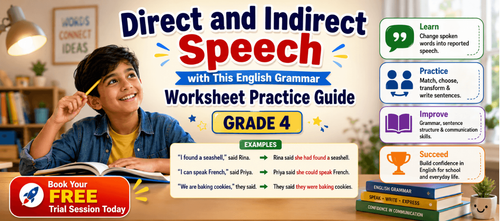

Direct and Indirect Speech with This English Grammar Worksheet Grade 4 Practice Guide
Learning direct and indirect speech helps students report what someone has said in a clear and correct way. This Grade 4 Direct and Indirect Speech Practice with Examples worksheet gives learners an opportunity to understand how spoken words can be changed into reported speech through matching activities, multiple-choice questions, sentence rewriting tasks, and sentence-writing exercises. By practicing these activities, students become more confident in grammar, sentence construction, and communication skills. The worksheet is designed to help young learners recognize patterns in speech transformation and apply them correctly in everyday English.
Download these English grammar worksheets and practice regularly to strengthen your language skills and build a strong foundation. You can also book a free trial to get expert guidance and improve your reading, writing, and comprehension abilities. The worksheets are designed in a simple and structured way to help K–8 students learn grammar concepts easily and use them confidently in everyday communication.
What Is the Topic?
Direct and indirect speech are two ways of reporting what someone says.
In direct speech, the exact words spoken by a person are presented.
In indirect speech, the speaker’s words are reported without using the exact quotation.
This worksheet helps Grade 4 students practice changing direct speech into indirect speech and changing indirect speech back into direct speech. Students also learn to identify correct indirect speech forms and create their own examples.
What’s in This Worksheet?
1. Match the following activity that connects direct speech sentences with their correct indirect speech forms.
2. Multiple-choice questions where students select the correct indirect speech sentence.
3. Sentence transformation exercises that require changing direct speech into indirect speech.
4. Sentence transformation exercises that require changing indirect speech into direct speech.
5. Sentence-writing activity where students create direct speech sentences and convert them into indirect speech.
6. Practice opportunities that strengthen grammar, sentence structure, and reporting skills.
7. Exercises arranged from guided practice to independent application.
Definitions, Examples, Techniques, and Tips
Definitions
• Direct Speech: Reporting the exact words spoken by a person.
• Indirect Speech: Reporting a person's words without repeating the exact statement.
Examples From the Worksheet
• “I found a seashell,” said Rina.
Rina said she had found a seashell.
• “We are baking cookies,” they said.
They said they were baking cookies.
• “I can speak French,” said Priya.
Priya said she could speak French.
Techniques
• Read the original sentence carefully.
• Identify the speaker.
• Change pronouns where needed.
• Adjust the verb form appropriately.
• Rewrite the sentence in a smooth reporting format.
Quick Learning Tips
• Pay attention to the reporting verb such as said or told.
• Check pronouns carefully.
• Read the transformed sentence aloud to ensure it sounds natural.
• Practice both direct-to-indirect and indirect-to-direct conversions.
Why Is It Important to Learn This?
Learning direct and indirect speech helps students communicate information accurately. It improves grammar awareness and teaches students how to report conversations correctly. Understanding this topic supports reading comprehension and writing skills because students often need to describe what others have said. Regular practice also improves confidence in speaking and storytelling activities.
Where Will This Knowledge Help You?
• School examinations and grammar assessments.
• Reading comprehension activities.
• Story writing and creative writing tasks.
• Class discussions and presentations.
• Everyday conversations when reporting information.
• English language learning and communication practice.
How to Use This Worksheet?
1. Read every sentence carefully before answering.
2. Attempt each exercise independently.
3. Match direct and indirect speech sentences thoughtfully.
4. Choose the best answer in multiple-choice questions.
5. Rewrite sentences accurately in transformation exercises.
6. Compare your responses carefully with the solutions.
7. The solutions below follow the exact worksheet order.
8. Review mistakes and understand corrections.
9. Practice similar sentence transformations regularly.
Important Tips and Tricks
1. Always identify who is speaking before changing a sentence.
2. Read all options carefully in multiple-choice questions before selecting an answer.
3. Check pronouns such as I, we, he, she, and they.
4. Ensure the sentence remains meaningful after conversion.
5. Use proper punctuation when writing direct speech.
6. Do not leave out important words while rewriting sentences.
7. For sentence-writing activities, create complete and meaningful sentences.
8. Practice regularly to improve accuracy and speed.
Complete Answer Key
Exercise:1
1. I found a seashell, said Rina. → a. Rina said she had found a seashell.
2. We are baking cookies, they said. → They said they were baking cookies.
3. He has a blue bicycle, said Omar. → f. Omar said he had a blue bicycle.
4. I will join you after lunch, she said. → e. She said she would join me after lunch.
5. They like painting, said Arjun. → c. Arjun said they liked painting.
6. We visited the museum last week, said Lila. → g. Lila said they had visited the museum the week before.
7. I can speak French, said Priya. → h. Priya said she could speak French.
8. They are feeding the ducks, said Karan. → Karan said they were feeding the ducks.
Exercise: 2
1. “I like the red kite,” said Nita.
Answer: a. Nita told she liked the red kite.
2. “Ravi is tired,” said his mother.
Answer: b. His mother said that Ravi was tired.
3. “I will help you,” said Arun.
Answer: c. Arun said that he would help me.
4. “We are late,” said the children.
Answer: b. The children said that they were late.
5. “I saw two parrots,” said Mira.
Answer: c. Mira said that she had seen two parrots.
6. “I can finish this,” said Kabir.
Answer: a. Kabir said that he could finish that.
7. “We went to the farm,” said the twins.
Answer: c. The twins said that they had gone to the farm.
8. “I am drawing a cat,” said Pia.
Answer: b. Pia said that she was drawing a cat.
Exercise: 3
1. “I am reading a story,” said Reena.
Reena said that she was reading a story.
2. “I will help you with homework,” said Rohan.
Rohan said that he would help me with homework.
3. “I like sweet mangoes,” said Meena.
Meena said that she liked sweet mangoes.
4. “We are playing outside,” said the children.
The children said that they were playing outside.
5. “I saw a deer in the forest,” said Arun.
Arun said that he had seen a deer in the forest.
6. “She can sing well,” said mother.
Mother said that she could sing well.
7. “We shall meet again,” said the boys.
The boys said that they would meet again.
8. “I have finished my drawing,” said Kavita.
Kavita said that she had finished her drawing.
9. “He is eating an apple,” said father.
Father said that he was eating an apple.
10. “I was running fast,” said the athlete.
The athlete said that he had been running fast.
Exercise:4
1. Rohan said that he was tired.
“I am tired,” said Rohan.
2. Anita said that she liked ice cream.
“I like ice cream,” said Anita.
3. Mother said that she was cooking dinner.
“I am cooking dinner,” said Mother.
4. The boys said that they had played football.
“We played football,” said the boys.
5. Father said that he would help me.
“I will help you,” said Father.
6. She said that she could sing a song.
“I can sing a song,” she said.
7. They said that they were going to the park.
“We are going to the park,” they said.
8. He said that he had finished his work.
“I have finished my work,” he said.
9. Grandpa said that he told us a story.
“I told you a story,” said Grandpa.
10. She told that she will sing a song tomorrow.
“I will sing a song tomorrow,” she said.
Exercise:5
1. “I am learning English,” said Riya.
Riya said that she was learning English.
2. “We are watching a movie,” said the children.
The children said that they were watching a movie.
3. “I can ride a bicycle,” said Aman.
Aman said that he could ride a bicycle.
4. “I will visit my grandmother,” said Neha.
Neha said that she would visit her grandmother.
5. “We finished our project,” said the students.
The students said that they had finished their project.
Practicing direct and indirect speech regularly helps Grade 4 students become more confident in grammar and communication. By completing matching exercises, multiple-choice questions, sentence transformations, and writing activities, learners can strengthen their understanding of reported speech and improve their writing accuracy. Continue practicing these sentence patterns to build strong English language skills and greater confidence in everyday communication.