
Grade 4 Homophones Exercises to Improve Spelling and Vocabulary
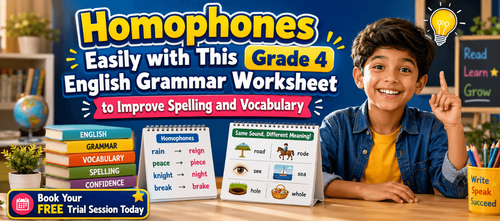

Homophones Easily with This Grade 4 English Grammar Worksheet to Improve Spelling and Vocabulary
Homophones are words that sound the same when spoken but have different meanings and spellings. Learning homophones helps students become better readers, writers, and speakers because they learn to choose the correct word according to the meaning of a sentence. This Grade 4 English grammar worksheet on homophones provides engaging activities that help learners identify, match, sort, correct, and use homophones correctly in sentences. Through a variety of exercises, students get opportunities to strengthen spelling skills, improve vocabulary, and build confidence in using similar-sounding words accurately.
Download these English grammar worksheets and practice regularly to strengthen your language skills and build a strong foundation. You can also book a free trial to get expert guidance and improve your reading, writing, and comprehension abilities. The worksheets are designed in a simple and structured way to help K–8 students learn grammar concepts easily and use them confidently in everyday communication.
What Is the Topic?
The topic of this worksheet is homophones.
Homophones are words that have the same pronunciation but different meanings and different spellings. Understanding homophones helps students recognize the correct word required in a sentence. This worksheet focuses on identifying homophone pairs, matching words with their correct homophones, choosing suitable homophones in context, correcting homophone mistakes, and using homophone pairs correctly in sentences.
Students are expected to:
- Recognize common homophone pairs.
- Understand word meanings through sentence context.
- Correct incorrect homophone usage.
- Improve spelling accuracy.
- Use homophones correctly in their own sentences.
What’s in This Worksheet?
1. Match the following activity where students match words with their correct homophones.
2. Multiple-choice questions that require selecting the correct homophone to complete a sentence.
3. A sorting exercise where students identify homophone pairs from a word box.
4. Sentence correction practice where incorrect homophones must be replaced with correct ones.
5. Sentence writing tasks that encourage correct use of homophone pairs in meaningful sentences.
6. Vocabulary-building exercises that strengthen understanding of word meanings.
7. Spelling practice activities that help students distinguish between commonly confused words.
8. Context-based learning tasks that improve grammar and sentence comprehension skills.
Definitions, Examples, Techniques, and Tips
Definition
Homophones are words that sound alike but have different spellings and meanings.
Examples from the worksheet include:
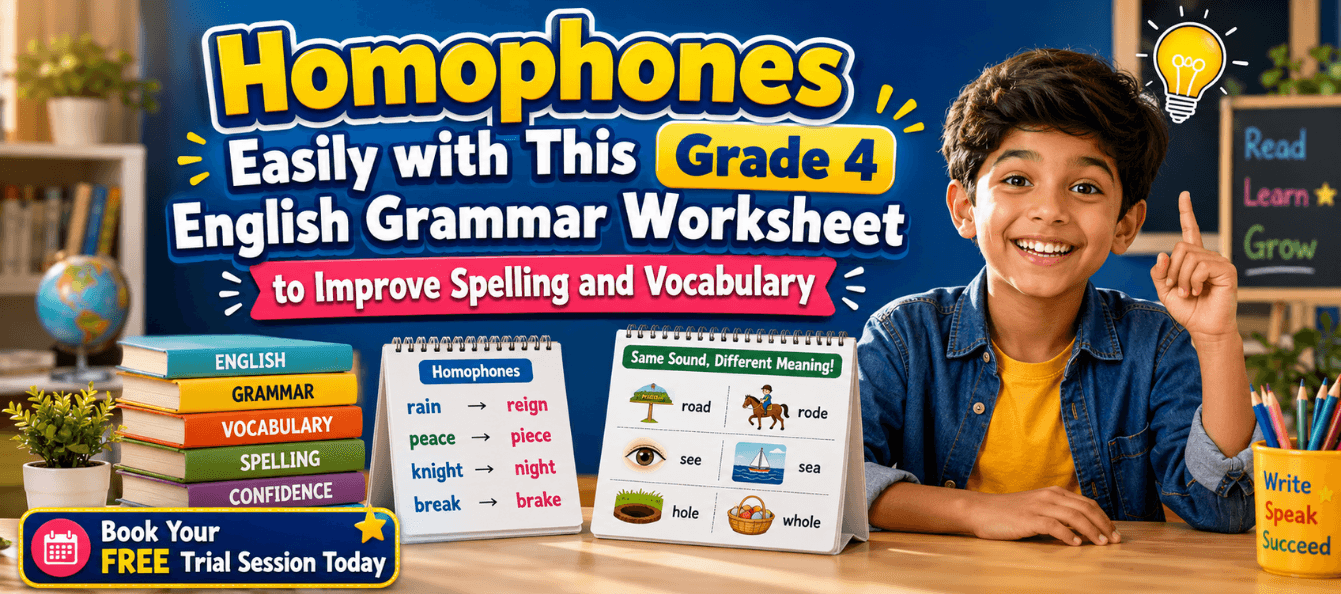
- rain – reign
- plane – plain
- night – knight
- piece – peace
- brake – break
- buy – by
- flower – flour
- week – weak
- waste – waist
- hole – whole
Examples in Sentences
- The bird flew high in the sky.
- I love to eat a juicy pear.
- He saw a bear in the forest.
- I saw a bee on a flower.
- The knight wore shiny armor.
Techniques
- Read the entire sentence carefully before choosing a homophone.
- Look for clues in the sentence meaning.
- Pay attention to spelling differences.
- Learn homophone pairs together.
- Practice using homophones in sentences.
Quick Learning Tips
- Say both words aloud.
- Remember that similar sounds do not always mean similar meanings.
- Review common homophone pairs regularly.
- Check whether the chosen word makes sense in the sentence.
- Practice correcting incorrect homophones.
Why Is It Important to Learn This?
Learning homophones is important because they appear frequently in reading and writing. Using the wrong homophone can change the meaning of a sentence and create confusion. By practicing homophones, students become more accurate spellers and stronger communicators.
This topic also helps students:
- Improve vocabulary.
- Strengthen reading comprehension.
- Develop better writing skills.
- Avoid common spelling mistakes.
- Understand sentence meaning more clearly.
Mastering homophones gives students greater confidence in classroom assignments, tests, and everyday communication.
Where Will This Knowledge Help You?
Students use homophones in many situations, including:
- School examinations and assessments.
- Reading comprehension passages.
- Creative writing activities.
- Paragraph and essay writing.
- Grammar worksheets and assignments.
- Classroom discussions.
- Vocabulary-building exercises.
- Everyday speaking and writing.
Understanding homophones helps students choose the correct word and express ideas clearly.
How to Use This Worksheet?
1. Read each question carefully before answering.
2. Attempt every exercise independently without immediately checking the answers.
3. Pay close attention to spelling differences between similar-sounding words.
4. Complete matching activities by finding the correct homophone pairs.
5. Use sentence clues when answering multiple-choice questions.
6. Review all corrected sentences and understand why the replacement word is correct.
7. Compare your work carefully with the answer key provided below.
8. The solutions follow the exact worksheet order, making it easy to check every response systematically.
9. Correct mistakes and rewrite incorrect answers neatly.
10. Practice similar homophone pairs regularly to strengthen long-term learning.
Important Tips and Tricks
1. Read the complete sentence before choosing a homophone.
2. Focus on meaning rather than pronunciation alone.
3. Learn commonly confused pairs such as:
- bear – bare
- sea – see
- knight – night
- hole – whole
- weak – week
4. Check spelling carefully because many homophones differ by only one or two letters.
5. In correction exercises, identify the incorrect word first and then replace it with the correct homophone.
6. For sentence-writing activities, make sure the meaning of each homophone is clear.
7. Examiners expect correct spelling and proper understanding of word meaning.
8. Practice frequently used homophone pairs to improve accuracy.
9. Review mistakes and learn why a particular homophone fits the sentence.
10. Always ensure the chosen word makes complete sense within the sentence context.
Complete Answer Key
Exercise:1
Match each word in Column A with its correct homophone in Column B.
1. rain → reign
2. plane → plain
3. night → knight
4. stare → stair
5. piece → peace
6. brake → break
7. buy → by
8. road → rode
9. maid → maid
10. waste → waist
Exercise: 2
Choose the correct homophone that best completes each sentence.
1. The bird flew high in the sky.
Answer: sky
2. She read the story aloud, not in her head.
Answer: head
3. He won the race, but his friend came in two.
Answer: two
4. I love to eat a juicy pear.
Answer: pear
5. He saw a bear in the forest.
Answer: bear
6. I saw a bee on a flower.
Answer: bee
7. The knight wore shiny armor.
Answer: armor
8. Have you seen her around?
Answer: seen
Exercise: 3
Find and write the correct pair of homophones from the box given below.
1. mail – male
2. right – write
3. pale – pail
4. knight – night
5. week – weak
6. flower – flour
7. hole – whole
8. waste – waist
Exercise:4
Fix the homophone error in each sentence and rewrite it correctly.
1. I saw a bear eating berries near the river.
2. They made the bed in the morning.
3. He rode a horse in the field.
4. She heard a loud noise from the stair.
5. I ate all the cookies.
6. The flower blew in the spring.
7. We went to the beach to see the sunset.
8. The knight wore heavy armor.
9. The sun shined through the hole.
10. There is a dog in the yard.
Exercise:5
Write a sentence using each homophone pair correctly.
1. break – brake
I need a break after finishing my homework.
The driver pressed the brake to stop the car.
2. steal – steel
It is wrong to steal someone else's belongings.
The bridge is made of strong steel.
3. weak – week
I felt weak after being sick.
We are going on a trip next week.
4. sail – sale
The boat will sail across the lake tomorrow.
The store announced a big sale this weekend.
5. plain – plane
She wore a plain white dress.
The plane landed safely at the airport.
Practicing homophones regularly helps students improve spelling, vocabulary, and sentence-writing skills. This Grade 4 English grammar worksheet provides excellent practice through matching activities, multiple-choice questions, correction exercises, and sentence-writing tasks. Keep practicing these homophone pairs to build confidence and become more accurate in reading and writing.