
Grade 5 Colon Before Long Quotation

English Grammar Worksheet for Grade 5: Colon Before Long Quotation
Mastering the use of a colon before long quotations is an essential grammar skill that students need to develop early. In Grade 5, students are introduced to punctuation marks like the colon, helping them better structure their writing for clarity and flow. Using a colon before a long quotation is a key skill that allows students to present information clearly, especially when they are incorporating direct speech or lengthy quotations in their writing.
Download these English grammar worksheets and practice regularly to strengthen your language skills and build a strong foundation. You can also book a free trial to get expert guidance and improve your reading, writing, and comprehension abilities. The worksheets are designed in a simple and structured way to help K–8 students learn grammar concepts easily and use them confidently in everyday communication.
What is the Topic?
The topic of this worksheet is using the colon punctuation mark before long quotations. A colon is used to introduce a lengthy quotation that follows a complete sentence. Understanding when and how to use a colon will help students structure their sentences in a grammatically correct manner, ensuring their writing is easy to read and professional. In this worksheet, Grade 5 students will practice the correct placement of colons before long quotations, which is an important skill for both academic writing and everyday communication.
What’s in This Worksheet?
1. Multiple choice questions to identify the correct use of colons.
2. True/false statements to assess understanding of colon usage.
3. Activities involving adding colons to sentences.
4. Sentence rewriting exercises where students practice inserting colons in the correct places.
5. A paragraph completion activity where students insert colons where appropriate in a short passage.
Definitions, Examples, Techniques, and Tips
Definitions:
Colon: A punctuation mark (:) used to introduce a list, a quotation, an explanation, or to emphasize a point. In this worksheet, the colon is specifically used before long quotations.
Examples:
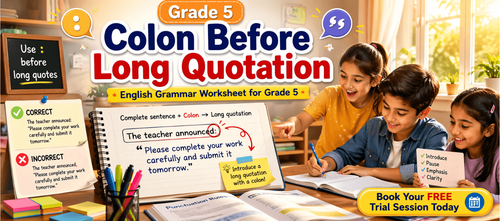
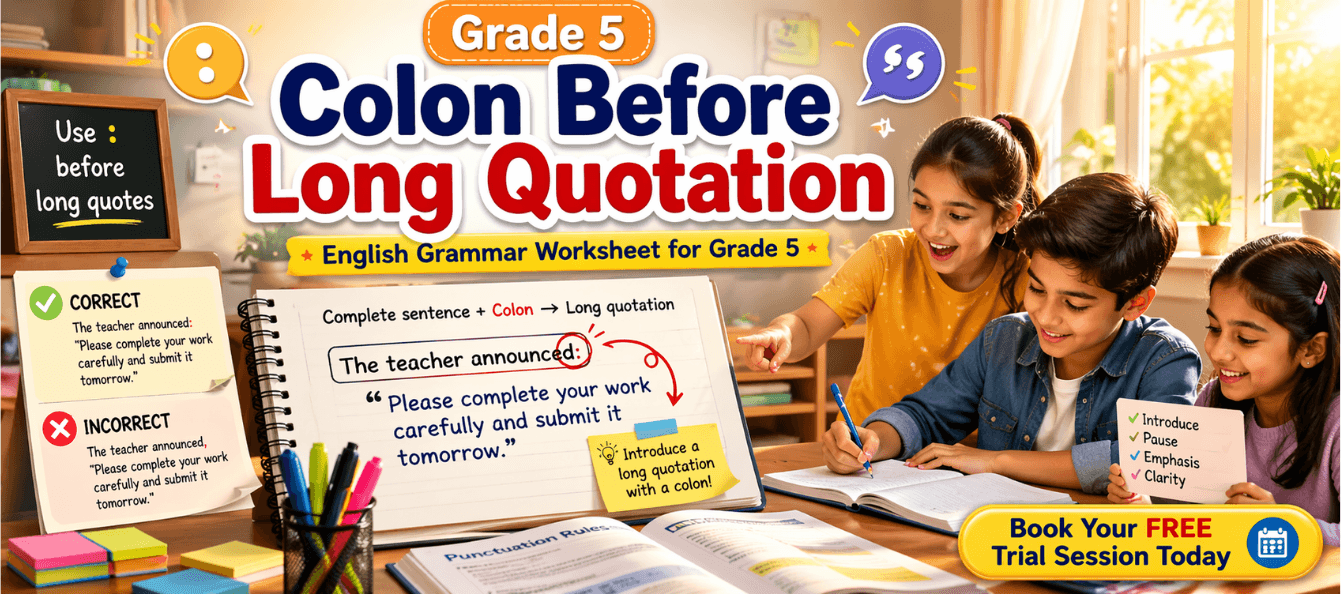
Correct usage: The teacher announced: “Please hand in your assignments by tomorrow.”
Incorrect usage: The teacher announced, “Please hand in your assignments by tomorrow.”
Techniques:
- The sentence before the colon must be a complete statement. It introduces the quotation that follows.
- Ensure the quotation is long enough to require a colon before it (typically, the quotation should be longer than one sentence).
Quick Learning Tips:
- Practice identifying where the colon is needed by reading passages aloud. This helps in recognizing where a pause or emphasis naturally occurs.
- Remember, the colon directs the reader’s attention to the quote that follows. Be sure the introduction is a complete thought before using it.
Why is it Important to Learn This?
Learning how to use a colon before long quotations is vital for several reasons:
- It improves clarity in writing by showing where a quotation begins.
- It helps students properly structure academic essays and formal writing.
- Mastering this skill builds a solid foundation for punctuation use in various writing formats, making students more effective communicators.
Where Will This Knowledge Help You?
Understanding how to use colons before quotations will help students:
- Perform well in school exams where punctuation questions are asked.
- Write clearer essays and reports with correct punctuation.
- Participate in class discussions or writing assignments by using correct punctuation marks.
- Use punctuation in emails, letters, and other forms of formal writing.
How to Use This Worksheet?
1. Read each sentence carefully before deciding if a colon is needed.
2. Try to complete each exercise independently to assess your understanding.
3. After finishing the exercises, compare your answers with the answer key provided.
4. Correct any mistakes and review the rules to ensure you understand why the changes were necessary.
5. Practice using colons in your own writing, paying special attention to the context in which you use long quotations.
The solutions follow the exact worksheet order, so students should compare their answers carefully.
Important Tips and Tricks
1. Ensure the sentence before the colon is a complete thought. A colon cannot follow an incomplete sentence.
2. Colons are typically used before longer quotations, but short quotations do not always need a colon.
3. Look out for phrases like “said” or “explained” that can introduce a quotation. Ensure the structure is correct before placing a colon.
4. Practice with both direct speech and formal quotations to understand the versatility of colons in different contexts.
Complete Answer Key
Exercise No. 1
Choose the correct sentence with proper colon usage.
1. b) The president stood before the crowd: "We must unite ...."
2. a) The teacher gave an instruction: "Open your books to page ten."
3. a) The scientist announced: "I have discovered ...."
4. c) Asha wrote: "Please read this note."
5. a) My brother yelled: "Wait for me!"
6. b) Vikram reported: "Exam results are out."
7. b) Sanya gave a quick excuse: "I am late for school."
8. c) Neha gave a quiet command: "Do not disturb."
9. a) Arjun explained: "The plan has changed ...."
10. c) The sign warned of a rule: "No swimming after dark."
Exercise No. 2
Write True or False for colon usage.
1. True
2. True
3. False
4. False
5. True
6. True
7. False
8. True
9. True
10. False
Exercise No. 3
Add colons to the following sentences.
1. The message read: "We will win."
2. My father gave me a quiet warning: "Don’t play in the sun."
3. His mother sent a clear message: "Study hard."
4. The note reads: "Complete your work."
5. He shared a simple instruction: "Begin now."
6. The teacher gave a final instruction: "Finish homework."
7. The coach called out a final command: "Jump now."
8. Deepak made a brief announcement: "Results are out."
9. Tina issued a soft command: "Be quiet."
10. Ankit gave a loud shout: "Come quickly."
Exercise No. 4
Rewrite the sentences by adding colons.
1. Meera gave a simple update: "I am ready."
2. Rohit gave a loud command: "Play outside."
3. The report shared a simple fact: "The earth is round."
4. The email contained the message: "The meeting is cancelled."
5. The sign had one rule: "No running."
6. Kabir had a simple goal: "I will win."
7. The scout gave a warning: "Watch for ice."
8. Her note was short: "See you soon."
9. The boss gave an order: "Start now."
10. The principal had a final word: "Be kind."
Exercise No. 5
Correctly punctuate the passage with colons.
Our family arrived at the gate where a giant sign displayed a warm greeting: "Welcome to the Feast!" My father reminded us of the golden rule: "Always save room for dessert." We walked to the pizza stall which featured a bold motto: "The cheesiest slices in town." The menu gave a mouth-watering description: "Crispy crust topped with fresh herbs." Near the grill, the head chef issued a loud command: "Get those burgers ready now!" A small chalkboard featured a funny message: "Don't count the calories; count the toppings." The ice cream stall carried a bright label: "Made with real farm cream." Next door, the baker shared a secret fact: "We use three types of chocolate in our cookies." The popcorn stand showed a simple price: "Hundred rupees for a giant bucket." My brother noticed a small note: "Gluten-free options are available here."
Practicing this English grammar worksheet for Grade 5 on the colon before long quotations helps students become more confident in using colons correctly. With regular practice, students can improve their punctuation skills and enhance their ability to present quotes clearly in both writing and speaking.