
Grade 5 Commas in Direct Speech with Names – Printable Worksheet
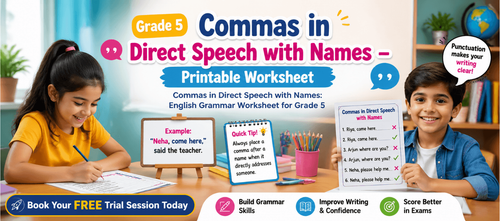

English Grammar Worksheet for Grade 5: Commas in Direct Speech with Names
Understanding punctuation marks like commas is essential for writing clearly. For Grade 5 students, one of the most important punctuation skills to master is the use of commas in direct speech, especially when names are involved. This worksheet will help you practice and improve your ability to correctly insert commas in sentences with direct speech and names. Whether you're writing dialogues or following instructions, knowing where to place commas is crucial for clarity and meaning.
Download these English grammar worksheets and practice regularly to strengthen your language skills and build a strong foundation. You can also book a free trial to get expert guidance and improve your reading, writing, and comprehension abilities. The worksheets are designed in a simple and structured way to help K–8 students learn grammar concepts easily and use them confidently in everyday communication.

What is the Topic?
The topic of this worksheet is about the use of commas in direct speech, particularly when names are included. Students will learn how to correctly place commas after names in direct speech, a key skill for writing clear and correct dialogue. By practicing with different exercises, students will understand the rules for inserting commas and improve their overall writing skills.
What’s in This Worksheet?
1. To identify correct and incorrect placements of commas in direct speech.
2. True or False for understanding when commas are required in direct speech.
3. Exercise to practice inserting commas where necessary.
4. Rewriting sentences with the correct punctuation.
5. Inserting commas in dialogue to complete a paragraph correctly.
Definitions, Examples, Techniques, and Tips
Definition: A comma is used to separate a name in direct speech from the rest of the sentence. For example, in "Riya, come here," the comma separates the name "Riya" from the rest of the sentence.
Example: “Neha, come here,” said the teacher.
Quick Learning Tip: Always place a comma after a name when it directly addresses someone in the speech.
Why is it Important to Learn This?
- Mastering the use of commas in direct speech is crucial for students because it helps make their writing more understandable.
- This skill is necessary not only for clear dialogue but also for avoiding confusion in written communication.
- Commas indicate pauses and clarify who is being addressed, which is especially important in dialogue writing.
Where Will This Knowledge Help You?
Understanding commas in direct speech will help in:
- Exams: This knowledge is tested in grammar exams and language assessments.
- Writing tasks: Whether it’s composing a story, an essay, or answering questions, using correct punctuation ensures clarity and professionalism.
- Class participation: Knowing punctuation rules will help in reading aloud and giving oral presentations clearly.
How to Use This Worksheet?
1. Attempt independently first: Try completing the exercises on your own without any help.
2. Review answers carefully: Once finished, compare your answers with the solution provided.
3. Correct mistakes: If you made any errors, understand why the correct answer is as such.
4. Practice regularly: Regular practice is key to mastering punctuation.
The solutions follow the exact worksheet order, so students should compare their answers carefully.
Important Tips and Tricks
1. Common mistakes: Forgetting to insert a comma after the name is a common mistake. Always check after each name.
2. Examiners expect: Correct placement of commas in direct speech. This helps students appear more meticulous in their writing.
3. How to score full marks: Be sure to double-check your answers, particularly in exercises involving multiple sentences or complex dialogues.
4. How to approach activity-based tasks: Read each sentence aloud and see where a natural pause occurs to decide where a comma should be placed.
Complete Answer Key
Exercise No. 1
Multiple Choice Questions
1. c) "Neha, come here," said the teacher.
2. a) "Vikram, complete your homework," said the librarian.
3. b) "Asha, pass the book," said the teacher.
4. b) "Raj, listen to the instructions," said the principal.
5. c) "Meera, take a seat," said the teacher.
6. a) "Riya, come here," said Mom.
7. a) "Sara, please pass the markers," said Pooja.
8. b) "Maya, please close the door," said the teacher.
9. c) "Tara, listen carefully," said her father.
10. b) "Meera, please come here," said the principal.
Exercise No. 2
True or False
1. False
2. True
3. True
4. False
5. False
6. True
7. False
8. True
9. False
10. True
Exercise No. 3
Correct the Sentences by Adding a Comma Where Necessary
1. Tina, stop talking.
2. Raj, wait for me.
3. Meenu, listen carefully.
4. Suniti, give me the book.
5. Dev, close the door.
6. Komal, study your lesson.
7. Sana, do your work.
8. Madhav, catch the bus.
9. Anaya, bring your books.
10. Neha, follow the instructions.
Exercise No. 4
Rewrite the Sentences After Inserting Commas in the Correct Places
1. "Aman, finish your lunch," she said.
2. "Rohit, where are you going?" asked mother.
3. "Arjun, please close the window," said the teacher.
4. "Nidhi, please help me," Rahul said.
5. "You know, Maya, that you are my best friend."
6. "Where did you put my car keys, Mohit?" asked Dad.
7. "Rohan, do you like this game?" asked Amit.
8. "Meena, come quickly," shouted her brother.
9. "Ankit, why are you late?" the coach said.
10. "Pooja, take your seat," said the principal.
Exercise No. 5
Read the Paragraph and Insert Commas in the Dialogue with Names Where Necessary
1. "Students, please line up behind the stage," whispered Mrs. Kapoor.
2. "Aarav, can you find your tiger mask?" The principal walked by and said, "Good luck, everyone, on your big performance!"
3. "Do not be nervous, Maya, because you practiced hard," whispered her best friend.
4. "Teacher, where should I put my dancing shoes?" asked Rohan. Mrs. Kapoor replied, "Put them in the blue bin, Rohan."
5. Suddenly, the music started, and a voice called, "Welcome, parents, to our silver jubilee show."
6. "Mom, look at the beautiful lights!" shouted a little boy in the front row.
7. On stage, the lead singer yelled, "Get ready, class, for the opening song!"
8. "Is the microphone on, Sarah?" asked the stage manager.
9. "I think, Sarah, that it is working perfectly," he added.
10. "Girls, remember to smile at the audience," the dance teacher reminded them.
By practicing this worksheet on commas in direct speech with names, students will become more confident in using punctuation correctly. This skill is essential for both writing and speaking, and mastering it will significantly improve grammar proficiency. Keep practicing, and soon inserting commas in your sentences will become second nature!